
An advisor pitching child life insurance will usually lead with love and responsibility, protecting your little one, building their future. Strip away that framing and look at what’s actually being sold, and the picture gets more complicated. Children have an extremely low mortality rate, which means the core reason adults buy life insurance, replacing income a family depends on, simply doesn’t apply to a child the way it applies to a working parent. Whatever case exists for insuring a child rests on something else entirely, and it’s worth understanding exactly what that something else is before deciding whether to buy in.
- How Child Life Insurance Actually Works
- What a Child Rider Actually Costs and What It Buys
- What Standalone Juvenile Whole Life Actually Offers
- The Real Case For It, Guaranteed Insurability
- What Happens if the Coverage Isn’t Converted
- A Real Alternative Worth Comparing Directly
- Mistakes People Make With This Decision
- Common Questions About Life Insurance for Children in Canada
Life insurance for children in Canada typically comes as either a low-cost child term rider added to a parent’s own policy, covering all eligible children for one flat premium, or a standalone whole life policy purchased directly on a child’s life. The real argument for either option isn’t income replacement, which the Financial Consumer Agency of Canada frames as the core purpose of life insurance generally, it’s locking in guaranteed future insurability and, in the case of whole life, starting a savings vehicle decades before the child could open one themselves.
How Child Life Insurance Actually Works
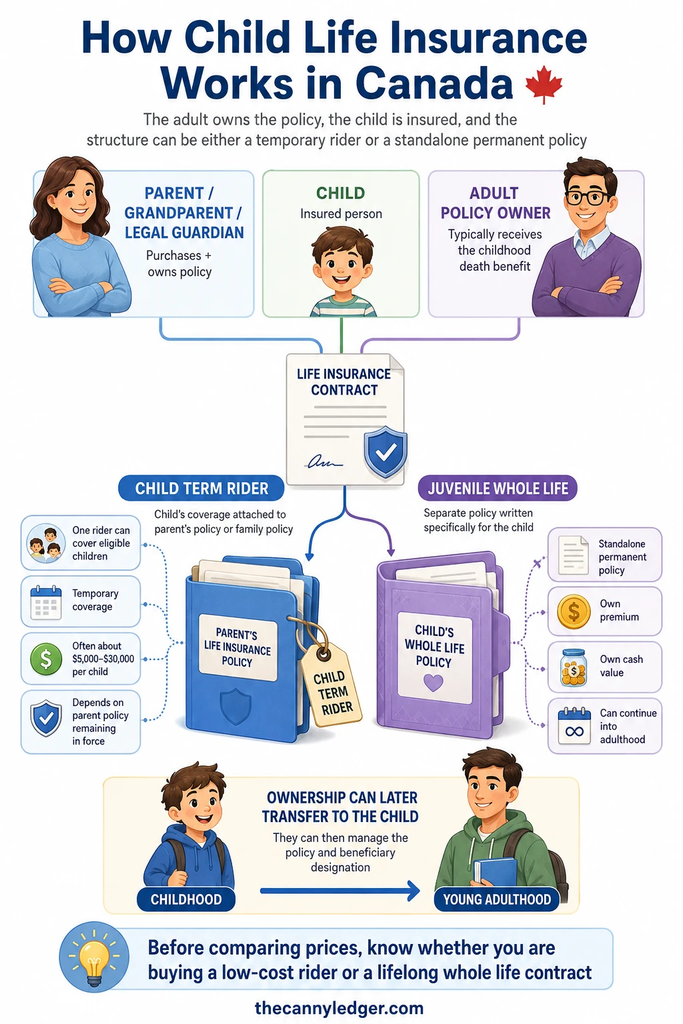
In Canada, only a parent, grandparent, or legal guardian can purchase a life insurance policy on a child’s life, and the structure is specific about who plays which role in the contract. RBC Insurance’s own guidance confirms the child becomes the insured person while the purchasing adult owns the policy and is typically named beneficiary, meaning a death benefit would be paid to the parent or guardian rather than directly to the child. Once the child reaches adulthood, ownership of the policy typically transfers to them, at which point they can name their own beneficiaries going forward.
Two distinct product types exist under this general structure, and they behave differently enough that comparing prices between them without noticing the difference leads to a poor comparison. A child term rider attaches to a parent’s existing term or whole life policy and provides a fixed amount of coverage, often somewhere between $5,000 and $30,000, for every eligible child in the household under one combined premium. A standalone juvenile whole life policy is a separate contract purchased specifically on the child, with its own premium, its own cash value growth, and no dependency on the parent maintaining a separate policy alongside it.
What a Child Rider Actually Costs and What It Buys
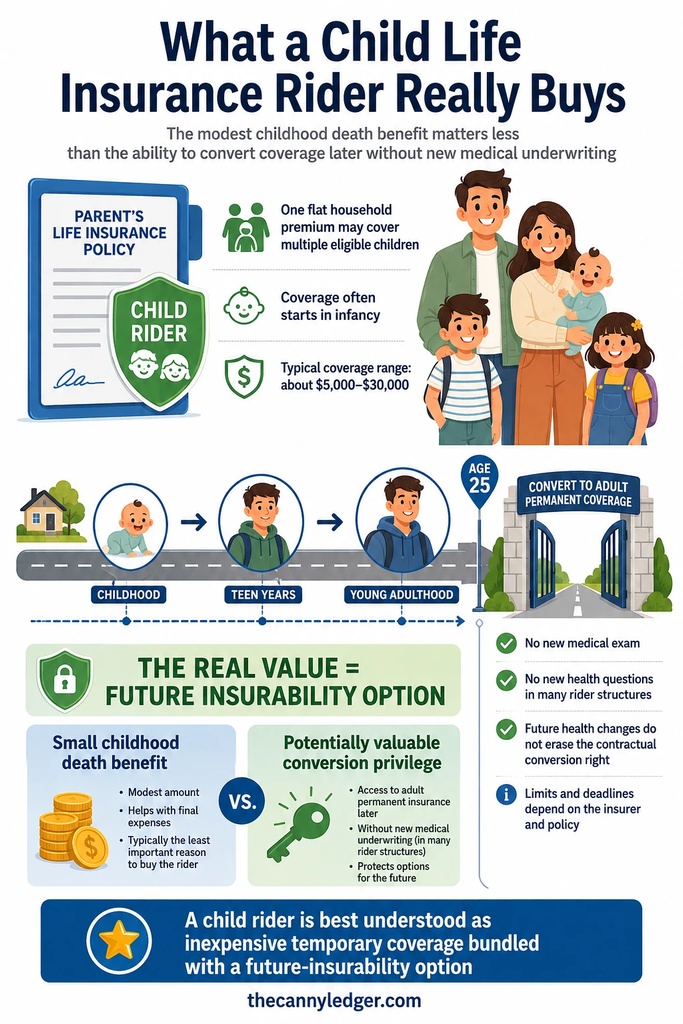
Child riders are priced to be nearly incidental next to the cost of the parent’s own policy, since a child’s mortality risk is so low that insurers can offer meaningful coverage for very little. One Manulife group plan document shows exactly this structure in practice, covering $10,000 of child life insurance for every eligible child under a single household for a flat monthly cost of a few dollars, regardless of how many children are in the family. The mechanics matter more than the price tag here. Most riders run from a child’s early infancy, sometimes as young as 15 days old, through a set age, commonly 25, at which point the coverage either ends or converts into a standalone adult policy.
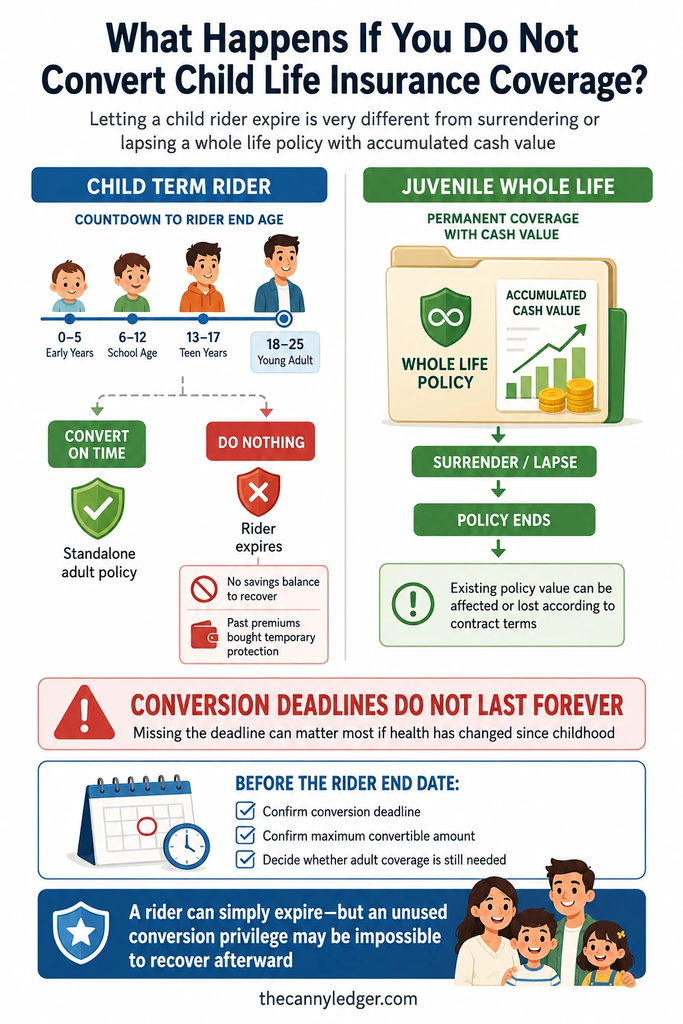
The conversion feature is the actual product being sold, not the modest death benefit itself. A child covered under a rider can typically convert to their own permanent policy when the rider ends, without answering new health questions or taking a medical exam, locking in insurability regardless of what health conditions may have developed since the rider started. This conversion right is worth understanding clearly, since it’s the piece of the product doing the real work, while the underlying death benefit during childhood is a secondary feature most families will thankfully never need to use.
What Standalone Juvenile Whole Life Actually Offers
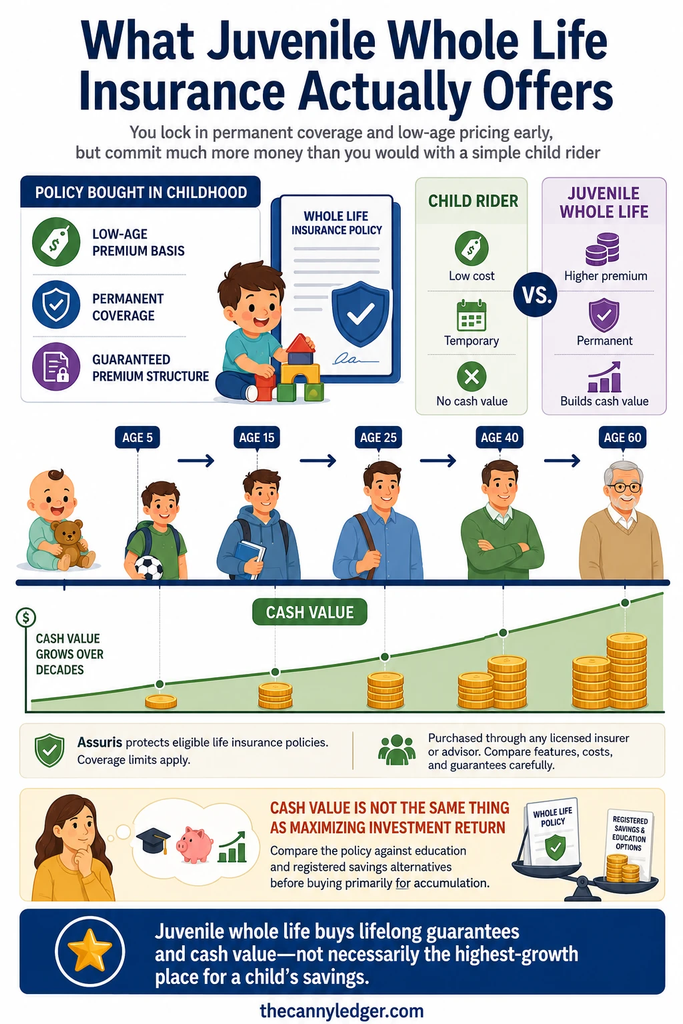
A standalone whole life policy purchased directly on a child costs meaningfully more than a rider, since it’s building lifelong cash value rather than providing a flat, temporary benefit tied to a parent’s own coverage. Because children qualify for the lowest possible premiums an insurer offers, locking in a whole life policy in early childhood means decades of guaranteed, unchanging premiums and cash value that compounds for far longer than if the same policy were purchased in adulthood.
This is also where the “is it worth it” question gets legitimately complicated rather than obvious in either direction. PolicyMe’s own guidance is direct about this trade-off, stating plainly that whole life insurance is generally not worth it for children, since the same premium dollars could grow faster in an RESP or TFSA, and that whole life for kids becomes worth considering mainly for families who’ve already maxed out those other savings vehicles or who specifically want to lock in insurability ahead of a known future risk. That’s a meaningfully different recommendation than what a whole life policy’s own sales materials tend to emphasize, and the same Assuris protection framework that covers any other Canadian life insurance policy applies to a child’s policy exactly the same way, so insurer solvency isn’t a meaningful factor in choosing between the two product types.
The Real Case For It, Guaranteed Insurability
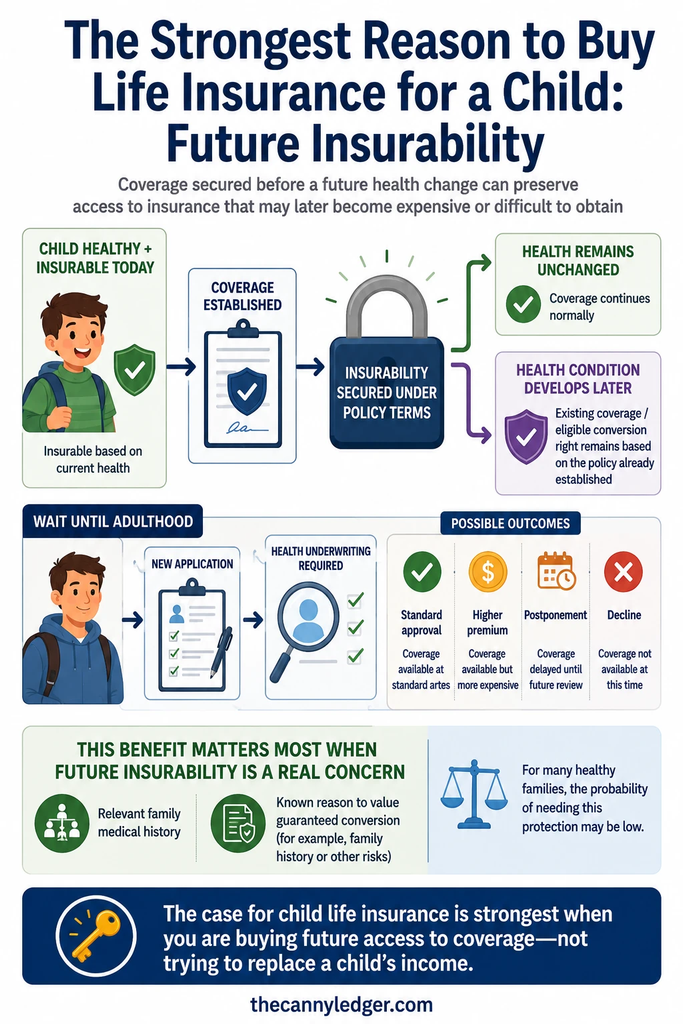
Set aside the marketing language and the actual argument for child life insurance comes down to a single, specific concern. Some health conditions that would make a person uninsurable, or insurable only at a steep premium increase, first show symptoms or get diagnosed in childhood or adolescence. A policy purchased before any such diagnosis locks in coverage regardless of what happens to that child’s health later, since the insurability guarantee doesn’t depend on future health status the way a fresh adult application would.
For most families, this risk is quite low, which is exactly why the case for child life insurance isn’t universal the way term life insurance for a working parent with dependents usually is. It becomes a more serious consideration specifically for families with a documented history of conditions that tend to emerge in childhood or young adulthood, where locking in future insurability ahead of a possible diagnosis has real value that a family without that history simply doesn’t need to buy.
What Happens if the Coverage Isn’t Converted
A child rider that reaches its end age without being converted simply expires, and the family loses nothing beyond the modest premiums already paid, since there was never a savings component to lose in the first place. A whole life policy behaves differently, since it’s been building real cash value the entire time, and letting it lapse or surrendering it means giving up that accumulated value rather than simply losing a low-cost temporary benefit.
This distinction matters when a family is deciding which type to buy in the first place, not just what happens years later. Choosing a rider commits a family to very little if their circumstances or priorities change, while choosing standalone whole life is a longer-term financial commitment that’s harder to walk away from without giving something up.
A Real Alternative Worth Comparing Directly
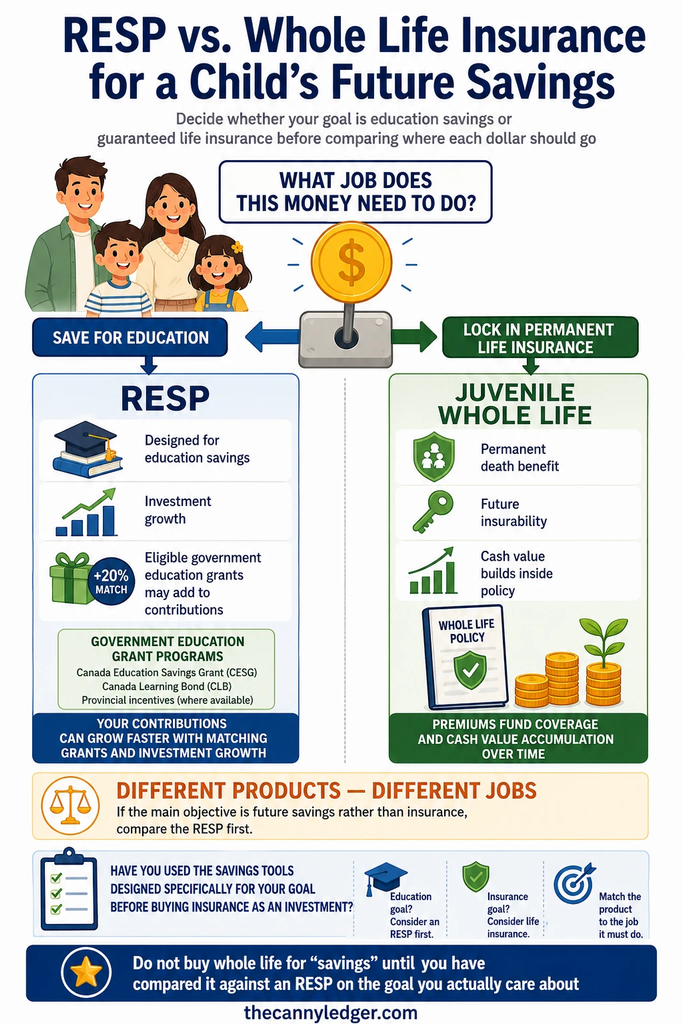
Anyone weighing whole life insurance for a child specifically as a savings vehicle owes it to themselves to compare it against a Registered Education Savings Plan before committing, since the two products are solving overlapping problems with very different tax and growth structures. An RESP comes with government grant matching that a life insurance policy’s cash value growth has no equivalent for, meaning a dollar contributed to an RESP for education savings can outpace a dollar paid into whole life premiums by a wide margin over the same childhood years.
The honest comparison isn’t really life insurance versus RESP as competing products, since one is fundamentally an insurance contract and the other a savings vehicle, but rather being clear about which job you’re actually trying to accomplish with each dollar. Money earmarked for a child’s future education or first home almost always belongs in an RESP or TFSA rather than a whole life policy’s cash value, while money specifically meant to lock in insurability against a real, known health risk is a different spending decision entirely.
Mistakes People Make With This Decision
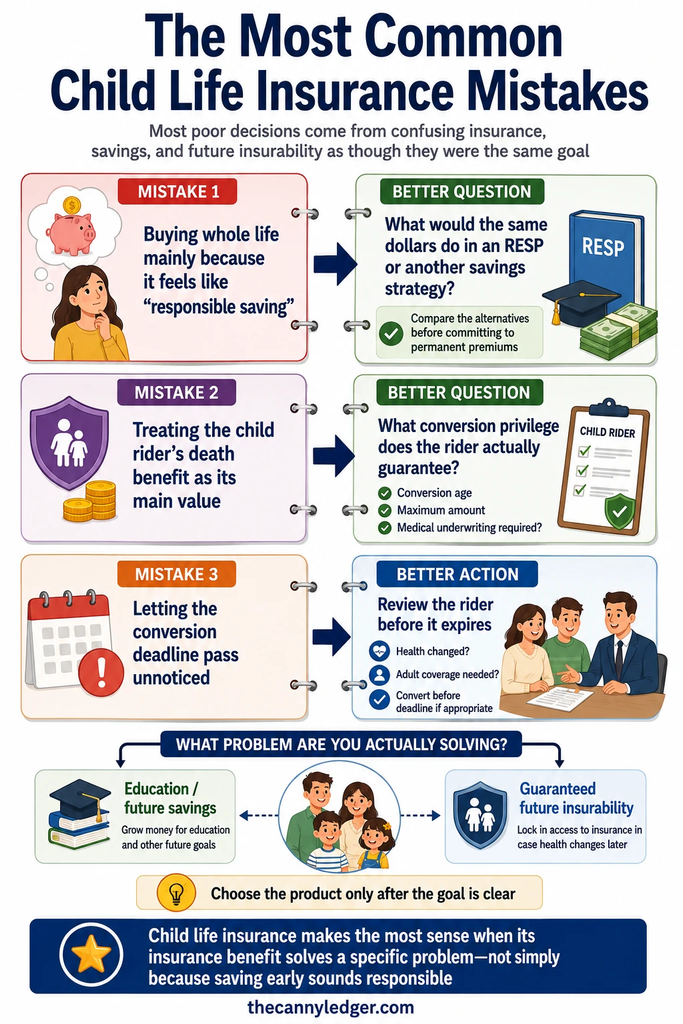
The most common mistake is buying a full standalone whole life policy on a healthy child with no family history of early-onset conditions, purely because an advisor framed it as responsible parenting, without comparing what the same premium dollars would do in an RESP instead. This isn’t a case of the product being bad, it’s a case of the sales framing outrunning the actual math for most families’ circumstances.
A second mistake is assuming a child rider provides meaningful death benefit protection worth budgeting around, when its real value sits almost entirely in the conversion privilege rather than the modest coverage amount itself. A third mistake is letting a rider’s conversion window pass without acting on it, particularly for a family that has since learned of a health condition that would make a fresh adult application more expensive or difficult, since that conversion right expires and can’t be recovered once the deadline passes.
If you’re weighing this decision right now, the practical next step is being specific about which problem you’re actually solving, guaranteed insurability against a known family health history, or a savings goal for your child’s future, since comparing what life insurance actually costs against other savings options only makes sense once you know which of those two questions you’re really asking.
Common Questions About Life Insurance for Children in Canada
Is the death benefit from a child’s life insurance policy taxable? No. Like any other Canadian life insurance death benefit, the payout reaches the named beneficiary tax-free, regardless of the insured person’s age at the time of death.
Can grandparents buy life insurance on a grandchild without the parents’ involvement? Yes, grandparents are among the parties permitted to purchase coverage on a child in Canada, though most insurers still require the child’s parent or legal guardian to provide consent as part of the application process.
Is a child term rider worth adding if I already have my own term life policy? Often yes, given how little it typically costs to cover every eligible child under one flat premium, but weighing that small ongoing cost against what it actually buys you is worth doing consciously rather than adding it automatically because it was offered at the point of sale.