

Nothing forces you to claim your FHSA deduction the same year you actually make the contribution. You can contribute the full amount this year and hold onto that deduction, unclaimed, until a future tax year when your income and marginal rate are genuinely higher, getting more value out of the exact same contribution simply by choosing when to claim it. Most people assume the deduction happens automatically the moment the money goes in, and that assumption alone can leave real money on the table.
- The Basic Mechanic Is A Dollar For Dollar Reduction
- Why Deferring The Deduction Can Genuinely Pay Off
- The Paperwork Behind Every Contribution And Deduction
- Getting This Wrong Has A Real Cost Beyond The Missed Deduction
- Making Sure Your Own Deduction Timing Works In Your Favour
- What People Get Wrong About The FHSA Deduction Most Often
Understanding how the deduction actually works, when deferring it genuinely makes sense, and what the paperwork behind it looks like is worth working through before assuming your FHSA deduction behaves exactly like every other line on your return.
The Basic Mechanic Is A Dollar For Dollar Reduction
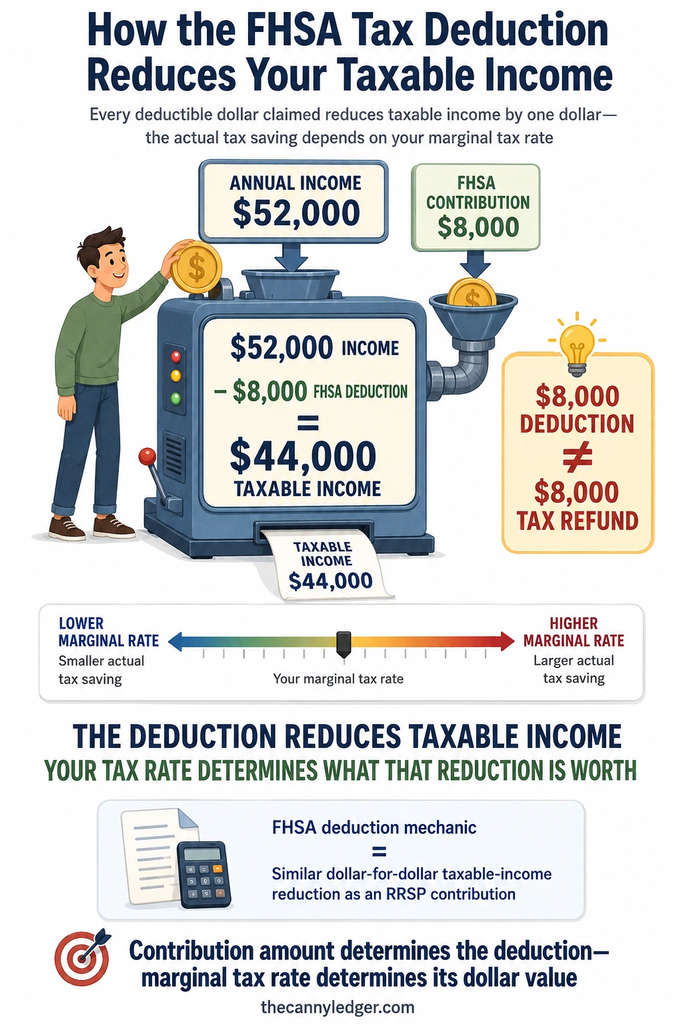
Every dollar contributed to an FHSA reduces your taxable income by that same dollar, the identical mechanic an RRSP contribution uses. Someone earning $52,000 in a given year who contributes $8,000 to their FHSA gets taxed as though they’d earned $44,000 instead, with the actual dollar value of that reduction depending on their specific marginal tax rate rather than being a flat, universal figure.
That marginal rate dependency is exactly why the same $8,000 contribution can be worth genuinely different amounts to different people, or even to the same person in different years. A contribution claimed while sitting in a lower tax bracket delivers a smaller reduction in actual tax owed than the identical contribution claimed during a year with meaningfully higher income, which is the entire logic behind choosing to defer the claim in the first place.
Why Deferring The Deduction Can Genuinely Pay Off
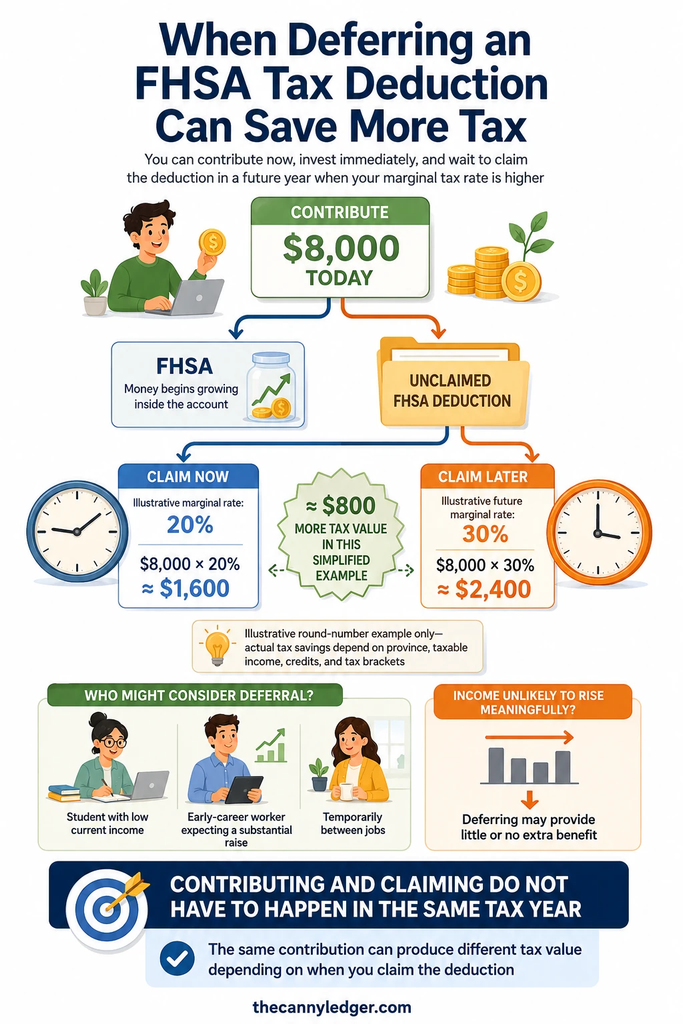
Illustrating the mechanic with round numbers makes the value concrete. A contribution claimed while sitting at roughly a 20 percent marginal rate might reduce tax owed by around $1,600 on an $8,000 contribution, while that same $8,000 claimed in a year at a 30 percent marginal rate could reduce tax owed by roughly $2,400 instead, an $800 difference purely from the timing of when the deduction gets claimed rather than anything about the contribution itself.
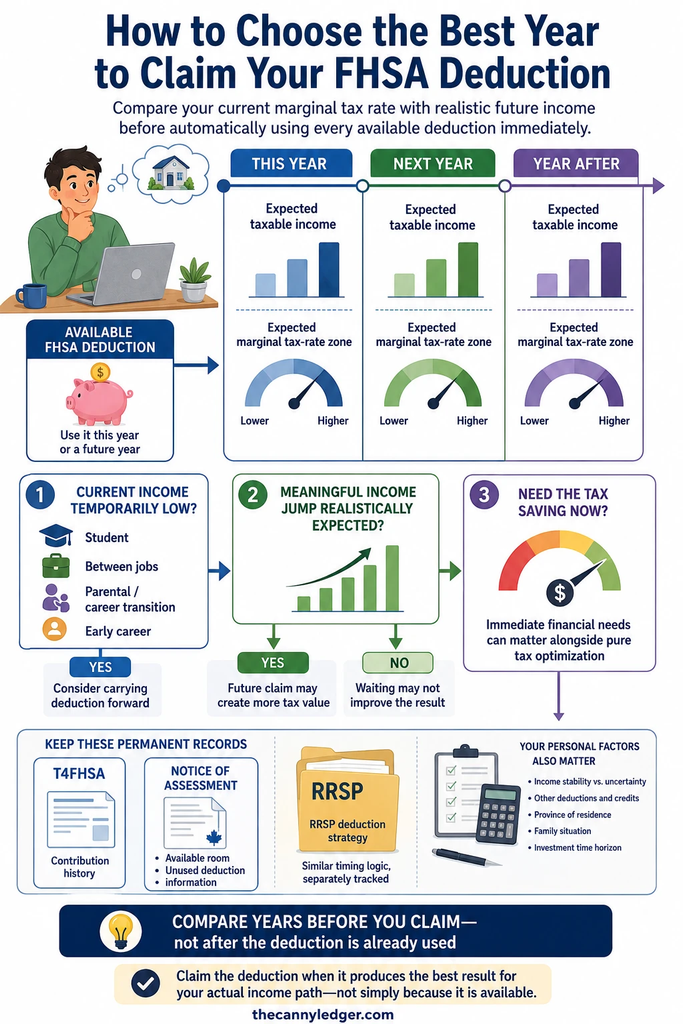
This makes deferral a genuinely useful strategy for anyone whose income is temporarily lower than it’s expected to be, a student, someone between jobs, or an early career worker anticipating a real income jump in the next few years. Contributing now locks in your participation room and starts your money growing tax sheltered immediately, while holding the deduction itself for a future, higher income year captures more actual tax value from the exact same contribution.
The Paperwork Behind Every Contribution And Deduction
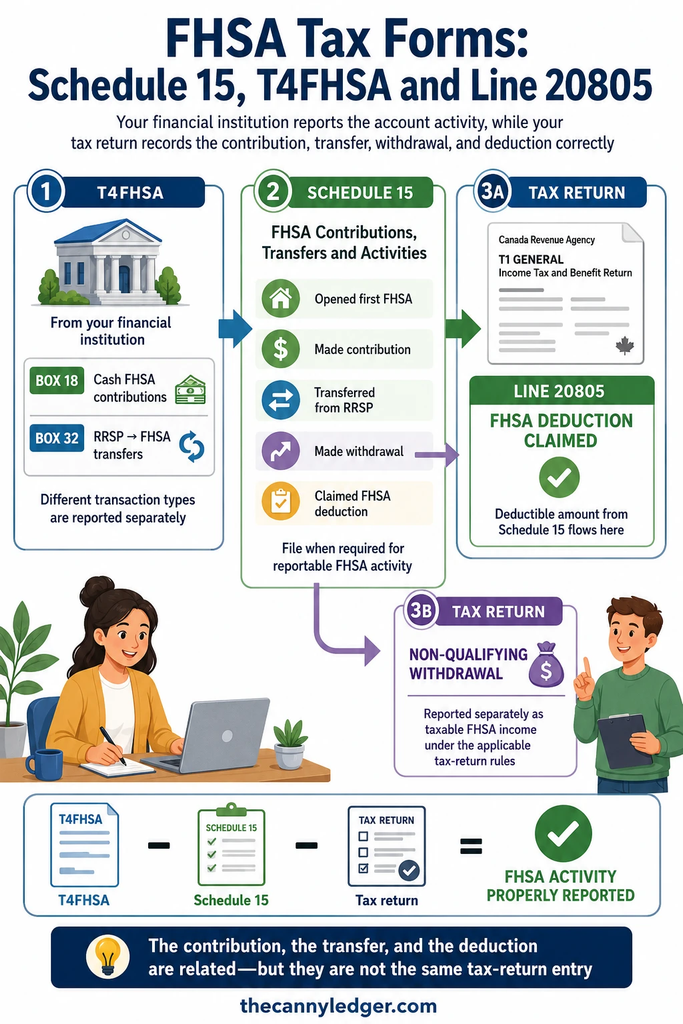
Schedule 15, FHSA Contributions, Transfers and Activities, has to be filed with your return in the year you open your first FHSA, make a contribution, transfer funds from an RRSP into an FHSA, make a withdrawal, or claim an FHSA deduction, essentially any year with genuine account activity. The deduction itself gets claimed specifically at line 20805 of your income tax and benefit return, a specific line worth knowing directly if you’re reviewing a return, your own or a preparer’s, to confirm the deduction was actually captured.
Your financial institution issues a T4FHSA slip, typically by the end of February, reporting your contributions and any transfers for the year, with cash contributions specifically appearing in Box 18 and RRSP-to-FHSA transfers appearing separately in Box 32. If a non-qualifying withdrawal happened during the year, that taxable amount gets reported separately at line 43700 rather than being folded into the same deduction line, since a withdrawal and a contribution move in genuinely opposite directions on your return.
Getting This Wrong Has A Real Cost Beyond The Missed Deduction
Filing Schedule 15 incorrectly, or skipping it entirely in a year with genuine FHSA activity, doesn’t just risk a missed deduction for that specific year. The CRA uses your filed Schedule 15 to calculate your FHSA participation room for the following year and reflects it on your Notice of Assessment, meaning an incomplete or missing filing can genuinely distort what the CRA believes your available room actually is going forward, not just what you were able to deduct in the year you filed incorrectly.
This is worth taking seriously even in a year where you’re deliberately not claiming a deduction, since Schedule 15 still needs to be filed correctly to record the contribution itself and preserve accurate room tracking, regardless of whether you’re claiming the associated deduction that same year or holding it for later.

Making Sure Your Own Deduction Timing Works In Your Favour
Confirm your actual marginal tax rate for the current year against your realistic expectations for the next few years before automatically claiming every FHSA deduction the same year you contribute, since a genuine income jump on the horizon is exactly the situation where deferring captures more real value. Keep every T4FHSA slip you receive, along with your Notice of Assessment each year, since both documents are what confirm your actual available room and unused deduction amounts going forward.
And if you’re also weighing how this deduction timing interacts with a broader retirement savings plan, our look at FHSA contribution limits covers how your available room actually accumulates alongside the deduction strategy covered here, and our comparison of RRSP tax deduction rules is worth reading too, since the same deferral logic applies to both accounts even though they’re tracked entirely separately.
What People Get Wrong About The FHSA Deduction Most Often
If I don’t claim my FHSA deduction this year, do I lose it permanently? No, an unclaimed FHSA deduction from a contribution you’ve already made can be claimed in a future tax year, provided you’ve correctly filed Schedule 15 in the year the contribution was actually made to preserve the record.
Does transferring money from my RRSP into my FHSA generate a new deduction? No, an RRSP-to-FHSA transfer moves funds between two already tax-sheltered accounts without creating a fresh deductible contribution, which is why it gets reported separately in its own box on the T4FHSA slip rather than counted alongside your cash contributions.
Do I need to claim the full deduction available, or can I claim only part of it? You can claim any portion of your available deduction in a given year and carry the remainder forward, giving you the same partial-claim flexibility an RRSP deduction offers rather than forcing an all-or-nothing decision each year.