
Search “best GIC rates Canada” and two of the names that consistently show up near the top, Achieva Financial and Outlook Financial, are both Winnipeg companies operating under different brand names. Achieva is a division of Cambrian Credit Union, Outlook is a division of Assiniboine Credit Union, and both compete nationally against every major bank in the country while running out of the same city as the rest of this content series. Neither markets itself loudly as a Manitoba institution, since a national online savings brand generally doesn’t lead with its hometown, but for a Winnipeg saver, that local connection comes with a real practical advantage most people never think to check.
- Two of Canada’s Top-Rated Online Savings Brands Are Secretly Winnipeg Companies
- What GICs and HISAs Actually Are, and Why the Choice Isn’t Either/Or
- Where Rates Actually Sit Right Now
- The Deposit Insurance Advantage Carries Over to Savings Too
- Redeemable vs Non-Redeemable GICs
- GIC Laddering: Spreading the Lock-In Risk
- Registered vs Non-Registered: Where to Actually Hold These
- Big Bank HISAs vs Online-Only Options
- Common Questions
- Compare the Actual Rate Before You Default to Your Regular Bank
GIC and savings interest rates in Winnipeg currently range from roughly 2.25 to 3.85 percent for one to five-year GICs and 1.50 to 4.75 percent for high-interest savings accounts, depending heavily on promotional offers and which institution you’re comparing. Manitoba-based online divisions like Achieva Financial and Outlook Financial regularly post rates at or near the top of national comparisons, and both carry the same unlimited deposit guarantee through the Deposit Guarantee Corporation of Manitoba that applies to their parent credit unions.
Two of Canada’s Top-Rated Online Savings Brands Are Secretly Winnipeg Companies
Achieva Financial, established in 1998 as a division of Cambrian Credit Union, is one of the country’s oldest online-only financial institutions, offering registered and non-registered GICs available to savers across Canada. As of recent national comparisons, Achieva has posted the highest available 1-year GIC rate in the country at 3.60 percent and the highest 5-year rate at 4.05 percent, regularly beating every major bank and most other online competitors on straightforward rate comparisons. Outlook Financial, a division of Assiniboine Credit Union operating since 2000, runs a similar model, high-interest savings accounts and GICs with no physical branches, keeping overhead low and passing the savings through to depositor rates. Both require a small one-time membership share, five dollars at Outlook specifically, to join the parent credit union, a minor step that’s easy to overlook given how digital and bank-like the rest of the sign-up experience feels.

What GICs and HISAs Actually Are, and Why the Choice Isn’t Either/Or
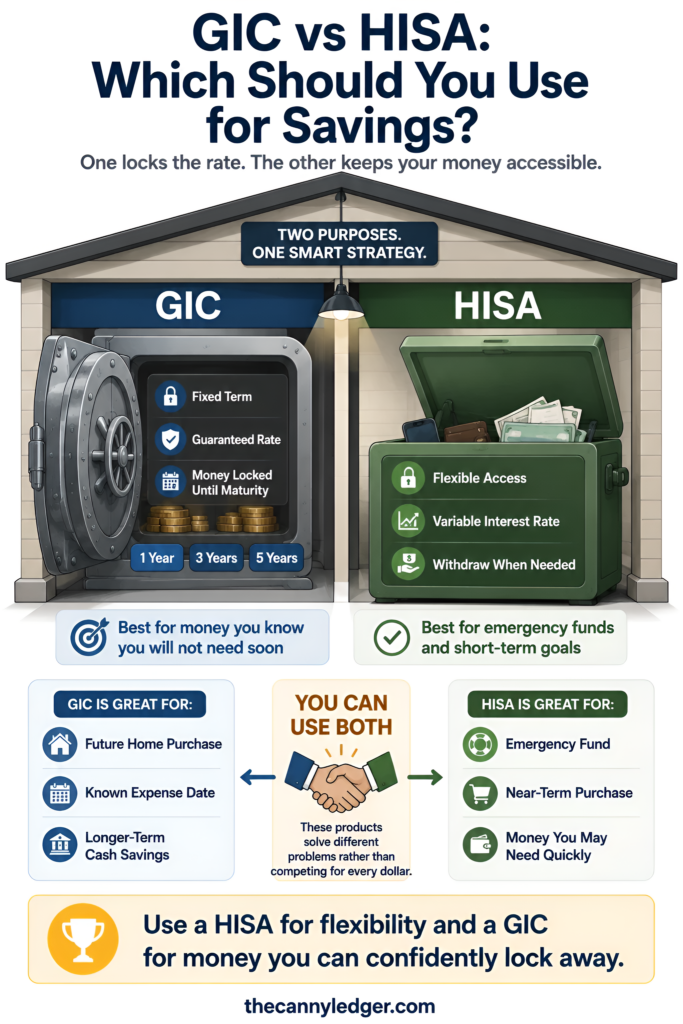
A Guaranteed Investment Certificate locks your money in for a fixed term, commonly ranging from 30 days to 10 years, in exchange for a guaranteed interest rate that won’t change regardless of what happens in the broader rate environment during that term. A high-interest savings account, by contrast, keeps your money fully accessible while still earning meaningfully more interest than a standard chequing or basic savings account, though the rate itself can float up or down as the Bank of Canada’s policy rate moves. These aren’t competing products so much as tools for different jobs. A HISA fits money you might need on short notice, an emergency fund or savings earmarked for a purchase within the next year, while a GIC fits money you’re confident you won’t need until a specific date, since locking in today’s rate protects you if rates fall later, at the cost of losing access to that cash until maturity.
Where Rates Actually Sit Right Now
With the Bank of Canada holding its policy rate at 2.25 percent through its most recent announcement, deposit rates across both GICs and HISAs have stayed relatively stable rather than shifting sharply in either direction. The broad national range for GICs currently runs from about 2.25 to 3.85 percent depending on term and institution, with the strongest rates concentrated at online-only providers like Achieva and Outlook rather than the major chartered banks, whose posted GIC rates tend to sit noticeably lower. HISA rates show a wider spread, from roughly 1.50 percent at the low end up to 4.75 percent, though the higher end of that range typically reflects limited-time promotional offers rather than a sustained ongoing rate, so checking whether a headline HISA number is promotional or permanent matters before assuming it’ll last.

The Deposit Insurance Advantage Carries Over to Savings Too
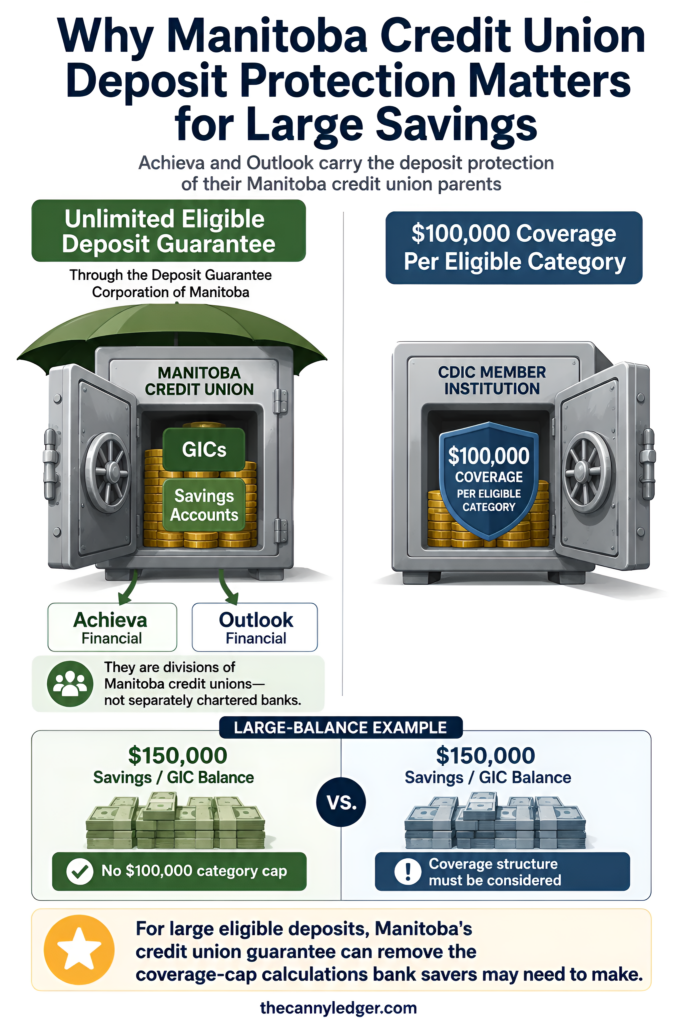
Our guide to bank versus credit union mortgages in Winnipeg covers how Manitoba credit unions carry unlimited deposit insurance through the Deposit Guarantee Corporation of Manitoba, a genuinely stronger protection than CDIC’s $100,000-per-category cap at national banks, and that same advantage applies directly to GICs and savings accounts held at Achieva and Outlook specifically, since both are divisions of Manitoba credit unions rather than separately chartered institutions. For a saver with a large GIC ladder or a substantial emergency fund that could exceed CDIC’s category limits at a bank, that unlimited guarantee is a genuine reason to consider a Manitoba-based online provider beyond the rate alone, since it removes the coverage-cap math entirely regardless of how large the balance grows.
Redeemable vs Non-Redeemable GICs
Most of the highest-rate GICs on the market are non-redeemable, meaning your money is genuinely locked in until maturity with no early withdrawal option at all, or only a heavily penalized one. Redeemable, or cashable, GICs allow early withdrawal, sometimes with a reduced interest rate applied to the shortened holding period, in exchange for a lower posted rate than the non-redeemable version of the same term. The tradeoff is straightforward: a non-redeemable GIC earns more precisely because the institution knows your money is committed for the full term, while a redeemable GIC costs you some yield in exchange for flexibility you may or may not actually end up needing. Being honest about how firm your timeline really is before choosing the higher, locked-in rate avoids the frustration of needing access to funds you’ve committed for years.

GIC Laddering: Spreading the Lock-In Risk
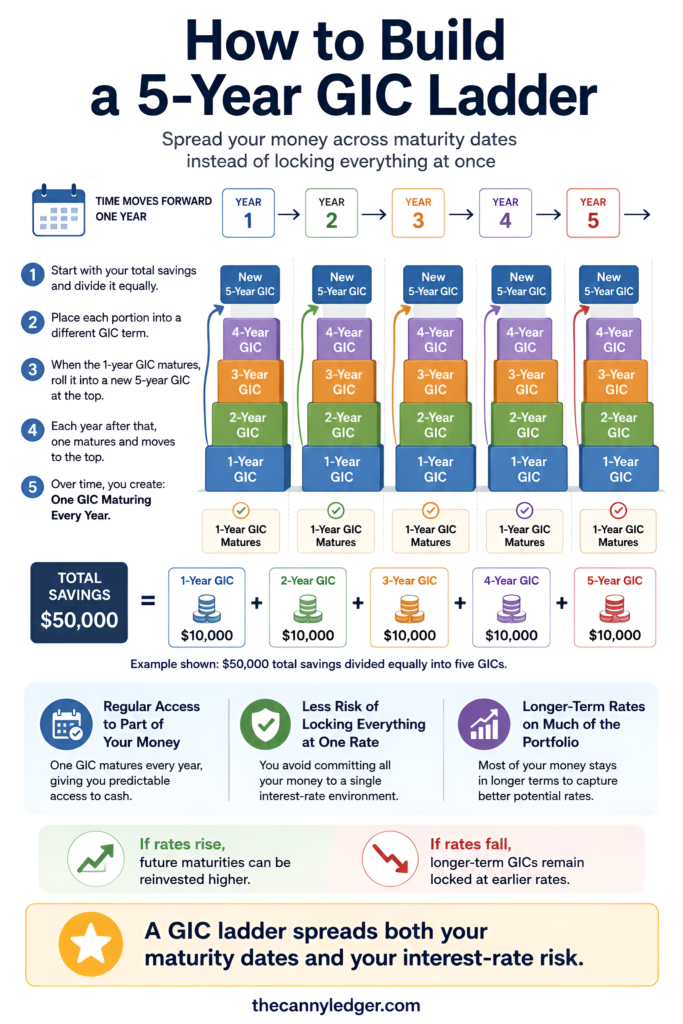
A GIC ladder splits a total investment across several different terms, say, one, two, three, four, and five years, rather than putting the full amount into a single term. As each shorter-term GIC matures, you reinvest it into a new five-year term, so within a few years you have a GIC maturing every single year while still holding the higher rates that longer terms typically offer. This structure solves the core anxiety of locking money into a single long term: the fear of missing a rate increase, or needing access sooner than expected, since a ladder guarantees you’ll have at least one portion of your savings coming free within any given year regardless of how the broader rate environment moves.
Registered vs Non-Registered: Where to Actually Hold These
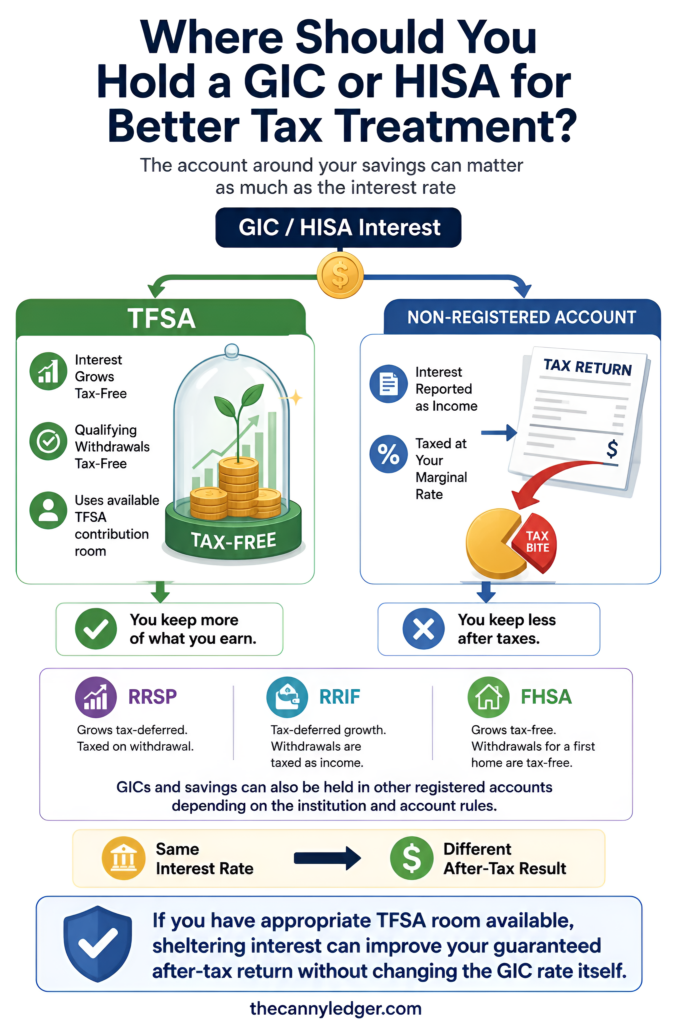
GICs and HISAs can be held inside a registered account, a TFSA, RRSP, RRIF, or FHSA, or outside one in a standard non-registered account, and the choice affects how the interest actually gets taxed. Interest earned inside a TFSA grows and can be withdrawn entirely tax-free, while interest in a non-registered account gets taxed as regular income in the year it’s earned, at your full marginal rate, the least favourable tax treatment of any major investment income type in Canada. Our Manitoba and Winnipeg personal income tax guide covers how interest income specifically factors into your overall return, but the practical takeaway here is simple: holding a GIC or HISA inside available TFSA room before defaulting to a non-registered account captures a real, guaranteed tax advantage that costs nothing extra to claim.
Big Bank HISAs vs Online-Only Options
The major chartered banks offer their own high-interest savings accounts, but their posted rates routinely sit well below what online-only providers, whether nationally known digital banks or Manitoba credit union divisions like Outlook and Achieva, are willing to pay. This gap exists for the same structural reason it does with mortgages, branch networks and in-person service cost real money to maintain, and an online-only provider without that overhead can pass more of the difference directly to depositors as interest. The tradeoff is limited product breadth, neither Outlook nor Achieva offers a full banking relationship with cheques, a debit card tied to a chequing account, or lending products, so most savers end up keeping day-to-day banking at a full-service institution while parking savings and GICs specifically wherever the rate is strongest.

Common Questions
Is my money safe at an online-only credit union division like Achieva or Outlook? Yes, both carry the exact same unlimited deposit guarantee through the Deposit Guarantee Corporation of Manitoba that applies to their parent credit unions directly, a level of protection that doesn’t diminish just because the account is opened entirely online.
Can I open an Outlook Financial or Achieva Financial account if I don’t live in Manitoba? Yes, both are available to Canadian residents nationwide despite being Winnipeg-based, and the DGCM guarantee applies regardless of where the depositor actually lives.
Should I choose a GIC or a HISA if I’m not sure when I’ll need the money? If genuine uncertainty exists about timing, a HISA’s flexibility is usually the safer default, since locking into a non-redeemable GIC and then needing early access can mean losing a meaningful portion of the interest you were counting on.
Compare the Actual Rate Before You Default to Your Regular Bank
The gap between a major bank’s posted GIC or HISA rate and what an online-only provider, including two genuinely Winnipeg-based options, currently offers is often large enough to matter over any meaningful savings balance. Before renewing a maturing GIC or parking new savings automatically at whichever institution already holds your chequing account, spend the ten minutes it takes to compare current rates at Achieva, Outlook, and at least one other online provider, since that comparison, unlike a mortgage negotiation, costs nothing but a few minutes and has no penalty for simply checking. Our guide to current mortgage rates in Winnipeg covers the borrowing side of the same rate environment this savings comparison sits within.