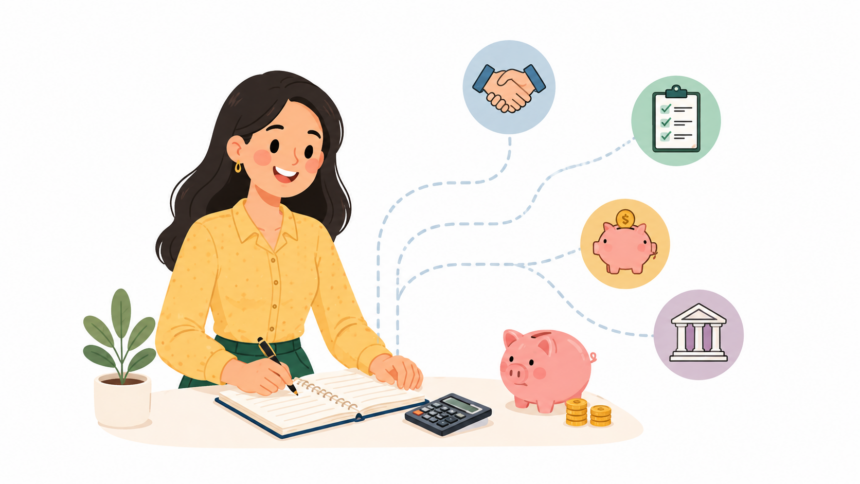
Debt relief in Canada isn’t one system, it’s two completely separate ones, and almost none of the companies selling debt relief services ever mention the first. One system exists specifically for government debt, tax owed to the CRA, an EI overpayment, a defaulted student loan, and runs entirely through federal departments rather than a lender or a credit counsellor. The other system covers private consumer debt, credit cards, personal loans, lines of credit, and includes everything from a straightforward consolidation loan to formal bankruptcy. Searching “debt relief” tends to surface only the second system, since that’s where the private companies advertising these services actually operate, which means a lot of Canadians never learn the first system exists at all.
The Government System Almost Nobody Talks About
The Government of Canada runs a dedicated relief process covering several distinct categories of government debt, CRA taxes, business GST and HST, benefits paid by the CRA, Employment and Social Development Canada debts, and customs duties, each with its own specific relief mechanism rather than one blanket program. For tax debt specifically, the CRA’s taxpayer relief provisions allow the agency to cancel or waive accumulated interest and penalties, though only under genuinely extraordinary circumstances or documented financial hardship, and only for the interest and penalty portion. The principal tax debt itself, what you actually owe before any interest was added, isn’t touched by this provision at all, a distinction that gets blurred constantly in how this program is described online.
Student and apprentice loan borrowers have a separate, genuinely useful mechanism worth knowing about specifically. The Repayment Assistance Plan can reduce your Canada Student Loan or Canada Apprentice Loan payment based on income, with no borrower required to make any payment until their income reaches $40,000 a year, an amount adjusted upward for family size, and the monthly payment capped at 10 percent of household income for anyone above that threshold. This pairs with a separate, equally underused fact, the federal portion of Canada Student Loans has carried no interest at all since April 1, 2023, which means a borrower struggling with a student loan today is often dealing with principal alone rather than accumulating interest on top of it. A borrower with a permanent disability qualifies for an enhanced version of the Repayment Assistance Plan with more generous terms, and severe permanent disability can qualify for outright cancellation of the debt entirely. None of this requires a private company, a fee, or an application through anyone other than the federal government directly, which makes it worth checking before assuming a defaulted student loan needs the same consolidation or settlement approach that private debt does.

The Consumer Debt System Most Content Actually Means
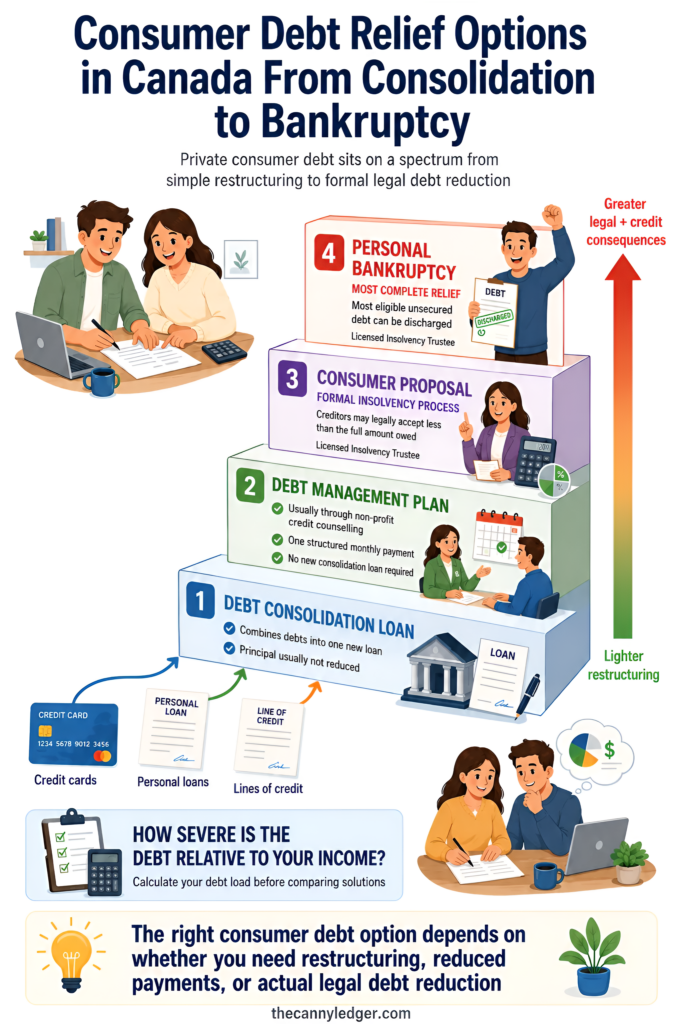
Everything most people picture when they hear “debt relief,” credit cards, personal loans, lines of credit, falls under a completely different framework, one built around private lenders, non-profit credit counsellors, and Canada’s formal insolvency law. Debt consolidation sits at the less severe end of this spectrum, restructuring existing debt into a single new obligation rather than reducing what’s owed. A debt management plan through a non-profit credit counsellor works similarly but without a lender’s credit requirements attached. Further along the spectrum sit the two genuinely legal insolvency processes, a consumer proposal and personal bankruptcy, both filed through a Licensed Insolvency Trustee and both capable of actually reducing the principal amount owed rather than just restructuring it, a real distinction from everything lighter on this list. Understanding your actual debt to income ratio before deciding where on this spectrum your situation actually sits saves real time comparing options that were never going to fit. Our full comparison of debt management plans against formal debt settlement covers exactly where the line sits between the informal and legally binding options, since the two get marketed with confusingly similar language despite being structurally very different.
Figuring Out Which System Actually Applies To You
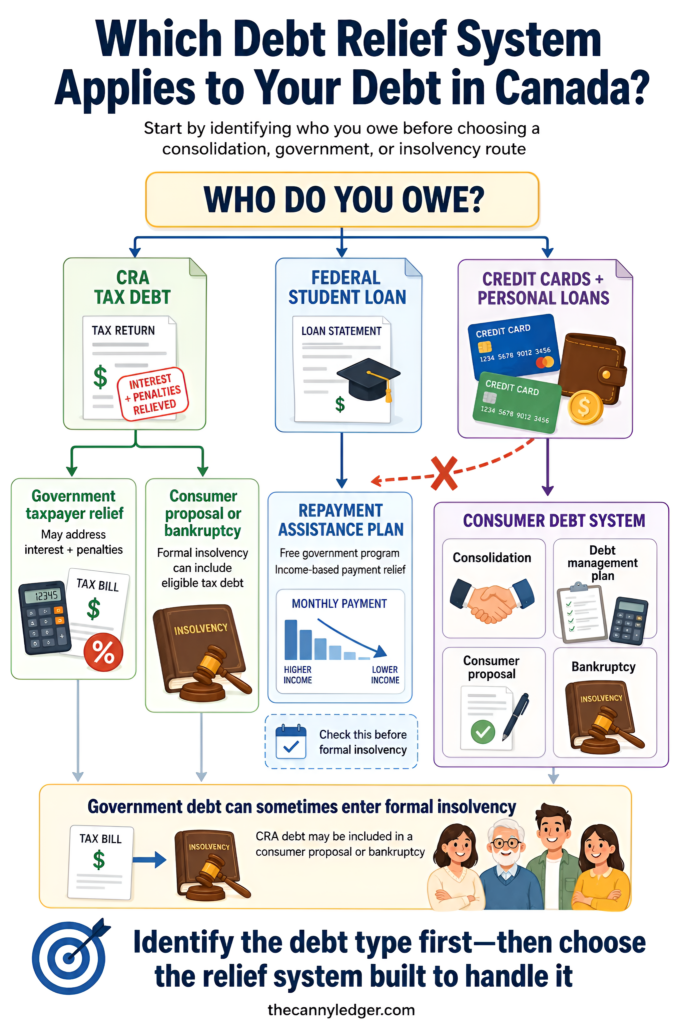
This distinction matters more than it might seem, since applying the wrong system’s logic to your specific debt wastes real time. Owe the CRA money specifically, and a consumer proposal or bankruptcy filed through a Licensed Insolvency Trustee absolutely can address that debt, since tax debt is included in Canada’s formal insolvency process even though it isn’t touched by a private debt management plan. Owe on a defaulted student loan, and the government’s own Repayment Assistance Plan is worth exhausting before considering formal insolvency, since it’s free, doesn’t damage your credit the way a consumer proposal does, and directly addresses the exact problem a struggling borrower actually has. Owe on credit cards or a personal loan, and the consumer system, consolidation through to bankruptcy depending on severity, is the relevant framework, with the government relief system offering nothing relevant to that specific debt at all.
What Debt Forgiveness Actually Means In Practice
The phrase “debt forgiveness” gets used loosely enough online that it’s worth being precise about what actually happens under each option covered here. CRA taxpayer relief forgives interest and penalties, never the principal tax owed, the exact scope of the form used to formally request it. The Repayment Assistance Plan reduces or pauses payments based on income, it doesn’t erase the loan balance outright. A consumer proposal is the closest thing to genuine forgiveness in the consumer system, since creditors formally agree to accept less than the full amount owed, but it comes with real credit consequences and isn’t available without going through a Licensed Insolvency Trustee. Bankruptcy discharges most unsecured debt entirely, the most complete form of relief available, but it carries the most severe and longest-lasting credit impact of anything on this list. Nowhere in either system does debt simply disappear without a real cost attached somewhere, whether that cost is time, credit impact, or a formal legal process, and any company suggesting otherwise is worth treating with real skepticism.

Where To Actually Start
If any part of your debt involves the CRA, EI, or a federal student loan, check the government’s own relief options directly before assuming you need a private consolidation loan or a credit counsellor, since the government relief system is free and specifically built for exactly that debt. For consumer debt specifically, a free consultation with a credit counsellor is a reasonable starting point regardless of how severe your situation feels, since a qualified counsellor can point you toward whichever option on the consumer spectrum actually fits rather than assuming the first product you found online is the right one. And if your debt load, private or government, is severe enough that none of the lighter options genuinely resolve it, a conversation about bankruptcy or a formal consumer proposal is worth having directly rather than cycling through consolidation attempts that were never going to be enough on their own, and understanding how collections actually work in the meantime helps you know your rights while you sort out the right path forward. Our broader guide to getting out of debt in Canada covers the practical sequencing across both systems in more depth than a single overview article can.