
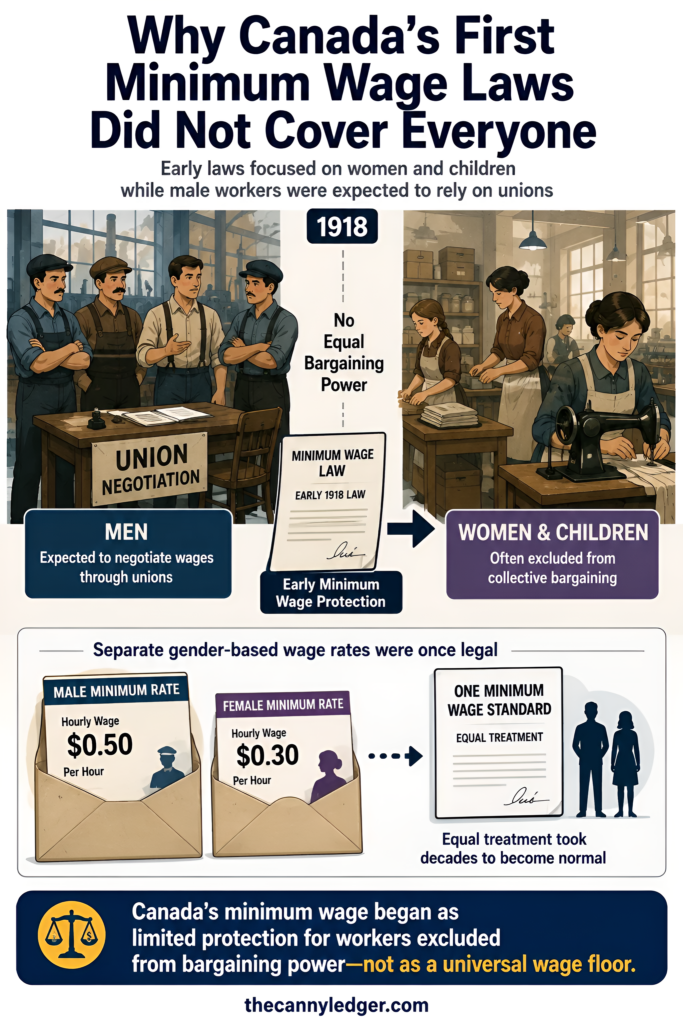
Canada’s first minimum wage laws weren’t written to protect workers in general. They were written to protect women, specifically, and for decades afterward it was entirely legal in most provinces to pay a man more than a woman for the identical job, since separate, lower minimum rates for women were built into the original legislation on purpose. That’s not a footnote to the story of minimum wage in this country, it’s close to the whole starting point, and it explains a lot about why the system still looks the patchwork way it does more than a century later.
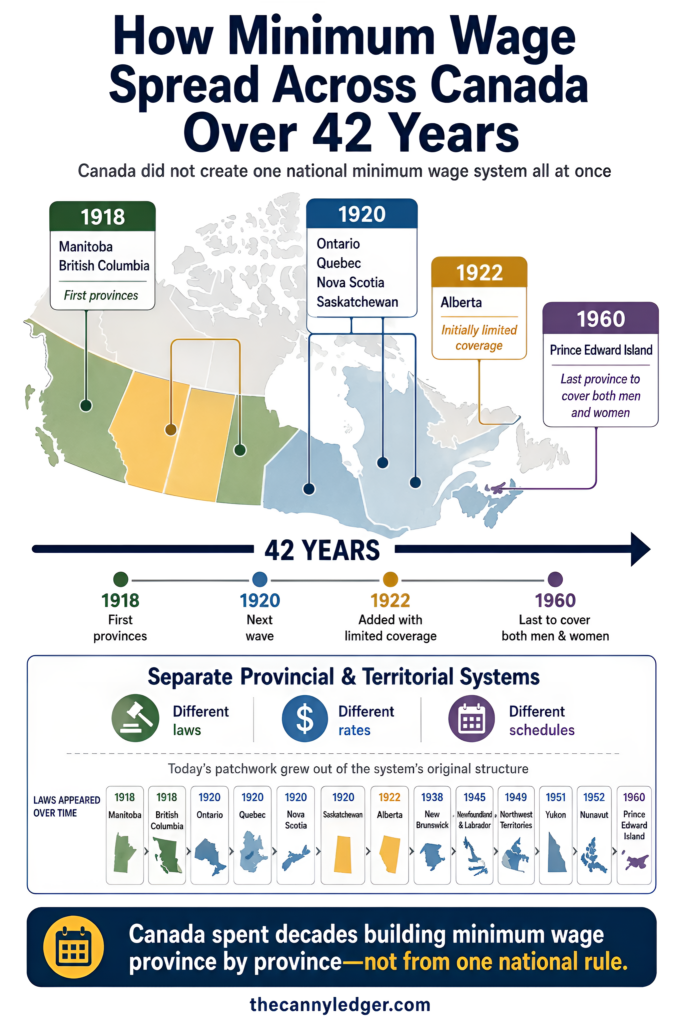
Minimum wage in Canada began in 1918, when Manitoba and British Columbia became the first provinces to legislate it, initially covering only women and children in specific industries. Every other province followed over the next several decades, with Prince Edward Island the last to extend coverage to both men and women in 1960. The federal government has run its own separate minimum wage twice, abolishing it in 1996 and only reestablishing it in 2021. That back-and-forth federal history alone tells you this was never a single, steady policy line moving in one direction.
Why It Started With Women, Not Everyone
The reasoning behind Canada’s earliest minimum wage laws reflected the labour thinking of the era rather than a broad commitment to worker protection. According to a federal government issue paper on the history of minimum wage policy, the earliest rates applied primarily to women and children, since labour unions at the time, which represented predominantly male workers, were seen as the appropriate mechanism for men to negotiate fair pay for themselves through collective bargaining instead. Women, largely excluded from those unions, had no equivalent path, which is the gap early minimum wage legislation was built to fill.
That framing produced a system that, for much of the 20th century, explicitly paid men more than women for comparable work under the same provincial laws, since separate, lower minimum rates for women were the norm rather than an accident. CBC News reporting on this history quotes labour historian Laurel MacDowell describing women as treated as cheap labour under the original framework, a characterization that lines up with how narrowly those first laws were written. The idea that a single minimum wage should apply to everyone regardless of gender took decades to become standard practice, and the later fight over Alberta’s and Ontario’s remaining student sub-minimum wages, covered in more detail elsewhere on this site, traces back to the exact same legal and philosophical question, whether it’s acceptable to pay one category of worker less than another for identical work based on a characteristic other than the job itself.
The Slow Spread Across the Map
Manitoba and British Columbia moving first in 1918 wasn’t followed by a swift national rollout. Ontario, Quebec, Nova Scotia, and Saskatchewan introduced their own minimum wage laws in 1920, two years later, and Alberta followed in 1922 with coverage limited to women in cities and towns above a certain population threshold, according to historical research published in the academic journal Labour/Le Travail. Prince Edward Island took by far the longest, becoming the last province in the country to pass minimum wage legislation covering both men and women in 1960, four full decades after the first wave of provinces had already acted. The Canadian Encyclopedia’s own entry on minimum wage confirms this same 1960 milestone independently, alongside the broader pattern of provinces and territories gradually building out their own separate policies across the century.
That 42-year gap between Manitoba’s first law and PEI’s final holdout is worth sitting with, since it means Canada spent more time as a patchwork of provinces with wildly inconsistent coverage than it’s spent operating under anything resembling a unified national floor. The current system, thirteen separate jurisdictions each running their own rate on their own schedule, isn’t a recent complication layered onto a once-simple system. The complication is closer to the system’s original design than most people realize.
When Ottawa Had Its Own Rate, Then Didn’t
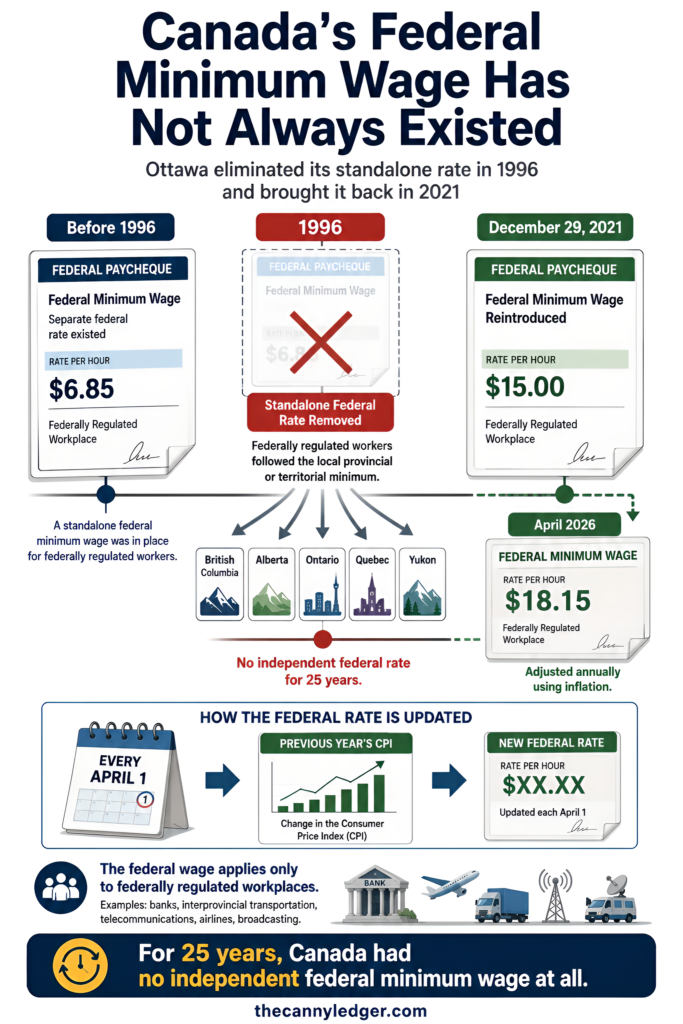
The federal government’s relationship with minimum wage has been surprisingly inconsistent in a way that catches people who assume Ottawa has always set one steady national floor for federally regulated workers. A federal minimum wage existed under Part III of the Canada Labour Code, but in 1996 it was effectively eliminated as an independent rate, redefined instead to simply match whatever the general provincial or territorial minimum wage happened to be wherever a federally regulated employee worked. For 25 years, there was no standalone federal number at all, only a rule pointing back to the province.
That changed on December 29, 2021, when the federal government reestablished an independent federal minimum wage at $15.00 an hour, a move recommended by the Expert Panel on Modern Federal Labour Standards back in 2019 and formally proposed in that year’s federal budget. Since 2022, that rate has adjusted every April 1 based on the previous year’s Consumer Price Index, the same mechanism now driving most provincial increases too. The federal rate climbing from $15.00 in late 2021 to $18.15 as of April 2026 represents a fast run of increases for a number that spent the previous quarter century not existing as its own distinct figure at all.
The Push to Fifteen
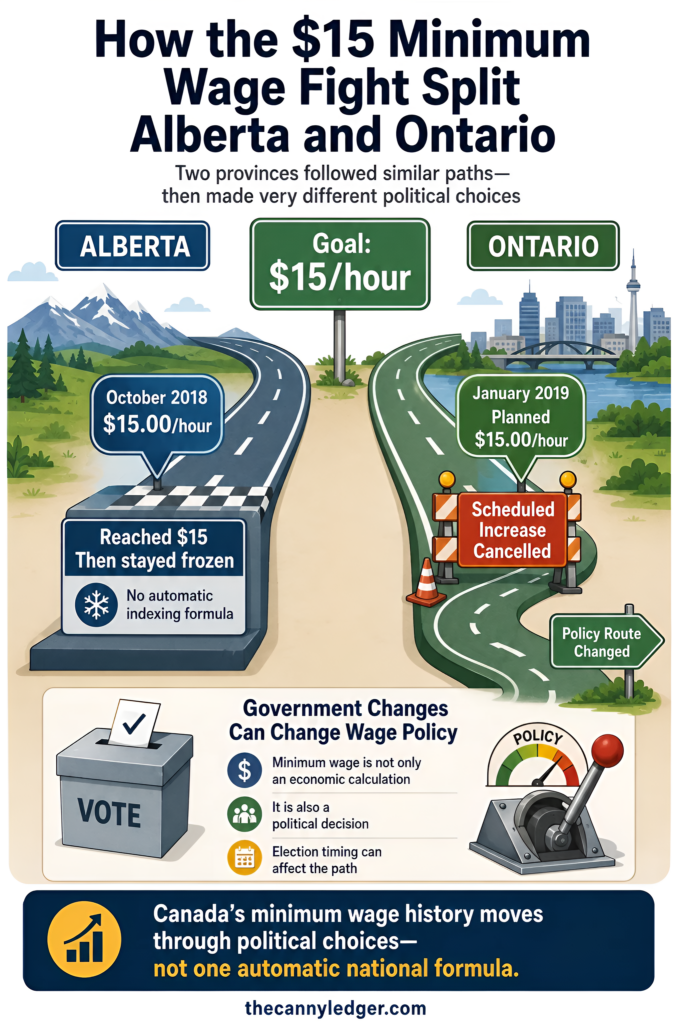
The mid-2010s produced the most politically visible minimum wage fight in recent Canadian memory, and it reshaped how several provinces think about the number even now. Alberta reached $15.00 an hour in October 2018 after a series of steep, deliberate increases under the provincial government of the day, a rate that made national headlines at the time as the highest in the country and has, strikingly, not moved since. Ontario was on the identical path, with legislation passed to bring its own minimum wage to $15.00 by January 2019, only for an incoming provincial government to cancel that final scheduled increase before it took effect, freezing the rate instead and setting Ontario’s minimum wage on a different trajectory than the one originally planned.
Those two outcomes sitting side by side, one province landing at $15.00 and staying there for going on eight years, the other reversing course before reaching the same number, capture something real about how minimum wage policy actually moves in this country. It isn’t a smooth economic calculation applied consistently. It’s a political decision, made and unmade by whichever government holds power in a given province, with real consequences for real paycheques depending entirely on election timing.
From Political Decision to Automatic Formula
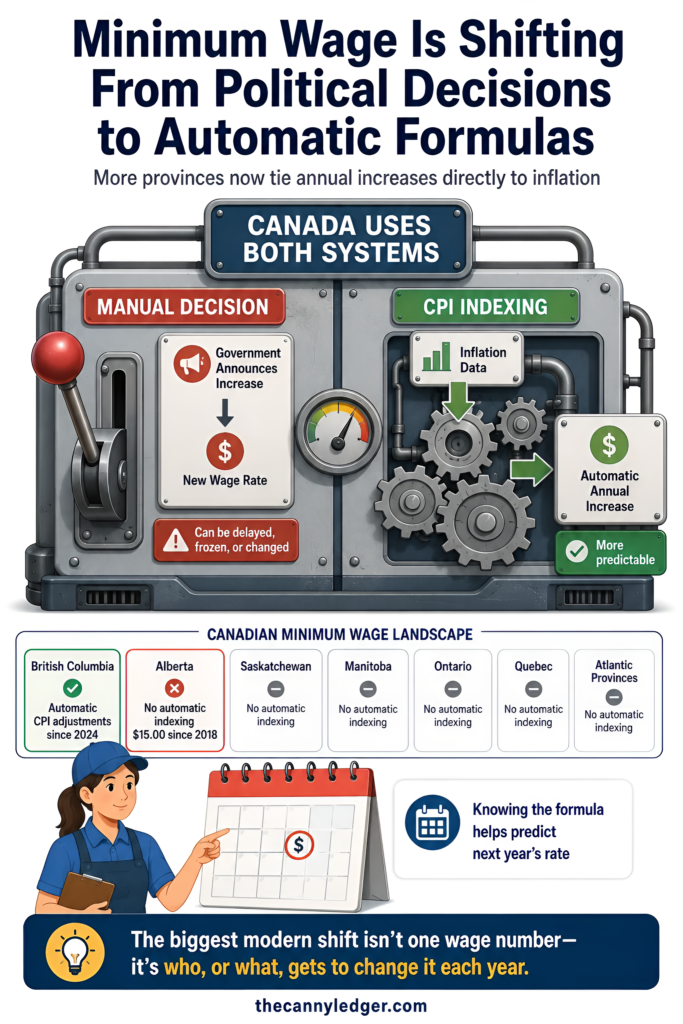
The most significant structural shift in recent minimum wage history isn’t any single dollar figure, it’s the move away from politicians deciding the number by hand and toward formulas that adjust it automatically. British Columbia locked in automatic Consumer Price Index adjustments starting in 2024. Most other provinces now run some version of the same idea, tying annual increases to inflation data rather than waiting for a government to schedule a standalone announcement. The full current picture across every province and territory shows just how far this shift has gone, with Alberta standing out today specifically because it never adopted an indexing formula at all, leaving its rate exactly where a 2018 political decision set it.
That shift matters because it changes what minimum wage actually represents, whether someone is weighing a part-time job in Winnipeg today or trying to predict where next year’s rate lands. A number set by direct political choice reflects whatever a specific government wanted to signal at a specific moment, Alberta racing to the top of the national rankings in 2018, or Ontario backing away from a promise the same year. A number set by automatic formula reflects something closer to a passive tracking mechanism, moving with inflation regardless of which party happens to be governing when the calendar flips to the adjustment date. Both approaches are still active in Canada today, sitting right next to each other on the same map, a structural quirk that also shapes how work rules for international students intersect with whichever provincial rate happens to apply.
Where This Leaves the Number Today
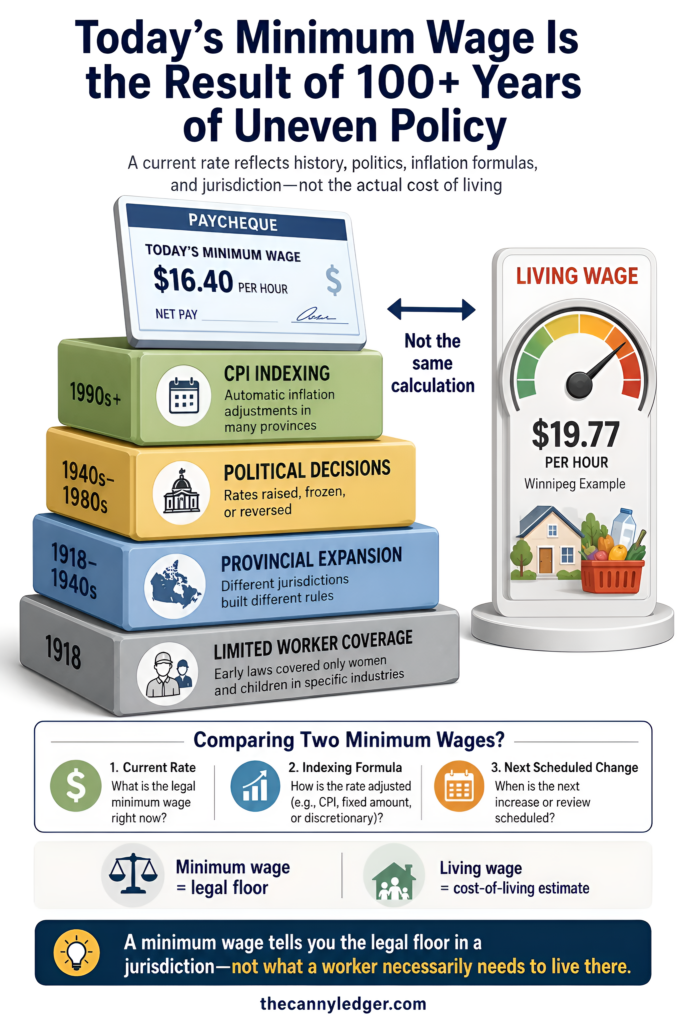
Understanding this history changes how a current minimum wage figure should actually be read. A province’s rate isn’t simply “the minimum wage,” it’s the current output of a specific policy mechanism, political decision, CPI formula, or some hybrid, layered on top of a century-old legal structure that started out excluding most workers entirely. If you’re comparing Manitoba’s current rate against a neighbouring province, knowing whether that neighbour is running an automatic formula or waiting on a political decision tells you something real about how predictable next year’s number is likely to be. And if you’re budgeting around minimum wage income at all, understanding it’s a legal floor built from a century of uneven, sometimes reversed policy choices, rather than a carefully calculated living standard, is worth keeping in mind alongside your own cost of living specifically.
What People Usually Ask Next
When did Canada eliminate separate minimum wages for men and women entirely? This happened at different times in different provinces rather than through one national reform, generally through the middle decades of the 20th century as provinces individually moved toward gender-neutral minimum wage laws, well after the original wave of women-only legislation in the 1918 to 1922 period.
Has the federal minimum wage ever been higher than every provincial rate? Not currently. As of 2026, several provinces and territories, including British Columbia, Yukon, and Nunavut, sit above the federal rate, though the federal number briefly matched or exceeded some provinces immediately after its 2021 reestablishment before provincial indexing formulas caught up.
Did any province ever lower its minimum wage after raising it? Outright reductions are rare in Canadian minimum wage history, but Ontario’s cancelled 2019 increase functioned similarly in practice, since workers who expected to reach $15.00 an hour on a specific date never received that increase at all under the incoming government’s reversal.