



Ask about minimum wage for international students in Canada and you’re asking the wrong question, or at least half of it. No province pays an international student a lower hourly rate for the same job simply because of their citizenship or study permit status. The real restriction international students actually run into has nothing to do with the number on their paycheque and everything to do with how many hours they’re legally allowed to work in the first place, a limit set by federal immigration rules rather than any provincial employment standards act.
- There’s No Special International Student Wage
- The Real Restriction Lives in Hours, Not Dollars
- What Actually Qualifies You to Work Off Campus at All
- On-Campus Work Runs by a Completely Different Rule
- Scheduled Breaks Change the Math Entirely
- The Co-op Change That Just Took Effect
- What Actually Happens If You Go Over
- Doing the Actual Math
- Questions Students Ask Once the Basics Click
International students in Canada earn the exact same minimum wage as any other worker in the province where they’re employed, with no separate lower rate based on citizenship or study permit status. What’s actually restricted is the number of hours they can legally work off campus, currently capped at 24 hours a week during academic terms under federal immigration rules, with full-time work allowed during scheduled school breaks. Confusing the wage question with the hours question is the single most common misunderstanding around international student work in this country.
There’s No Special International Student Wage
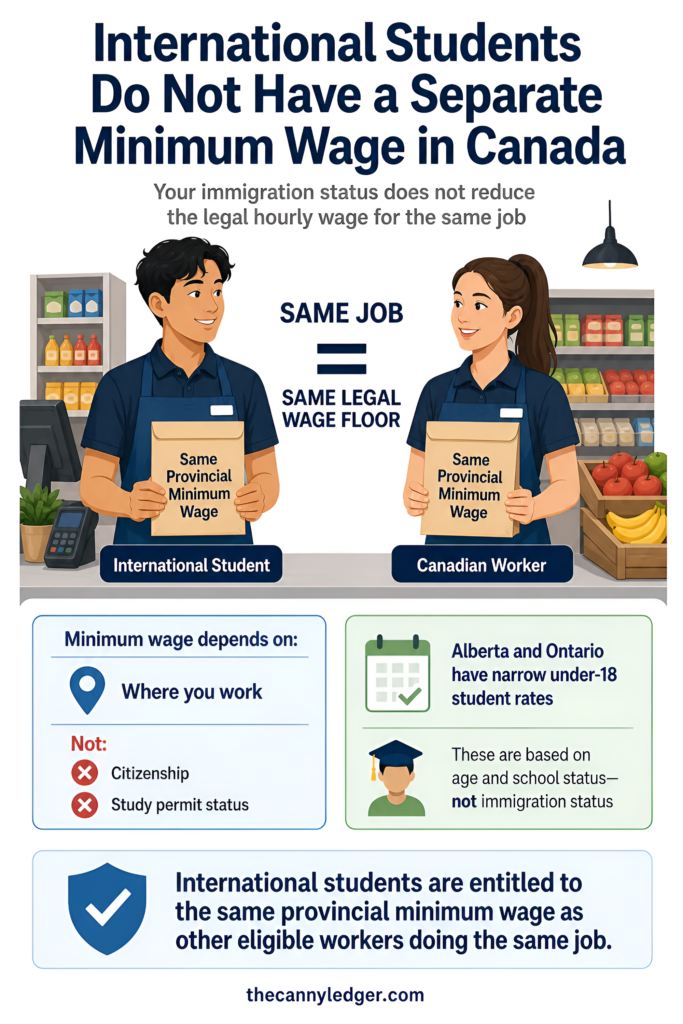
Every province’s minimum wage law applies to a worker based on where the job happens, not the worker’s immigration status. An international student working a retail shift in Winnipeg earns Manitoba’s general minimum wage exactly like a Canadian-born coworker doing the identical job beside them, with the same overtime rules, the same right to a pay stub, and the same legal protections against being paid below the provincial floor, even as the broader cost of living for international students in Winnipeg shapes how far that pay actually stretches. There is no citizenship-based carve-out anywhere in Canadian employment standards legislation, and any employer suggesting otherwise, whether through ignorance or an attempt to underpay, is simply wrong.
The only sub-minimum wages that exist anywhere in the country are Alberta’s and Ontario’s student rates, and those apply based on age and school enrollment, specifically workers under 18 attending school, not citizenship. Since the overwhelming majority of international students in Canada are enrolled in post-secondary programs and well past 18, that provincial student rate almost never actually applies to them in practice, which makes the entire “international student wage” framing something of a red herring from the start.
The Real Restriction Lives in Hours, Not Dollars
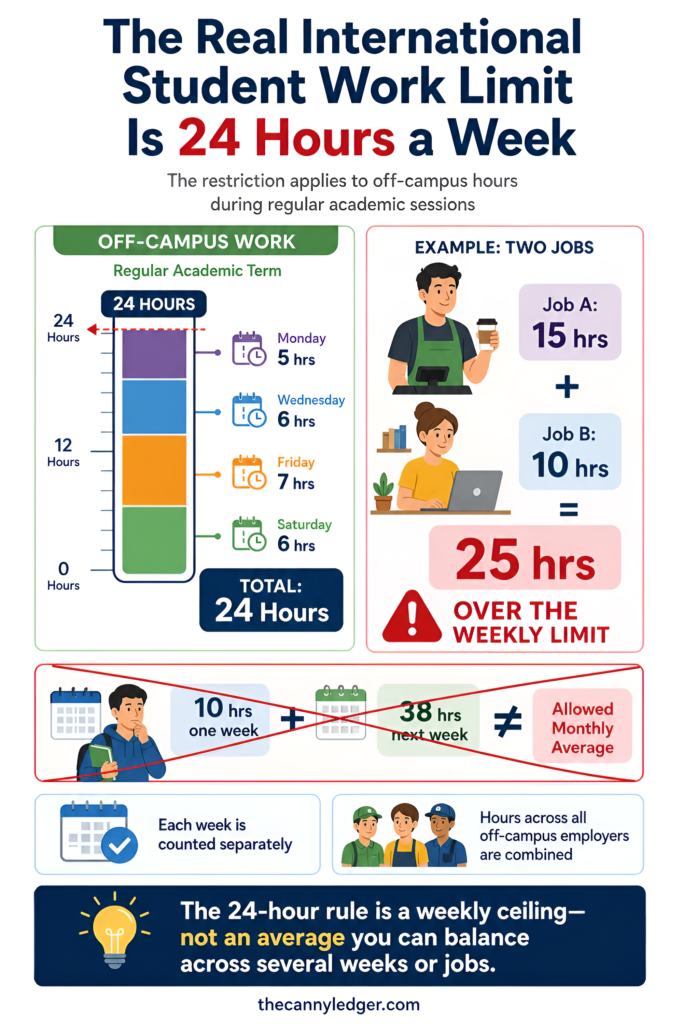
This is the part that actually matters for planning a budget or a work schedule, more so than tracking general provincial rates alone would suggest. According to the Government of Canada’s own guidance on working off campus, eligible international students can work up to 24 hours a week off campus during a regular academic session, with no upper limit during a scheduled school break. That 24-hour figure became the permanent standard in November 2024, replacing a lower 20-hour cap that governed off-campus work for years before a series of temporary pandemic and post-pandemic exemptions loosened it, then tightened it back to a new permanent number.
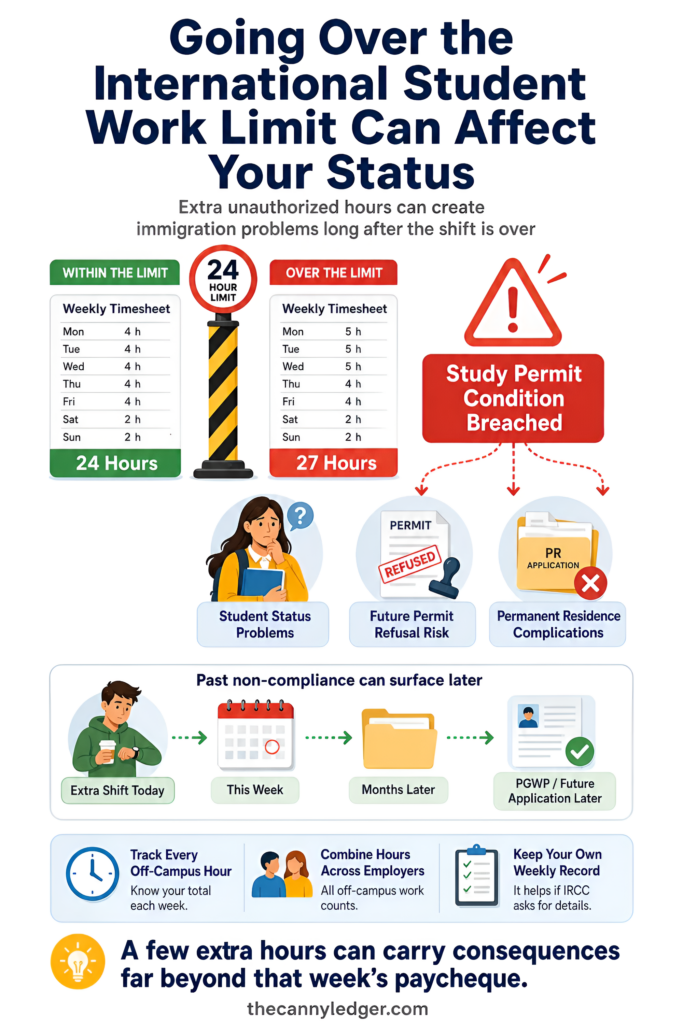
The cap is a hard weekly ceiling rather than an average you can balance out over a month. Working 10 hours one week and 38 the next doesn’t average out to something acceptable, since IRCC counts each week on its own and treats any single week over 24 hours as a breach of study permit conditions, regardless of what happened the week before or after. It also applies cumulatively across every employer at once, so splitting 15 hours between two different part-time jobs in the same week still adds up to a violation if either combination pushes the weekly total past 24.
What Actually Qualifies You to Work Off Campus at All
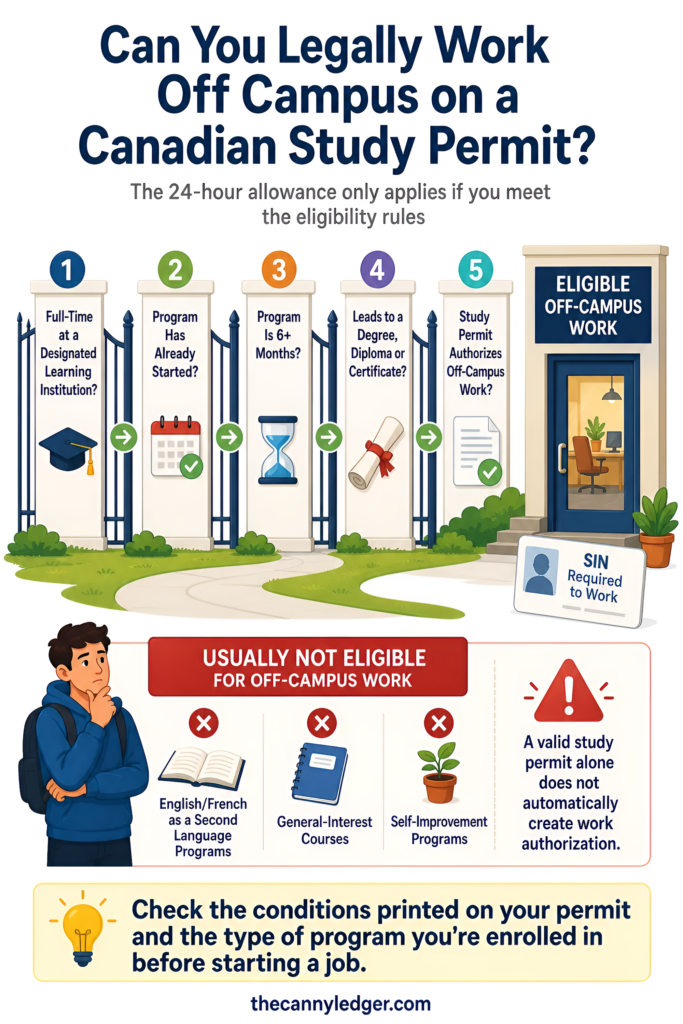
Not every international student in Canada is even eligible to work off campus in the first place, and the eligibility list is worth checking carefully before assuming the 24-hour allowance automatically applies. Per the same government guidance, a student needs to be enrolled full-time at a designated learning institution, have already started their program of study, hold a valid study permit or have applied to extend one before it expired, and be in a program that runs at least six months and leads to a degree, diploma, or certificate. The current 24-hour figure itself replaced a long-standing 20-hour cap only after a series of temporary policy exemptions tested a higher allowance during the labour shortages of 2022 and 2023 before the government settled on 24 hours as the permanent replacement. Critically, the study permit itself has to carry a specific printed condition authorizing off-campus work, and without a social insurance number, none of this is usable in practice regardless of what the permit says.
Students enrolled in English or French as a second language programs, or in general-interest and self-improvement courses, don’t qualify for off-campus work authorization at all under these rules, which is a detail that catches people who assume any valid study permit automatically comes with work rights attached. It doesn’t. The permit has to say so explicitly, and the underlying program has to meet the eligibility bar in the first place.
On-Campus Work Runs by a Completely Different Rule
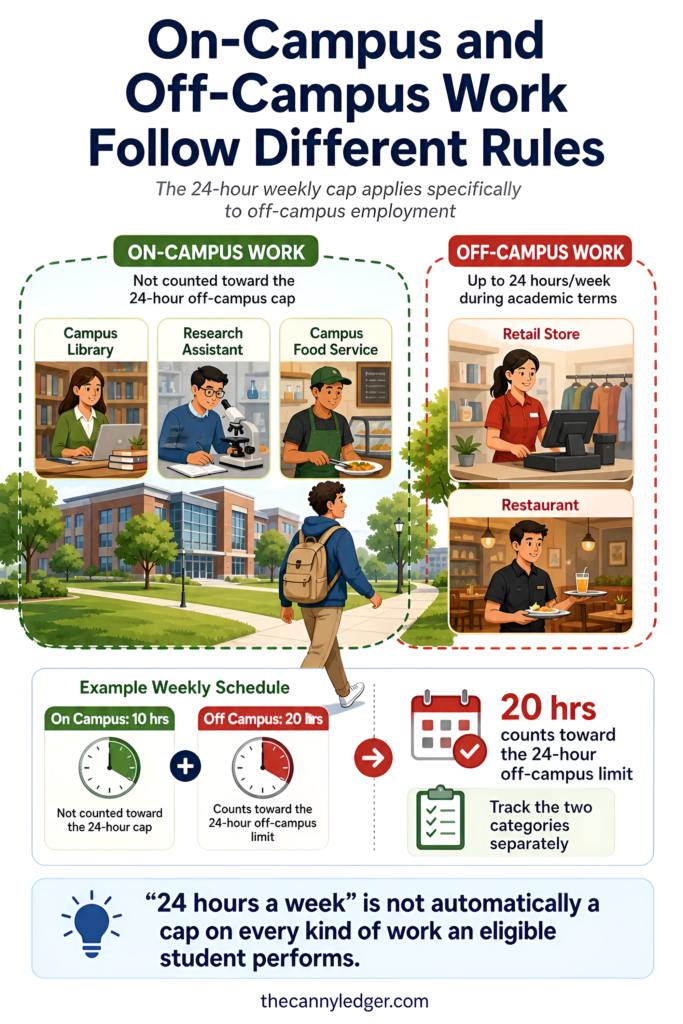
Work performed on the actual campus of the institution where a student is enrolled isn’t subject to the 24-hour off-campus cap at all. According to the University of Calgary’s own international student services office, a study permit carrying on-campus work authorization functions as its own work permit for that purpose, separate entirely from the off-campus conditions. A student working at the campus library, a research position with a professor, or a job through the school’s own food services isn’t counted against the weekly off-campus limit, which means a student juggling both an on-campus job and an off-campus one needs to track only the off-campus hours against the 24-hour ceiling, not the combined total across both. This distinction gets lost constantly in casual conversation about student work limits, since most people default to thinking of “24 hours a week” as a blanket cap on all work rather than a rule that specifically targets off-campus employment.
Scheduled Breaks Change the Math Entirely
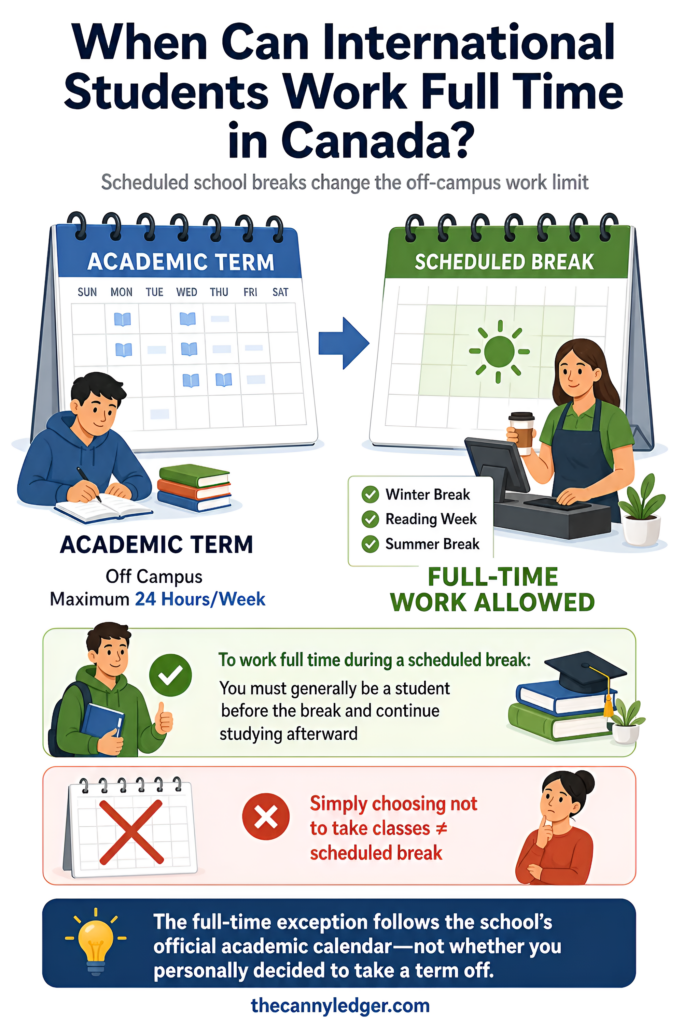
During a real scheduled break, winter holidays, a reading week, or the summer term for a student enrolled in the terms immediately before and after it, the 24-hour cap disappears completely and full-time work becomes legally available. This is where a lot of international students make up meaningful ground financially, working close to 40 hours a week during a summer break after being capped at 24 all winter and spring. The distinction that matters here is between an actual scheduled break built into the academic calendar and simply choosing not to take classes during a term, which doesn’t qualify for the same full-time work allowance no matter how it feels from the student’s own perspective.
The Co-op Change That Just Took Effect
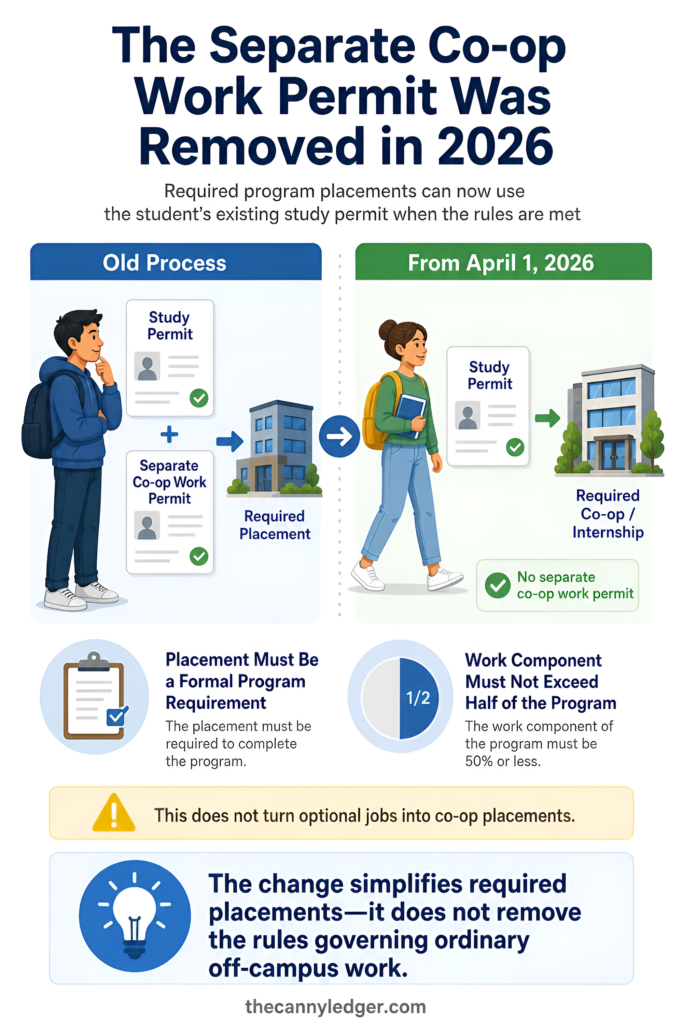
Anyone who researched this topic even a year ago is working from an outdated picture, since one significant piece of it has since changed. Effective April 1, 2026, a major regulatory simplification eliminated the separate co-op work permit that international students previously needed for mandatory work placements built into their program. Students in a program with a required co-op term or internship can now complete that placement under their existing study permit alone, provided the placement is an actual, formal requirement of the program and doesn’t exceed half the program’s total length. Before this change, a separate application, with its own processing time and fee, stood between a student and a placement their own program required them to complete, which made an already tight academic timeline tighter still.
What Actually Happens If You Go Over
Going over the 24-hour weekly limit isn’t a minor administrative slip, and treating it as one is a real mistake. Immigration law guidance on this exact risk confirms IRCC treats exceeding authorized work hours as a breach of study permit conditions, with consequences that can include loss of student status, refusal of future study or work permit applications, and removal from Canada. This isn’t a theoretical risk tucked into fine print either, since a violation from years earlier can surface later during a post-graduation work permit application or a permanent residence application, well after the specific extra shift that caused it has been forgotten.
This is exactly the kind of consequence that’s easy to underestimate in the moment, since working an extra few hours during a busy week feels harmless when it happens and only becomes a real problem much later, at a point where fixing it is far harder than avoiding it would have been. Tracking hours honestly against the 24-hour line, especially when working more than one job, is worth the minor inconvenience compared to the alternative.
Doing the Actual Math
Take Manitoba’s current general minimum wage of $16.00 an hour, the rate that applies here in Winnipeg with no international student discount attached to it. Twenty-four hours a week at that rate works out to $384 before deductions, and close to $1,660 a month if the hours stay consistent across four weeks. During a scheduled break with full-time hours available, that same $16.00 rate at 40 hours a week climbs to $640 weekly, nearly double the term-time ceiling. That gap between term-time and break-time earning potential is worth building directly into a budget rather than assuming income stays flat year-round, since for most international students it doesn’t, whether that budget is covering student housing in Winnipeg, transit costs, or day-to-day expenses while searching for the right student job.
Questions Students Ask Once the Basics Click
Does working for a foreign company remotely while physically in Canada count against the 24-hour limit? This is a real edge case in current immigration guidance, and the honest answer is to confirm directly with an immigration professional or IRCC before assuming either way, since getting this wrong carries the same consequences as any other hours violation.
If my study permit still says 20 hours because it was issued before the change to 24, which number applies to me? The current 24-hour limit applies regardless of what an older permit physically states, according to the government’s own guidance, since the policy change applies to the underlying authorization rather than requiring every existing permit to be reprinted.
Can I switch from working two off-campus jobs to one without any paperwork? Yes, changing which off-campus employer you work for doesn’t require a new permit or IRCC approval, as long as your total off-campus hours across whatever combination of jobs you hold still stays within the 24-hour weekly cap.