



A 17-year-old library page in Ontario got called into the head librarian’s office one week into the job and told her pay was dropping from $4 an hour to $3.15, an administrative correction, she was informed, since she’d been paid the adult rate by mistake. That happened in the late 1980s, and it led to a Charter of Rights and Freedoms challenge that almost eliminated Ontario’s two-tier minimum wage system entirely, decades before the rate structure that still exists today. The lawsuit got dropped only because the incoming government promised to scrap the system on its own. It never fully did.
- The Two Provinces Still Doing It
- Why Quebec and Manitoba Killed Theirs Decades Ago
- Nova Scotia’s Slower Path to the Same Conclusion
- What “Student” Actually Means Here
- The Hour-Counting Trap
- The Argument on Both Sides
- Where This Leaves a Student Actually Applying for a Job
- Questions That Tend to Come Up Next
Yes, a student minimum wage still exists in Canada, but only in two provinces. Alberta pays students under 18 a lower rate for limited weekly hours, and Ontario does the same. Every other province and territory pays students the identical general minimum wage paid to adult workers, with no separate lower rate at all. That’s a narrow answer for a question that sounds like it should apply nationwide, and the history behind why most of the country abandoned the idea is more interesting than the current rate itself.
The Two Provinces Still Doing It
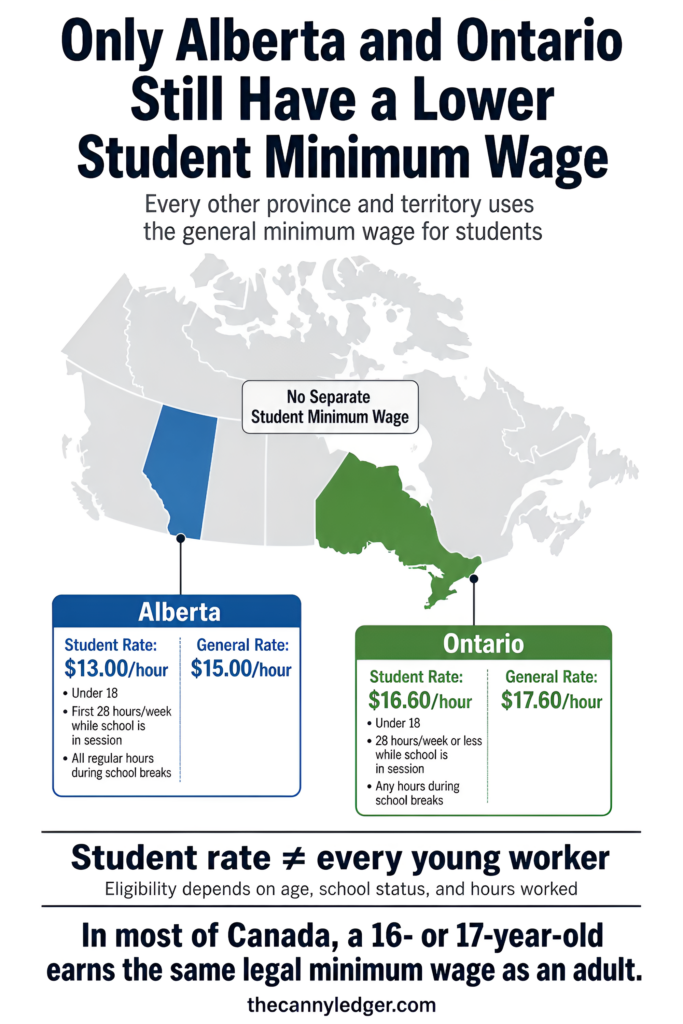
Alberta and Ontario are the only jurisdictions left in Canada running a distinct lower wage specifically for students. According to Alberta’s own employment standards page, the province’s job creation student wage pays $13.00 an hour to students under 18, but only for the first 28 hours worked in a week while school is in session. Cross that 28-hour line in a single week and every hour beyond it must be paid at the full $15.00 general rate. During school holidays, Christmas break, spring break, summer vacation, the $13.00 rate applies to all regular hours worked, with no 28-hour cap at all.
Ontario runs a similar structure at a different price point. Ontario’s own Employment Standards Act guide confirms the student rate applies to workers under 18 who work 28 hours a week or less while school is in session, or any hours at all during a school break. That rate currently sits at $16.60 an hour, against a general minimum wage of $17.60, a gap of exactly one dollar that’s held fairly steady as both figures have climbed together over the past several years.
Why Quebec and Manitoba Killed Theirs Decades Ago
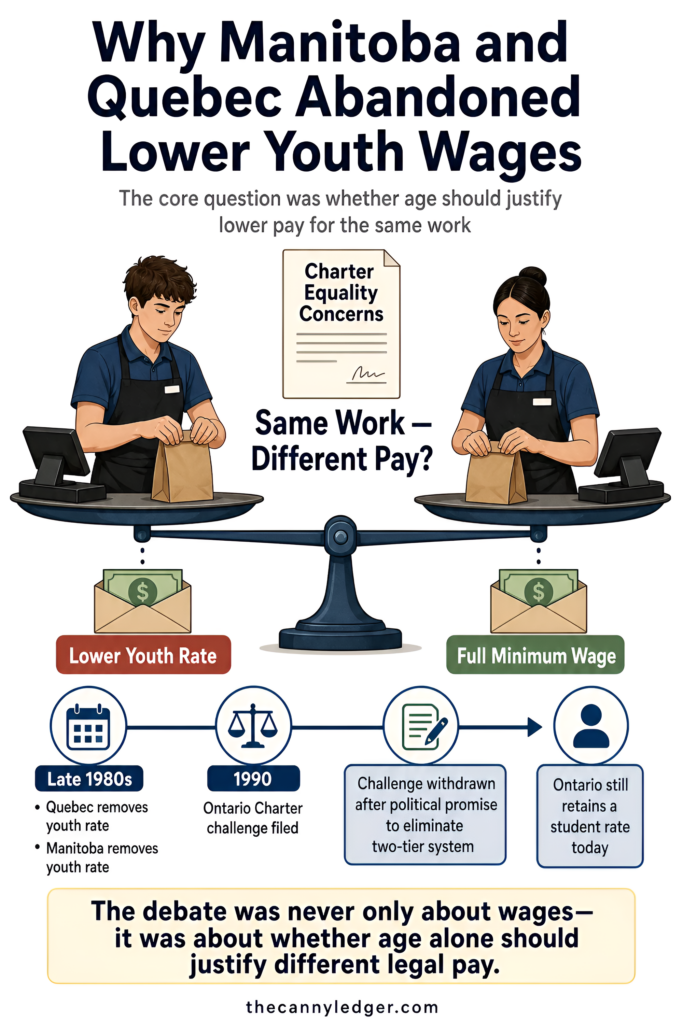
The two-tier system Alberta and Ontario still run today used to be closer to the national norm than the exception, a shift worth situating against the broader history of minimum wage in Canada rather than treating in isolation. Quebec and Manitoba eliminated their own student and youth minimum wages back in the late 1980s, and the reasoning behind it is worth understanding directly rather than treating as ancient history. According to an account published by The Conversation from someone who lived through the Ontario version of this fight, both provinces acted specifically over concerns that paying a young worker less for identical work violated the equality guarantees in Canada’s Charter of Rights and Freedoms, since age was being used as the deciding factor rather than the actual work performed.
Ontario came close to following the same path. A Charter challenge was filed against the province’s own two-tier system in April 1990, only to be dropped when the incoming NDP government won that fall’s election on a platform that explicitly promised to eliminate the two-tier structure entirely. The promise showed up in the government’s first speech from the throne. The court challenge was withdrawn on the strength of that commitment. Decades later, Ontario still runs a version of the system the government once pledged to scrap, which is exactly the kind of detail a straight government wage-rate page will never volunteer on its own.
Nova Scotia’s Slower Path to the Same Conclusion
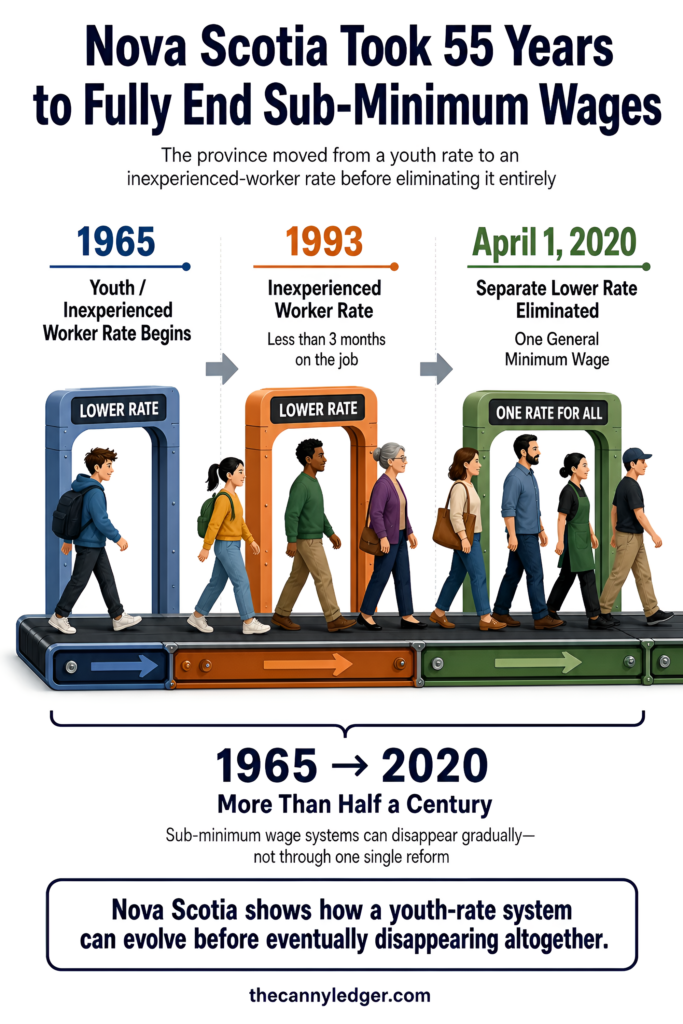
Nova Scotia took a different route to a similar destination, and its timeline shows how gradually these systems can unwind rather than end in one clean policy reversal. Nova Scotia first introduced a separate youth and inexperienced worker wage back in 1965, restructured it in 1972 into a province-wide two-tier system split by age, and eventually replaced the youth-specific version in 1993 with a rate for “inexperienced workers” instead, defined as anyone with less than three months on the job regardless of age. According to research on the province’s wage history, that inexperienced-worker rate itself wasn’t fully eliminated until April 1, 2020, meaning Nova Scotia carried some form of sub-minimum wage in one shape or another for well over half a century before landing on a single rate for everyone.
That history matters because it shows the current landscape isn’t the product of one national policy debate that resolved itself cleanly. It’s the accumulated result of several separate provincial decisions made decades apart, for overlapping but distinct reasons, which is exactly why Alberta and Ontario’s continued use of the concept looks increasingly unusual next to everywhere else rather than standard practice most provinces simply haven’t gotten around to changing.
What “Student” Actually Means Here
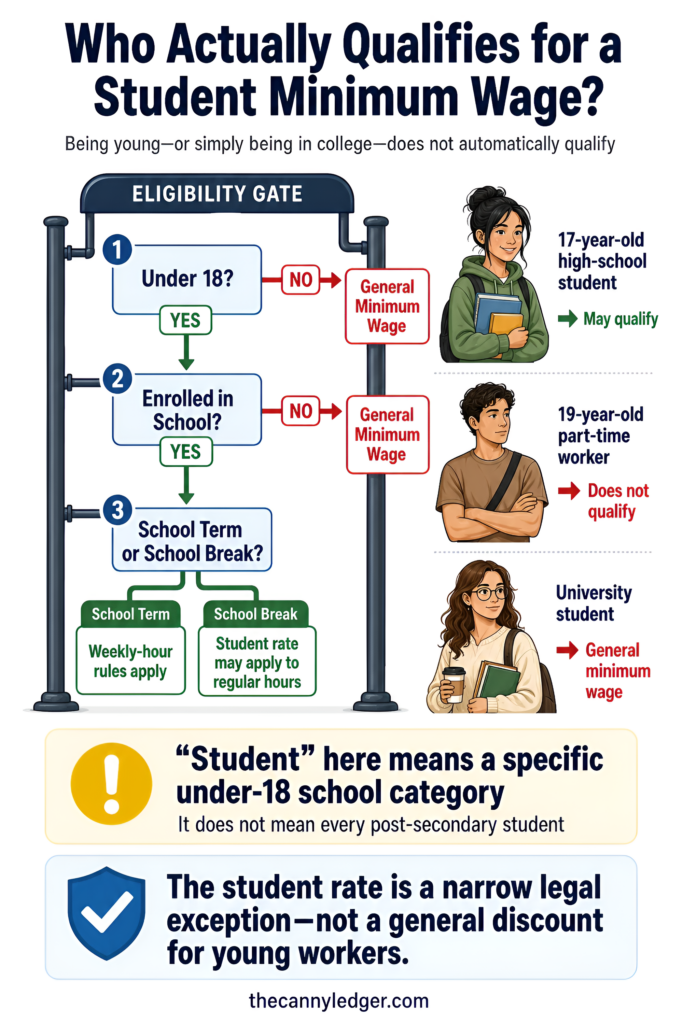
This is the detail that trips up both employers and workers constantly, and it’s worth being precise about since getting it wrong in either direction has real consequences. Historical overviews of Canadian minimum wage policy confirm that sub-minimum categories like this have always been narrower carve-outs rather than a general “youth discount,” tied to specific, defined circumstances rather than age on its own. Neither Alberta nor Ontario’s student rate applies simply because a worker is young. Both provinces tie the lower rate specifically to being under 18 and enrolled in school, not to age alone and not to post-secondary status. A college or university student, of any age, gets the full general minimum wage in both provinces, since the student rate in both jurisdictions is built around the K-12 school schedule, not the broader concept of being a student in any educational program.
An employer assuming any teenage hire automatically qualifies for the lower rate is making a mistake that can produce real back-pay liability once caught. A 19-year-old still living at home and working part-time doesn’t qualify for either province’s student rate no matter how junior the role looks on paper, since the age cutoff is a hard line rather than a general vibe about who counts as young.
The Hour-Counting Trap
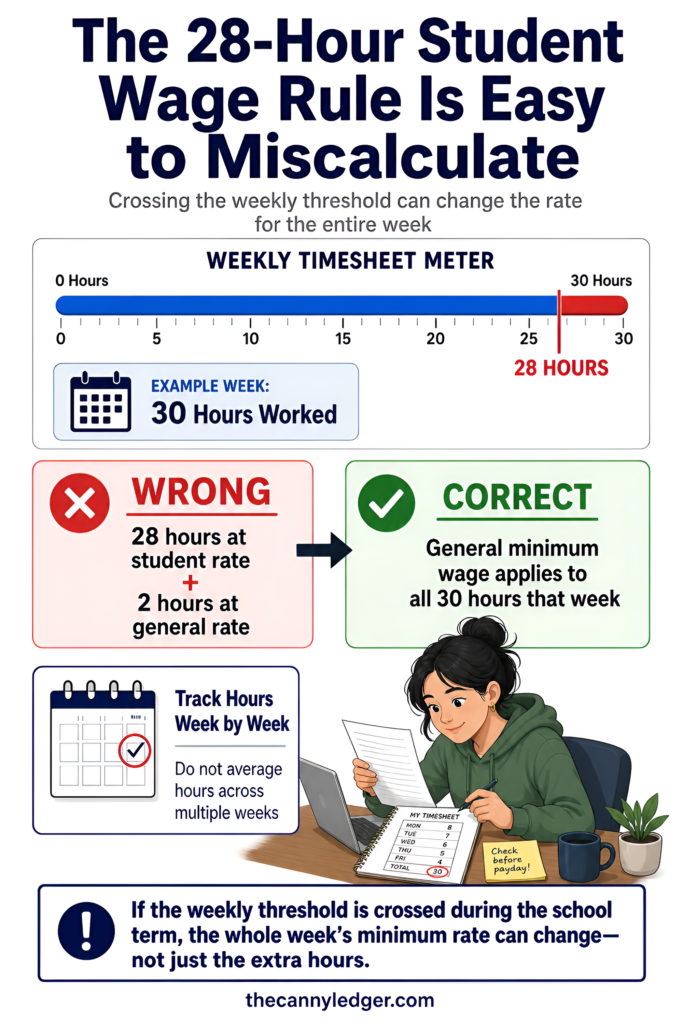
The 28-hour threshold in both provinces creates a specific payroll trap that catches employers who don’t track it carefully week by week rather than averaging it out. A student who works 30 hours in a single week during the school term isn’t paid the student rate for 28 hours and the general rate for two, the way some employers mistakenly calculate it. Once the weekly total crosses 28 hours, the general minimum wage applies to every hour worked in that specific week, not just the hours past the threshold. Getting this backwards is one of the more common wage complaints filed against employers in both provinces, since it looks like a reasonable way to prorate the difference and simply isn’t how either province’s rule actually works.
The Argument on Both Sides
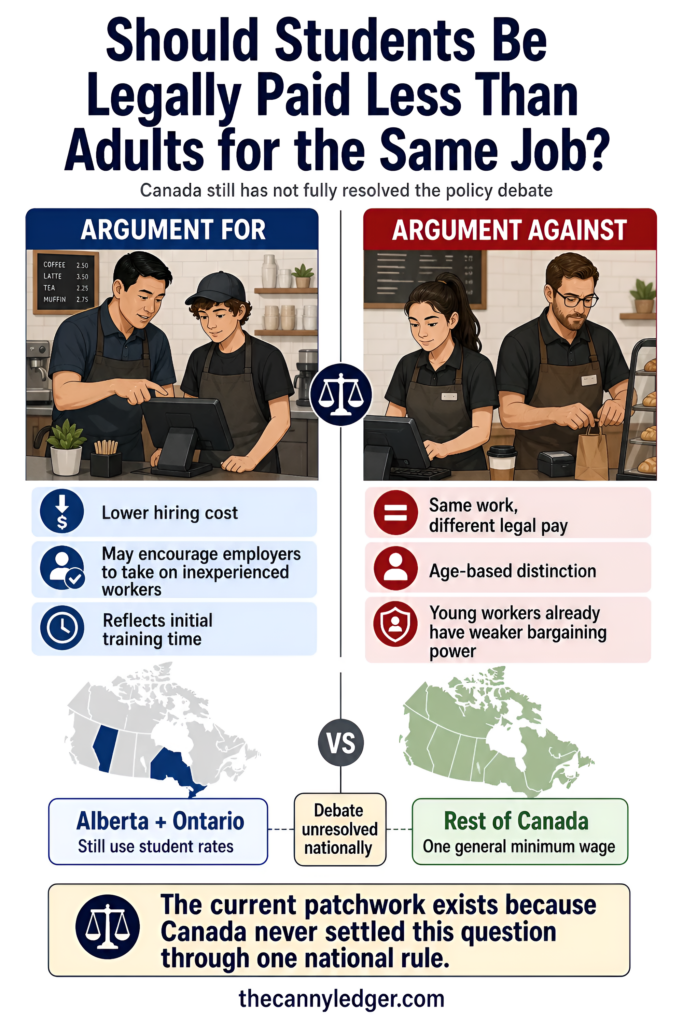
The case for keeping a student rate rests on the idea that it lowers the cost of hiring truly inexperienced workers, making employers more willing to take a chance on a 16-year-old with no work history than they might be at the full adult rate, and that the lower pay reflects training time and lower initial productivity rather than the value of the work itself once a student is fully up to speed. The case against it, the one that drove the Charter challenges and the eliminations in Quebec, Manitoba, and eventually Nova Scotia, holds that paying a worker less purely because of their age for identical work is age discrimination in substance even when it’s framed as a training incentive, and that an inexperienced worker of any age already earns less in practice through fewer hours, slower promotion, and weaker negotiating position without needing a separate legal wage tier to enforce the gap. Both positions have shaped real policy in this country, and the current patchwork, two provinces still running it, everywhere else having walked away, reflects that disagreement never fully resolving nationally rather than one side clearly winning.
Where This Leaves a Student Actually Applying for a Job
A student under 18 applying for a first job in Alberta or Ontario specifically should ask directly which rate applies before assuming, since the answer depends on enrollment status and specific weekly hours, not age alone. Track your own hours weekly if you’re close to the 28-hour line during the school term, since that’s the exact spot where payroll errors happen most often, and catching it yourself is faster than waiting for an employer to notice. Everywhere else in Canada, a first job at 16 or 17 pays the identical rate an adult in the same role earns, which is worth knowing before assuming a lower “youth rate” applies somewhere it legally doesn’t. Anyone weighing student job options in Winnipeg specifically, or a part-time position more broadly, can count on Manitoba’s general minimum wage as exactly what they’re entitled to regardless of age, with no separate student tier to account for at all.
Questions That Tend to Come Up Next
Does the student rate apply to international students in Canada? The age and enrollment mechanics work the same way regardless of citizenship or study permit status in the two provinces that have a student rate, though international students face a separate set of work-hour rules tied to their study permit that have nothing to do with minimum wage itself. Beyond wage rules, students juggling coursework and part-time work may also want to look at student aid options in Manitoba or general student discounts around Winnipeg to stretch a minimum-wage income further.
Can an employer pay a 17-year-old the student rate even if they’ve already graduated high school? No. Both provinces tie the lower rate to being enrolled in school, not simply to being under 18. A 17-year-old who’s finished high school and isn’t currently enrolled doesn’t qualify for either province’s student rate and must receive the general minimum wage.
Is there a push to eliminate Alberta’s or Ontario’s student rate right now? Labour advocates and some policy commentators continue to raise the same discrimination argument that drove Quebec and Manitoba’s decisions decades ago, but neither province has an active legislative process underway to eliminate its student rate as of this writing.