

Ask around, or scan a few other roundups, and you’ll get the same answer every time: North End is the cheapest place to rent in Winnipeg, full stop. That reputation is real, but the actual tracked numbers tell a messier story. Over just the past few months, the title of “cheapest neighborhood” has bounced between St. Boniface, downtown, and North End itself, sometimes swinging by close to a hundred dollars a month in either direction. Treating any single neighborhood as a permanently fixed budget winner means missing what the market is actually doing right now.
- Why “Cheapest Neighborhood” Isn’t a Fixed List
- The Six Areas Winnipeg’s Rent Data Actually Tracks
- What Each Budget-Friendly Area Is Actually Like
- Three Months of Real Numbers, Side by Side
- Downtown Isn’t What You Think
- Where the Savings Cost You Something Else
- How to Actually Use This Data When You’re Searching
- Common Questions About Winnipeg’s Cheapest Neighborhoods
As of March 2026, downtown Winnipeg holds the title for the cheapest average unfurnished one-bedroom, at $1,252 a month. That’s not a fixed ranking though. St. Boniface held the same title as recently as December 2025, and North End, often assumed to be the default cheap option, has actually been climbing faster than almost anywhere else in the city.
Why “Cheapest Neighborhood” Isn’t a Fixed List
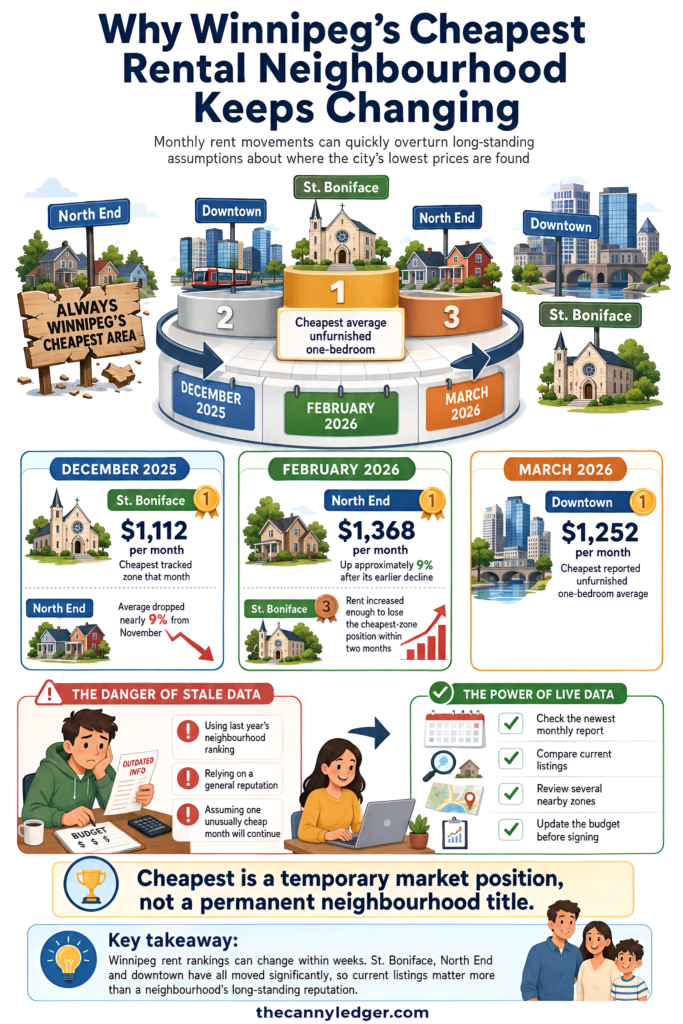
Winnipeg’s rental market gets tracked monthly across six broad zones, downtown, North End, East Winnipeg, West Winnipeg, South Winnipeg, and St. Boniface, and the rankings inside that list move constantly. Liv.rent’s monthly rent reports show unfurnished one-bedroom rents in North End dropping nearly 9% in December 2025, then climbing back up 9% by February 2026. St. Boniface swung the opposite direction, cheapest in December at $1,112 a month, then rising fast enough that it lost that title within two months.
The practical lesson: a neighborhood being cheap last year, or even last quarter, doesn’t guarantee it’s cheap right now. Anyone budgeting around a specific area’s reputation instead of checking current listings risks planning around a number that’s already gone stale.
The Six Areas Winnipeg’s Rent Data Actually Tracks
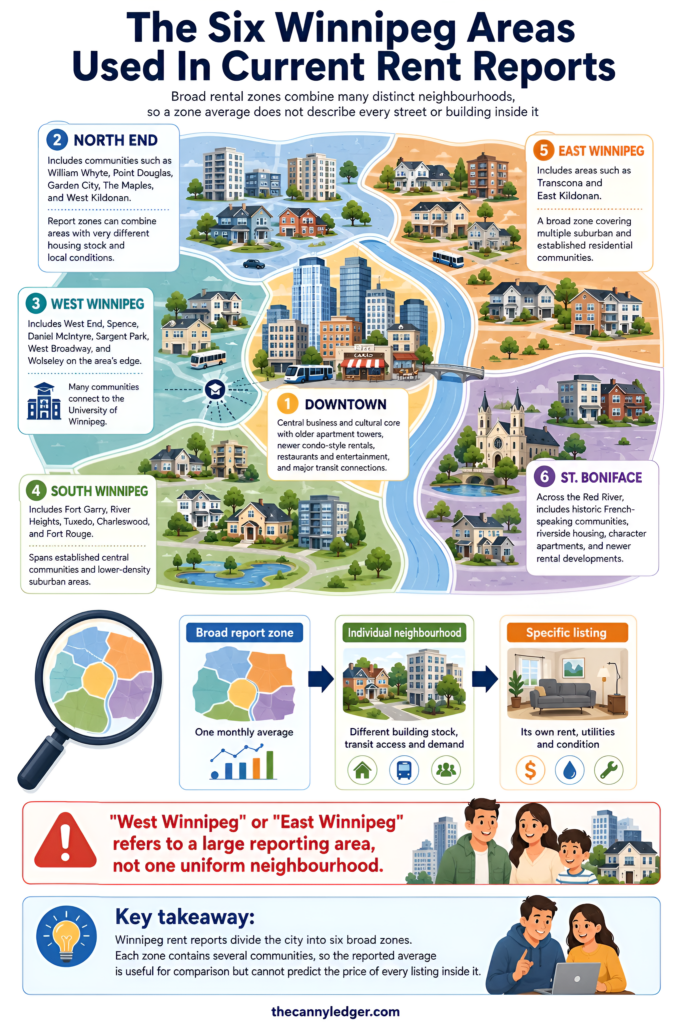
Before diving into specific neighborhoods, it helps to know how the city actually breaks down geographically. Winnipeg splits roughly into a northwest cluster (North End, West End, Wolseley, Garden City, The Maples, West Kildonan), a southwest cluster (Fort Garry, River Heights, Tuxedo, Charleswood, Fort Rouge), a northeast cluster (Transcona, East Kildonan), and a southeast cluster centered on St. Boniface and the historically French-speaking communities across the Red River, alongside downtown sitting at the geographic and cultural core. The rent-tracking zones used in most current reports roughly follow this same shape, which is why “West Winnipeg” and “East Winnipeg” cover a lot of ground rather than a single tight neighborhood.
What Each Budget-Friendly Area Is Actually Like
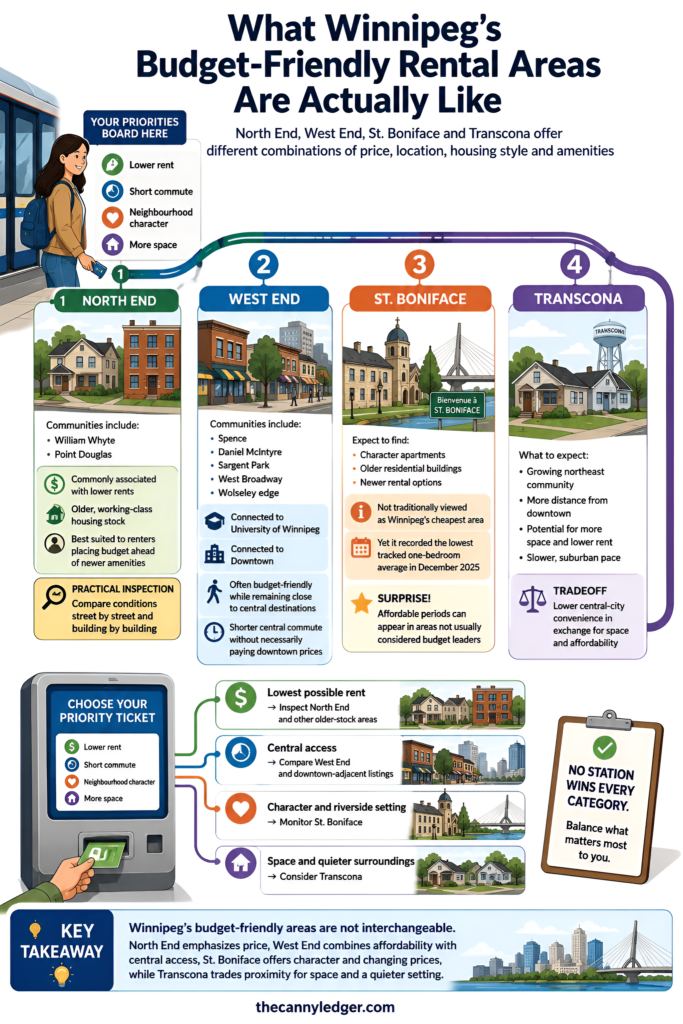
North End consistently gets described, including by liv.rent’s own neighborhood guide, as one of the more affordable parts of the city, best suited to renters prioritizing budget over amenities. It covers well-known communities like William Whyte and Point Douglas, both older, working-class areas with a mix of houses and smaller apartment buildings. West End gets a similar label, described as diverse and budget-friendly with rent that stays relatively low while keeping a short trip into downtown. It includes Spence, Daniel McIntyre, Sargent Park, and West Broadway, plus Wolseley on its edge, all walkable to the University of Winnipeg without downtown’s price tag.
St. Boniface sits in a different category entirely, a historic, French-speaking community with riverside views and a mix of character apartments and newer rentals. It isn’t the cheapest area by reputation the way North End or West End are, which makes its December 2025 run as the city’s cheapest tracked zone a genuine surprise rather than an expected result. Transcona, further out in the city’s northeast, gets described as a growing suburban area with more affordable rent and a quieter pace, a reasonable option for anyone willing to trade proximity to downtown for lower cost and more space.
Three Months of Real Numbers, Side by Side
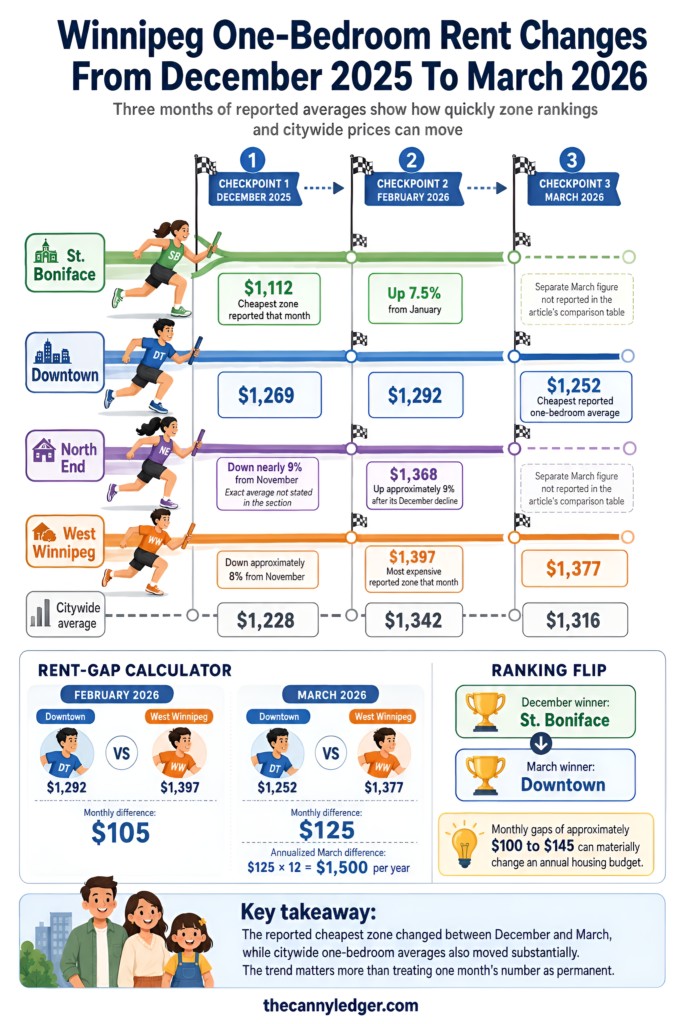
Average unfurnished one-bedroom rent by zone, tracked from December 2025 through March 2026:
| Zone | December 2025 | February 2026 | March 2026 |
|---|---|---|---|
| Downtown | $1,269 | $1,292 | $1,252 |
| North End | dropped ~9% from Nov. | $1,368 | not separately reported |
| St. Boniface | $1,112 (cheapest that month) | up 7.5% from Jan. | not separately reported |
| West Winnipeg | down ~8% from Nov. | $1,397 (priciest that month) | $1,377 |
| Citywide average | $1,228 | $1,342 | $1,316 |
The gaps here matter more than any single number. Downtown and West Winnipeg sat about $125 to $145 apart depending on the month, real money over a full year, but the ranking of which zone actually held the “cheapest” spot moved twice in that same stretch. West Winnipeg, worth noting directly, was consistently at or near the most expensive end of the range across all three months, so despite the name suggesting a wide swath of the city, it isn’t where the budget deals cluster.
Downtown Isn’t What You Think
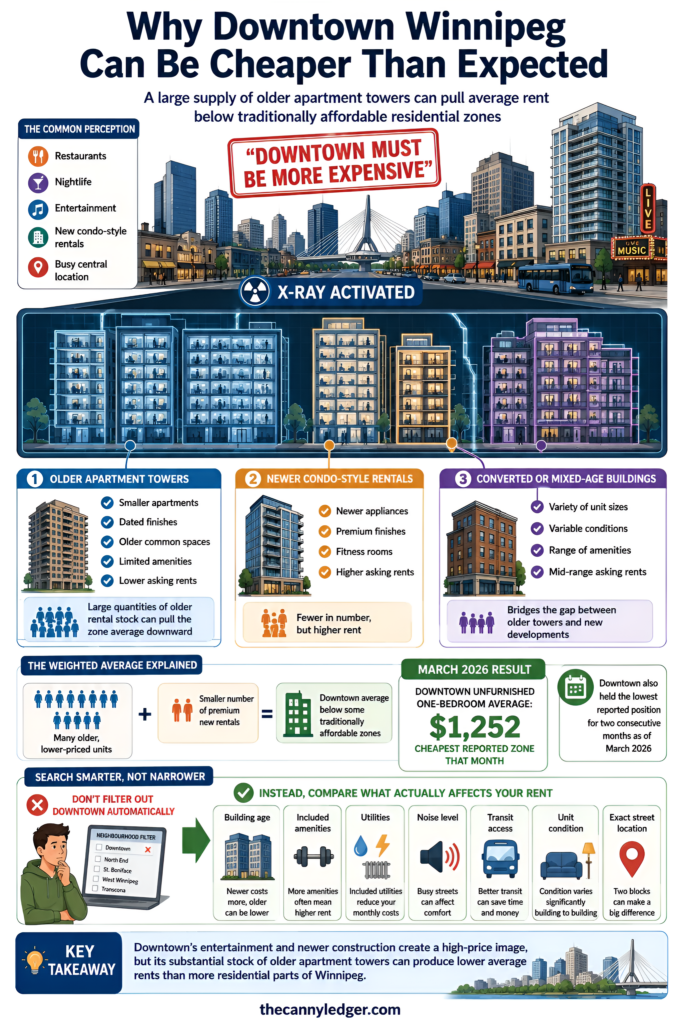
Downtown Winnipeg has a reputation for nightlife, restaurants, and a busier, pricier feel than the residential neighborhoods surrounding it, so it’s a genuine surprise that it’s held the cheapest unfurnished one-bedroom average for two months running as of March 2026. Part of the explanation is likely building stock: downtown has a large supply of older apartment towers alongside newer condo-style rentals, and that older inventory pulls the average down even as newer units command higher prices. Anyone ruling out downtown purely on reputation is skipping a zone that’s currently pricing below more residential, traditionally “affordable” parts of the city.
Where the Savings Cost You Something Else
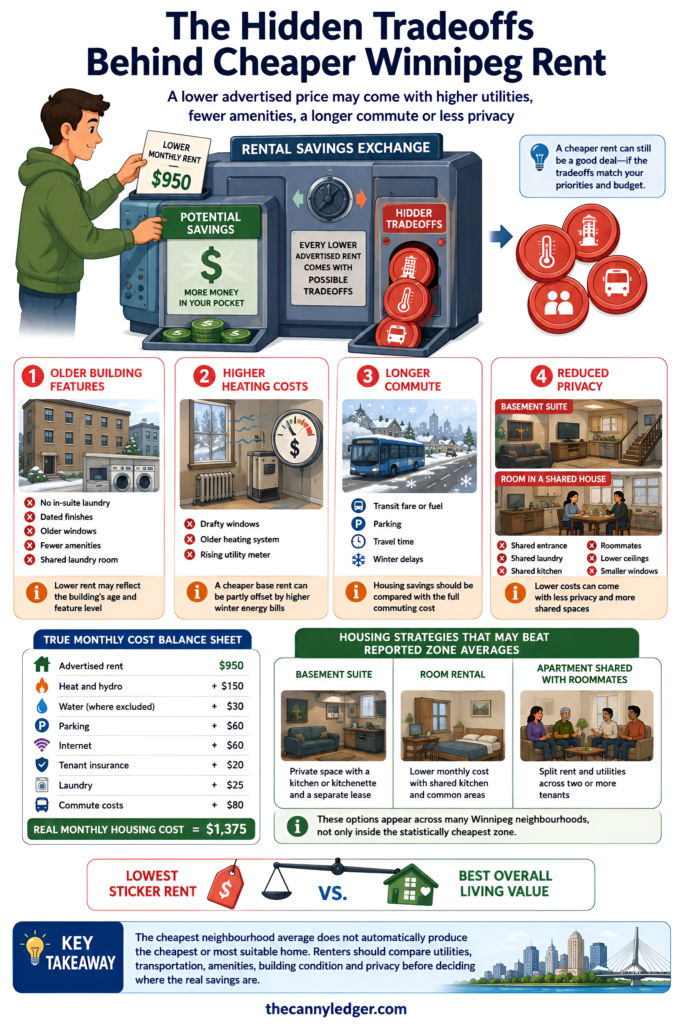
None of these zone averages capture everything that goes into an actual monthly cost. A cheaper zone with an older building often means no in-suite laundry, higher heating bills in an under-insulated unit, or a longer commute if your job or school isn’t nearby. If squeezing under a strict number matters more than the neighborhood itself, a basement suite or a room in a shared house can beat any of these zone averages regardless of which part of the city you’re in, since both options exist across nearly every neighborhood on this list. The full picture of what’s realistically available under a specific budget ceiling, and where the tradeoffs show up, is covered in Winnipeg apartments under $1,000 a month.
How to Actually Use This Data When You’re Searching
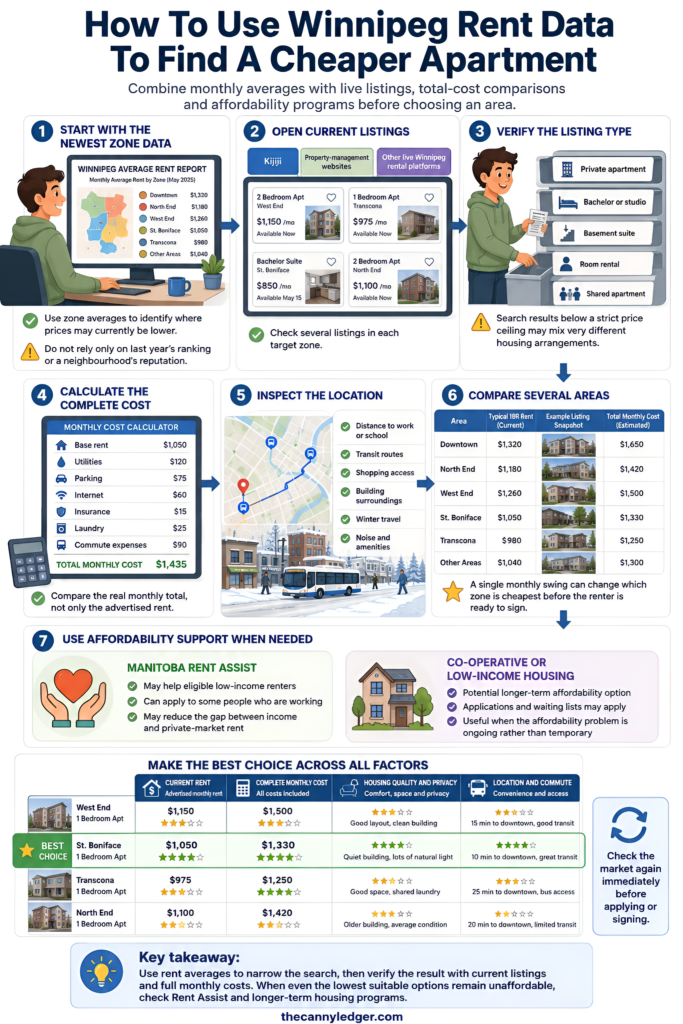
Treat every number on this page as a starting point, not a guarantee. Before committing to a neighborhood based on its reputation or last month’s average, check current listings directly, since a single month’s swing can flip which zone is actually cheapest by the time you’re ready to sign a lease. Kijiji remains one of the most complete sources for live Winnipeg listings across every zone, and cross-checking a handful of current posts in your target area takes a few minutes and beats budgeting around a stat that’s already a month or two old.
If a strict rent ceiling makes even the cheapest zones a stretch, check whether Rent Assist closes the gap before assuming a longer commute or a shared living situation is the only option, and look into co-op and other low-income housing programs for a longer-term fix rather than a month-to-month budget squeeze.
Common Questions About Winnipeg’s Cheapest Neighborhoods
Why do different rental sites list different neighborhoods as “most affordable”? Different platforms track different slices of the market. Some pull from purpose-built apartment listings only, others include basement suites, condos, and houses in the same average, and some rank narrow, specifically-named neighborhoods rather than the broader zones used in most rent reports. Two sites can both be accurate and still disagree, simply because they’re measuring different things.
Is St. Boniface only for French speakers? No. St. Boniface is historically French-speaking and remains a cultural hub for Franco-Manitobans, but it’s a fully bilingual community open to any renter, with the same lease terms and tenant protections as anywhere else in the city.
Do these zone averages match Canada Mortgage and Housing Corporation’s official rental data? Not exactly, and the difference is worth knowing. CMHC’s rental market survey covers only purpose-built rental apartments and tends to run lower, since it includes long-term tenants who haven’t seen a rent increase in years. Listing-based averages like the ones in this guide reflect what’s actively advertised right now, which usually runs closer to what a new renter will actually be quoted.
The neighborhood that’s cheapest this month won’t necessarily hold that title by the time you’re ready to move, so use this guide as a map of where to start looking rather than a final verdict, and confirm the current numbers for your shortlist before signing anything.