
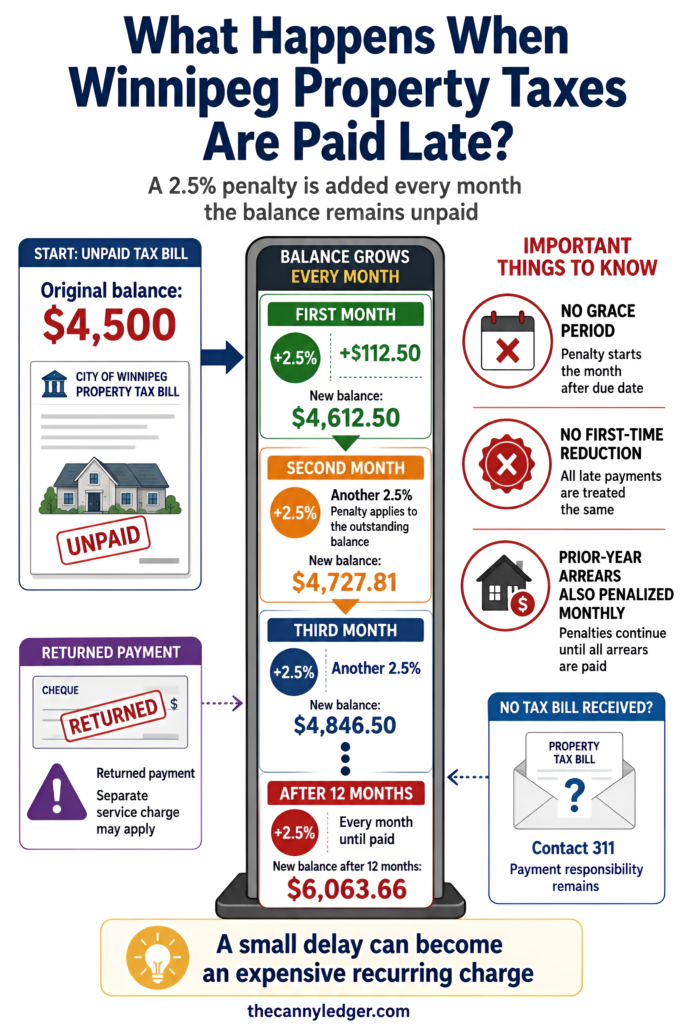
A $4,500 property tax bill left unpaid past the deadline picks up $112.50 in penalties by the first of the following month, then another $112.50 on top of that the month after, compounding as the balance grows. There’s no grace period, no warning call, no reduced rate for a first-time miss. The City of Winnipeg applies a flat 2.5 percent monthly penalty starting the day after the deadline passes, and it keeps applying every month the balance sits unpaid. Knowing exactly when the deadline lands and which payment method actually gets there on time matters more than most homeowners realize until the first penalty shows up on their account.
- The 2026 Deadline, and Why It Rarely Moves
- Every Way to Actually Pay
- TIPP: Skip the June 30 Deadline Entirely
- Paying Early Gets You an Actual Discount
- What Actually Happens If You Miss the Deadline
- The Two-Year Point of No Return
- Special Situations Worth Knowing About
- Common Questions About Paying Winnipeg Property Tax
Direct answer: Winnipeg’s 2026 property tax deadline is June 30, and payment can be made online or by phone through your bank, in person at one of two City locations, by mail, through a third-party credit card processor, or automatically every month through the Tax Instalment Payment Plan (TIPP), which sidesteps the June 30 deadline entirely in exchange for a small administration fee.
The 2026 Deadline, and Why It Rarely Moves
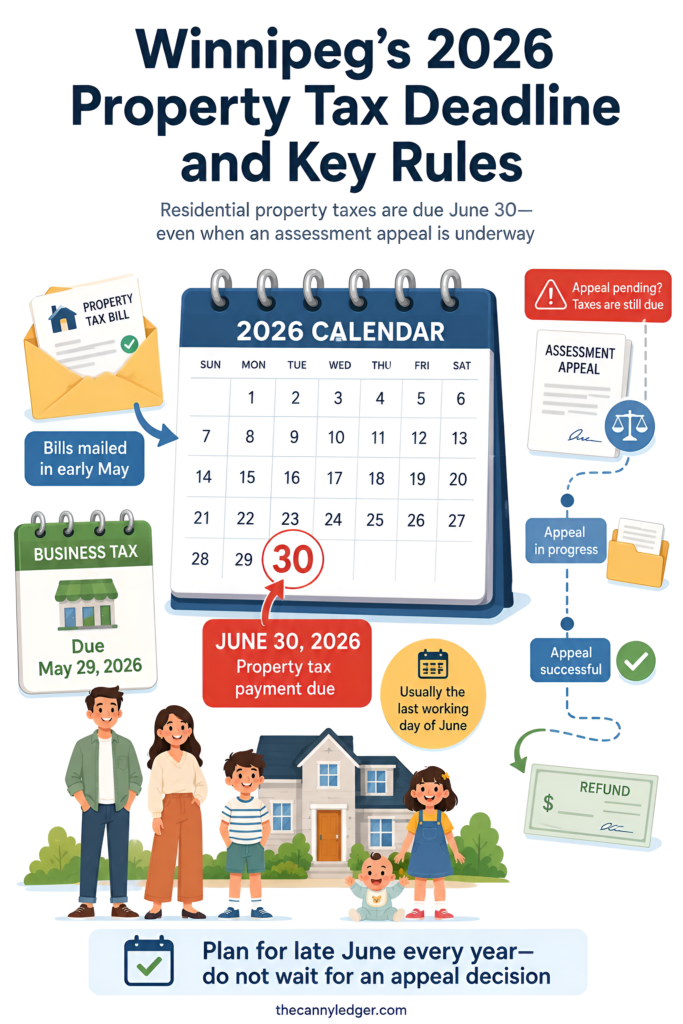
Property tax bills for 2026 were mailed to roughly 240,500 Winnipeg property owners in early May, and the payment deadline is June 30. This isn’t a one-off date specific to this year, either, property tax due dates in Winnipeg are consistently set as the last working day of June, year after year, which makes it reasonable to plan around late June as a standing annual deadline even before a specific bill arrives. Business taxes run on a separate, earlier schedule, due by May 29 for the 2026 tax year, so a property owner who also runs a business through the same address needs to track two different dates rather than assuming one deadline covers both.
Filing an appeal against your assessment doesn’t pause this deadline either. Property taxes are still due by June 30 regardless of whether a Board of Revision application is pending, since the tax obligation and the assessment dispute run on entirely separate tracks. Anyone expecting an assessment appeal to buy extra time on the payment itself should assume otherwise and pay on schedule, with any refund due coming later if the appeal succeeds.
Every Way to Actually Pay
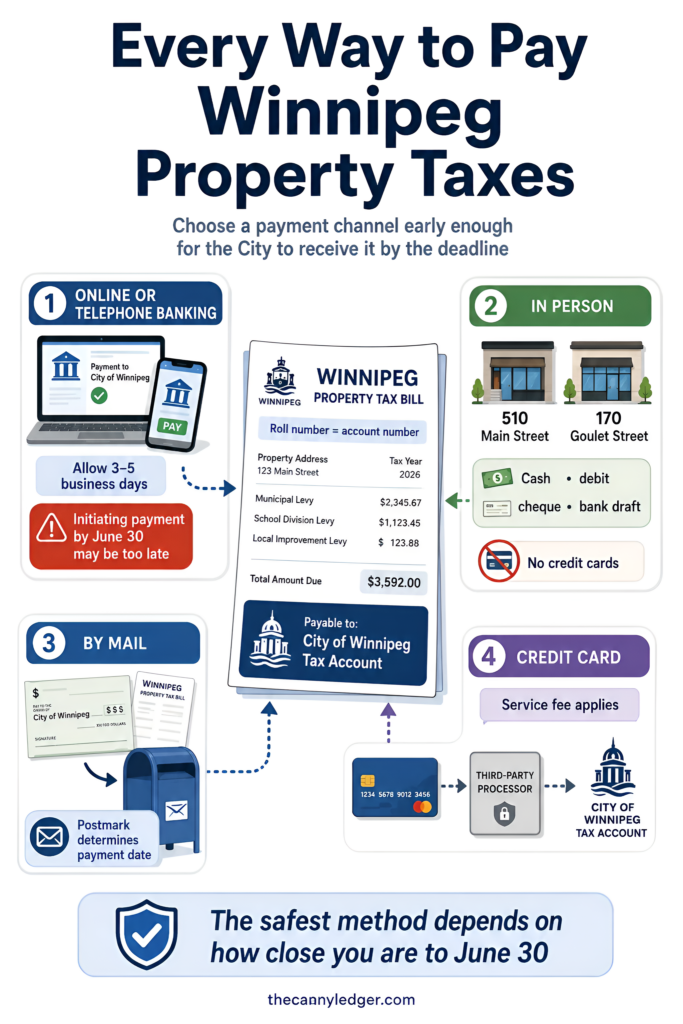
The City offers a genuinely wide range of payment channels, and which one makes sense depends mostly on timing and personal preference. Online or telephone banking through your own financial institution works the same way as paying any other bill, search for “City of Winnipeg” as a payee and use your roll number as the account number, though it’s worth building in three to five business days of processing time before the deadline, since that’s how long a bank transfer typically takes to actually land and get credited. Paying too close to June 30 through online banking risks the payment posting after the deadline even though you initiated it before, which still triggers a penalty despite your intent being on time.
In-person payment is available at two locations: 510 Main Street and the Bilingual Service Centre at 170 Goulet Street, both accepting cash, debit, cheque, and bank draft. Credit cards are explicitly not accepted in person at either location, a detail that catches people off guard who assume any government office takes any major card. Bringing photo ID that matches your name and address, along with the physical tax bill itself, speeds up an in-person payment considerably.
Mailing a cheque or money order remains a valid option, sent to the Assessment and Taxation Department at 510 Main Street along with the bottom stub of the tax bill. The postmark date on the envelope, not the date the City actually opens and processes it, determines whether a mailed payment counted as on time, and postdated cheques are accepted as long as they’re dated on or before the due date itself.
For anyone who specifically wants to use a credit card, the City doesn’t accept one directly for property tax under any circumstance, but a third-party service provider, currently Plastiq, processes credit card payments on the City’s behalf for a service fee that stays entirely with the third-party provider rather than the City. This is worth factoring into the decision, since a credit card’s rewards or points earned on the payment need to outweigh that added fee to actually make financial sense compared to a fee-free payment method.
TIPP: Skip the June 30 Deadline Entirely
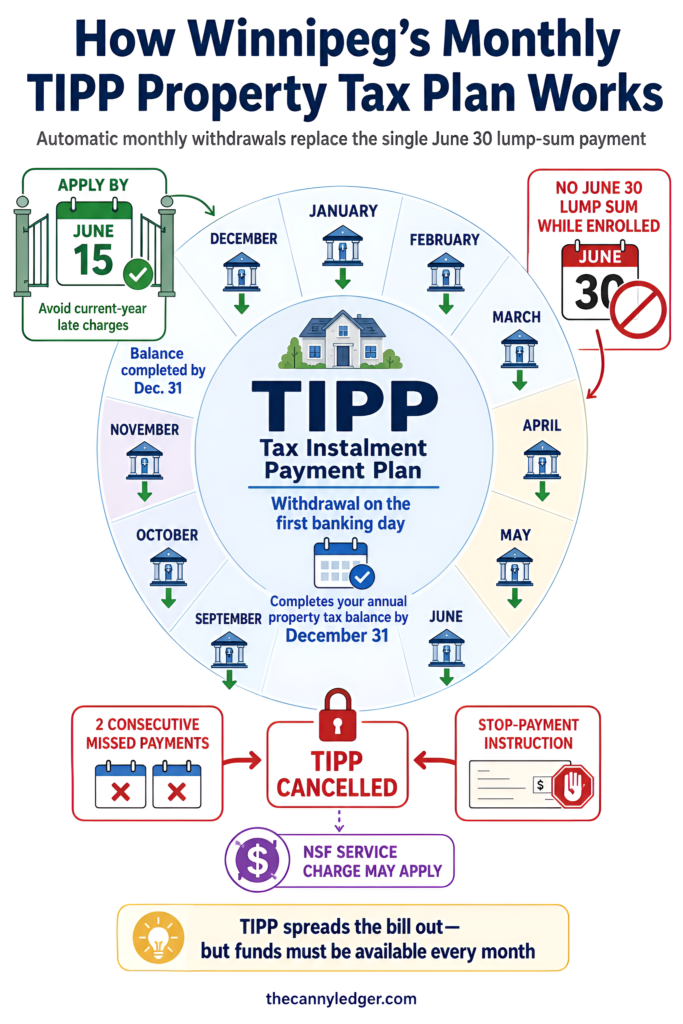
The Tax Instalment Payment Plan works differently from every method above, since enrolled property owners aren’t held to the June 30 deadline at all. Instead, monthly automatic withdrawals from a chequing account happen on the first banking day of each month, and the requirement is simply that the full year’s taxes are paid off by December 31 rather than in one lump sum by late June. New TIPP applications need to be received by June 15 to take effect without triggering late charges on the current year, and participants should watch for a message on their tax bill explaining how the July 1 payment adjusts once the year’s actual tax amount is confirmed.
TIPP isn’t a completely hands-off, worry-free system, though. Missing two consecutive monthly payments automatically cancels a property owner’s participation in the program, as does initiating a stop-payment through your bank, and rejoining after cancellation means starting over as a brand-new applicant rather than simply resuming. A payment returned for insufficient funds triggers a separate service charge on top of whatever was already owed, so TIPP still requires making sure the funds are actually there each month, not just enrolling once and forgetting about it entirely.
Paying Early Gets You an Actual Discount
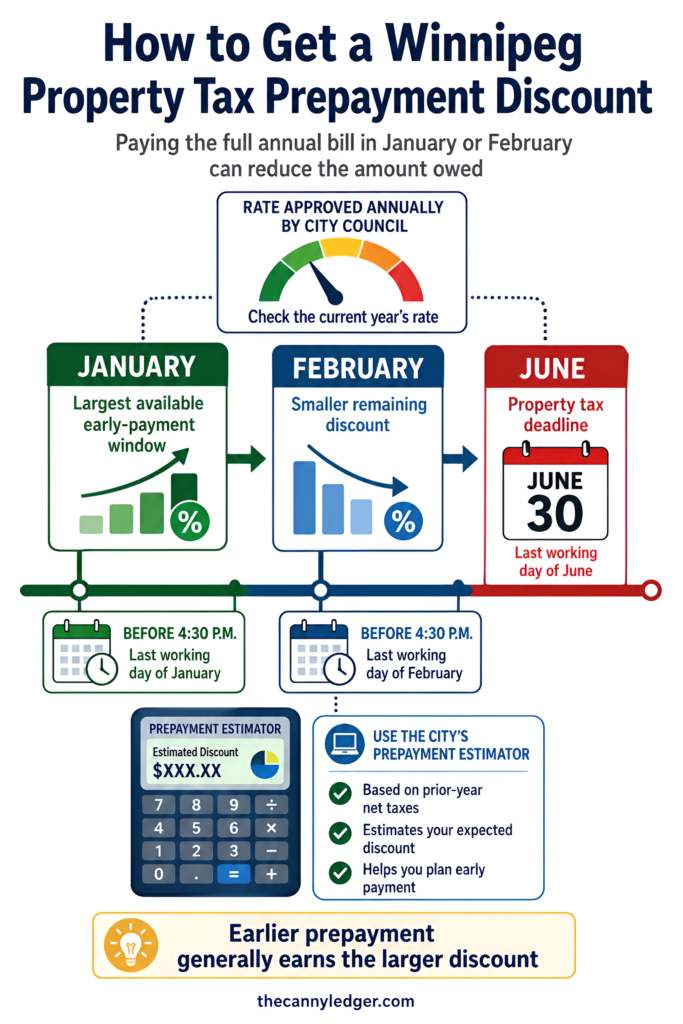
Fewer people know about this than probably should: the City offers a prepayment discount for property owners who pay their full year’s taxes in January or February, well before the June 30 deadline even applies. The discount rate itself isn’t fixed year to year, City Council approves a new rate each November or December for the following year based on prevailing market conditions, so the exact percentage varies and is worth checking fresh each year rather than assuming last year’s rate still applies. Prepayment can be made the same ways as a regular payment, electronic banking, in person, or by mail, but the payment has to actually arrive at the Assessment and Taxation Department before 4:30 p.m. on the last working day of January or February to qualify, and the discount shrinks the later within that window the payment lands. The City’s own Prepayment Estimator tool calculates the specific discount available based on the prior year’s net taxes, worth running before deciding whether prepaying is worth the cash flow tradeoff of paying five or six months earlier than required.
What Actually Happens If You Miss the Deadline
Property taxes still unpaid after June 30 start accumulating a 2.5 percent penalty on the first of the following month, applied again on the first of every subsequent month the balance remains outstanding. This isn’t a one-time late fee, it’s a recurring monthly charge that keeps compounding against whatever’s still owed, which is why a balance left unpaid for several months can grow substantially beyond the original tax amount. Taxes carried over as arrears from a prior year face the same 2.5 percent monthly penalty structure, applied every month from January through December on whatever remains outstanding. A payment returned by your bank, whether a bounced cheque or a failed TIPP withdrawal, adds a separate service charge on top of any penalty already accruing, so a single NSF payment can end up costing more than just the missed payment itself.
Even not receiving a tax bill doesn’t provide any protection here. Property owners remain legally responsible for paying by the deadline whether or not a bill physically arrived in their mailbox, and anyone who hasn’t received their property tax bill by late May is expected to contact 311 proactively rather than wait and later claim they never got it.
The Two-Year Point of No Return
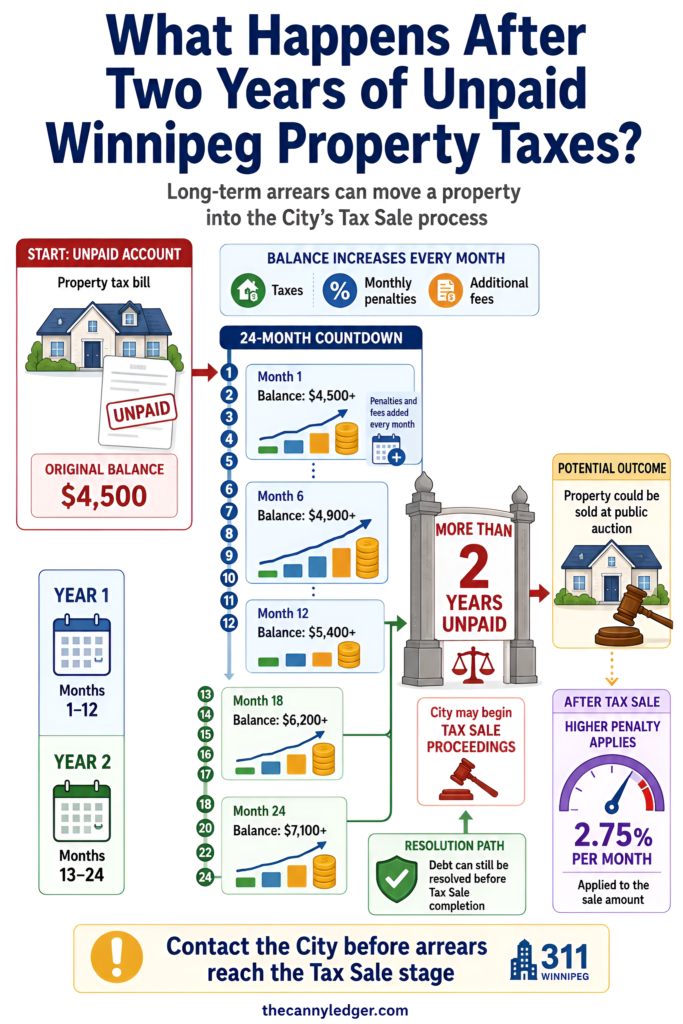
There’s a more serious consequence sitting behind the routine monthly penalties. If property taxes go unpaid for more than two years, the City gains the legal right to begin moving the property toward a Tax Sale, with taxes, penalties, and fees continuing to accumulate throughout that entire process. In practice, very few properties actually reach a completed sale, since most owners resolve the debt before it gets that far, and the properties that do end up sold tend to be ones where the total owed genuinely exceeds what the property itself is worth. Once a property has been sold through Tax Sale, a steeper 2.75 percent monthly penalty applies to the sale amount going forward, a full quarter point higher than the standard rate, which underscores how much more serious the situation becomes once it crosses that two-year line.
Special Situations Worth Knowing About
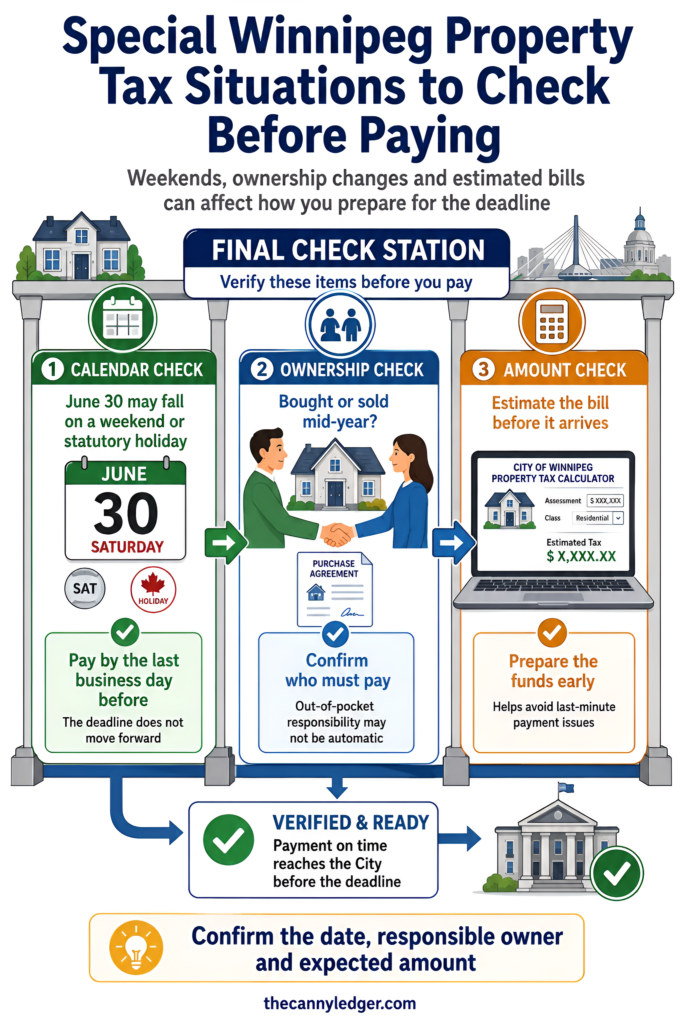
A few edge cases come up often enough to plan for directly. When June 30 lands on a weekend or a statutory holiday, the deadline itself doesn’t shift forward, payment still needs to arrive by the last business day before that date, not the actual calendar date. Anyone who’s sold a property mid-year, bought one, or otherwise had a change in ownership should confirm directly who’s actually responsible for that year’s tax bill rather than assuming it automatically transfers cleanly, since the City bills based on ownership as of specific dates rather than prorating automatically between buyer and seller in every case. And for anyone comparing this deadline against their own calculated tax estimate, running the actual numbers through Winnipeg’s property tax calculator before the bill even arrives avoids any surprise about how much needs to be ready by June 30.
Common Questions About Paying Winnipeg Property Tax
Can I pay part of my property tax bill now and the rest later without penalty? Not through a standard payment, no, partial payments still leave the unpaid remainder subject to the same monthly penalty once June 30 passes. TIPP is the only official mechanism for spreading a full year’s taxes across multiple payments without triggering the standard late-payment penalty structure.
Does the prepayment discount apply if I pay in March instead of January or February? No. The discount window is specifically January and February, and paying in March or later means paying the regular full amount by the June 30 deadline with no early-payment reduction, even though it’s still well ahead of the actual due date.
If I’m enrolled in TIPP, do I still need to worry about the June 30 date at all? No, that’s the entire point of the program. As long as monthly payments continue without two consecutive misses, TIPP participants are exempt from the June 30 lump-sum deadline, with the only real requirement being that the account is fully paid by December 31 of that tax year.
Pick a payment method that matches how far ahead you’re planning, TIPP for hands-off monthly budgeting, prepayment in January or February for a discount if the cash is available early, or a straightforward one-time payment by June 30 through whichever channel is most convenient. Whichever route fits, the one constant across all of them is that the deadline itself doesn’t bend, and the 2.5 percent monthly penalty starts compounding the moment it passes.

