



Picture two houses, both assessed at exactly $400,000, one in Pembina Trails and one in Seven Oaks. Same value, same city, same municipal services. The Pembina Trails owner’s 2026 tax bill lands around $4,540 before credits. The Seven Oaks owner, on an identical assessment, owes closer to $6,041. The gap, over $1,500 a year, has nothing to do with the house itself and everything to do with which school division line runs down the middle of the street.
- The Exact Formula the City Uses
- 2026 Mill Rates by School Division
- Three Worked Examples at Different Price Points
- The Credit That Changes Your Real Number
- What This Math Doesn’t Include
- Turning the Annual Number Into a Monthly One
- Using the City’s Own Change Calculator
- Common Calculator Questions, Answered
Here’s how the actual math works: multiply your home’s assessed value by 45 percent to get your portioned assessment, then multiply that by the combined municipal and school division mill rate, divide by 1,000, and subtract the Homeowners Affordability Tax Credit if you qualify. Every number in that formula is public, and running it yourself takes a few minutes with 2026’s confirmed rates.
The Exact Formula the City Uses
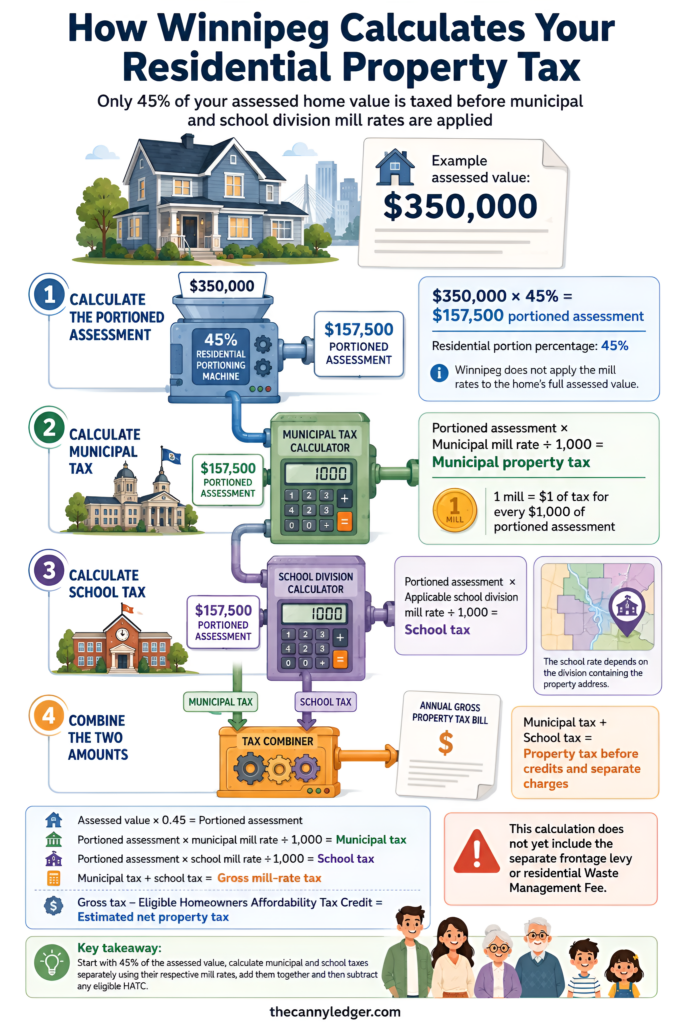
Winnipeg doesn’t tax your home’s full assessed value, only a portion of it. For residential property, that portion sits at 45 percent, so a $350,000 assessed home is only taxed on $157,500 of that. A mill, by the City’s own definition, represents $1.00 of tax for every $1,000 of that portioned value, which is why the formula divides by 1,000. Put together: portioned assessment multiplied by the mill rate, divided by 1,000, equals the tax owed for that portion of your bill. You do this calculation twice, once with the municipal mill rate for your municipal taxes, and once with your school division’s mill rate for your school taxes, then add the two together.
2026 Mill Rates by School Division
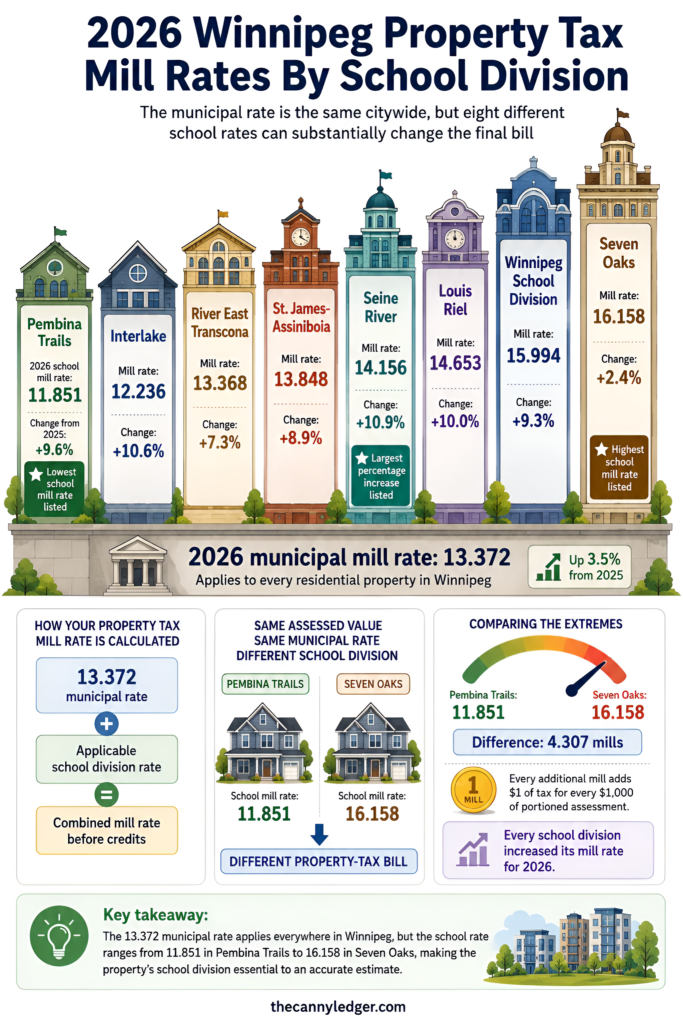
The municipal mill rate for 2026 is 13.372, up 3.5 percent from 2025, and it applies to every residential property in the city regardless of address. School division mill rates vary considerably by comparison, since each of Winnipeg’s eight divisions sets its own rate based on its own budget:
| School Division | 2026 Mill Rate | Change from 2025 |
|---|---|---|
| Pembina Trails | 11.851 | +9.6% |
| River East Transcona | 13.368 | +7.3% |
| St. James-Assiniboia | 13.848 | +8.9% |
| Interlake | 12.236 | +10.6% |
| Louis Riel | 14.653 | +10.0% |
| Seine River | 14.156 | +10.9% |
| Winnipeg | 15.994 | +9.3% |
| Seven Oaks | 16.158 | +2.4% |
Every division raised its rate this year, but the size of that increase, and the base rate it’s increasing from, varies enough that knowing your specific division matters more than any citywide average would suggest.
Three Worked Examples at Different Price Points
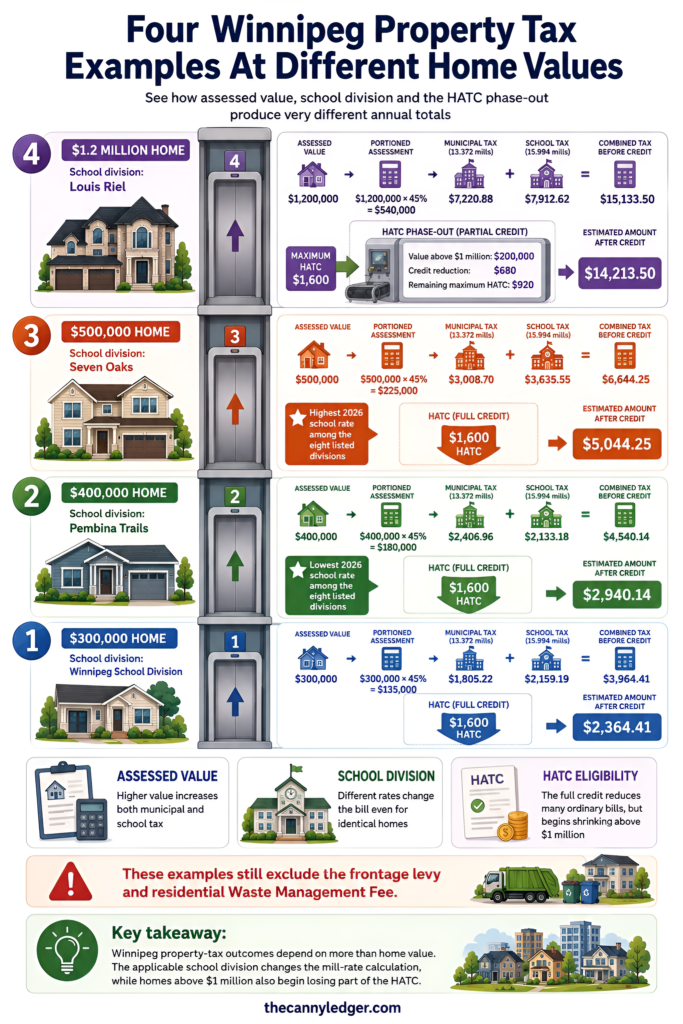
Numbers make this concrete faster than the formula alone. A $300,000 home in Winnipeg School Division: portioned assessment of $135,000, municipal tax of $1,805.22, school tax of $2,159.19, for a combined $3,964.41 before any credit. A $400,000 home in Pembina Trails, currently the lowest school mill rate in the city: portioned assessment of $180,000, municipal tax of $2,406.96, school tax of $2,133.18, totaling $4,540.14. A $500,000 home in Seven Oaks, currently the highest: portioned assessment of $225,000, municipal tax of $3,008.70, school tax of $3,635.55, for a combined $6,644.25. Same math, three different real outcomes, entirely dependent on assessed value and which of the eight division lines a specific address falls inside.
A fourth example shows what happens once the HATC phase-out enters the picture. A $1.2 million home in Louis Riel: portioned assessment of $540,000, municipal tax of $7,220.88, school tax of $7,912.62, for a combined $15,133.50 before any credit. Because the property sits $200,000 over the HATC’s $1 million threshold, the usual $1,600 maximum shrinks to $920, bringing the net total to $14,213.50 rather than the $13,533.50 a lower-valued property with the full credit would land on. Higher-value homes don’t just pay more in raw tax, they also get proportionally less help from the one credit designed to soften the bill.
The Credit That Changes Your Real Number
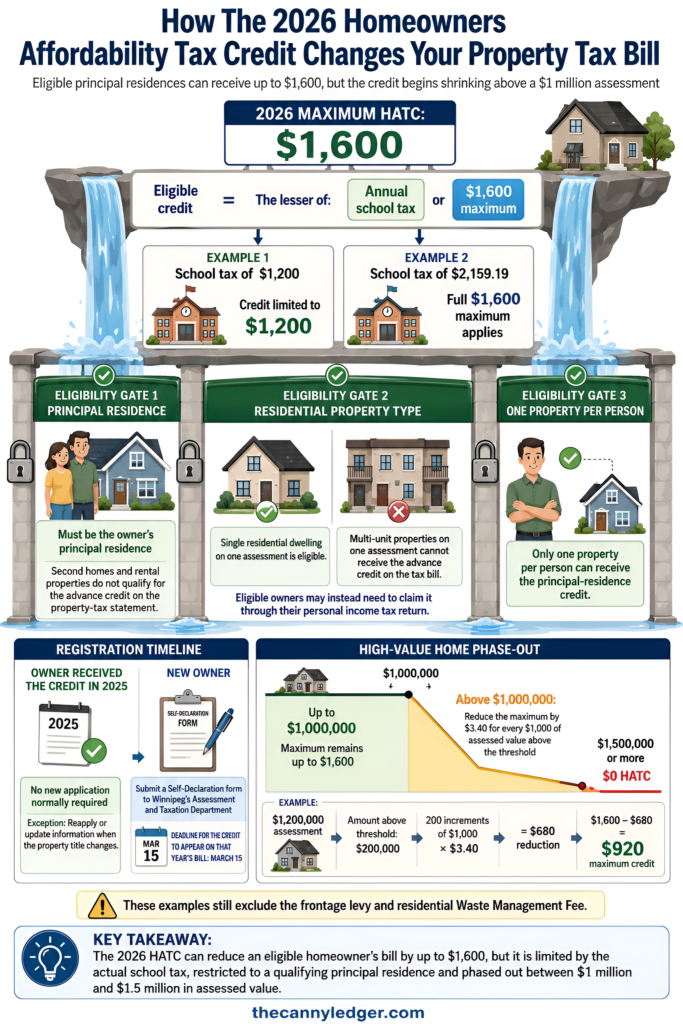
None of those totals above are what most homeowners actually pay, because they don’t yet account for the Homeowners Affordability Tax Credit. For 2026, the credit equals the lesser of your school taxes for the year or $1,600, applied directly to your municipal property tax statement rather than requiring a separate claim. Run it against the three examples above: the Winnipeg School Division home’s $2,159.19 in school tax exceeds $1,600, so the full $1,600 applies, dropping that total to $2,364.41. The same logic applies to the other two, since both school tax amounts also exceed $1,600.
Eligibility isn’t automatic for everyone, though. The credit only applies to a principal residence, assessed as a single residential dwelling, and only one property per person, so a second home or rental doesn’t qualify for the advance version. Owners of a duplex or triplex-style property, where multiple units sit on one assessment, can’t receive the advance on their tax bill at all and instead have to claim the credit on their personal income tax return. Homeowners who already received the credit in 2025 don’t need to reapply unless the property’s title changes, but new owners need to submit a Self-Declaration form to the Assessment and Taxation Department by March 15 to have it appear on that year’s bill.
The credit also shrinks for higher-value homes rather than staying flat at $1,600 across every price point. For properties assessed over $1,000,000, the maximum benefit drops by $3.40 for every $1,000 of assessed value above that mark, and homes assessed at $1,500,000 or more receive no HATC at all. Run that against a $1.2 million home: $200,000 over the threshold works out to a $680 reduction, leaving a maximum credit of $920 rather than the full $1,600 a lower-valued home in the same school division would receive. This detail rarely shows up in general summaries of the credit, but it matters directly for anyone in Winnipeg’s higher-value neighborhoods running these numbers for the first time.
What This Math Doesn’t Include
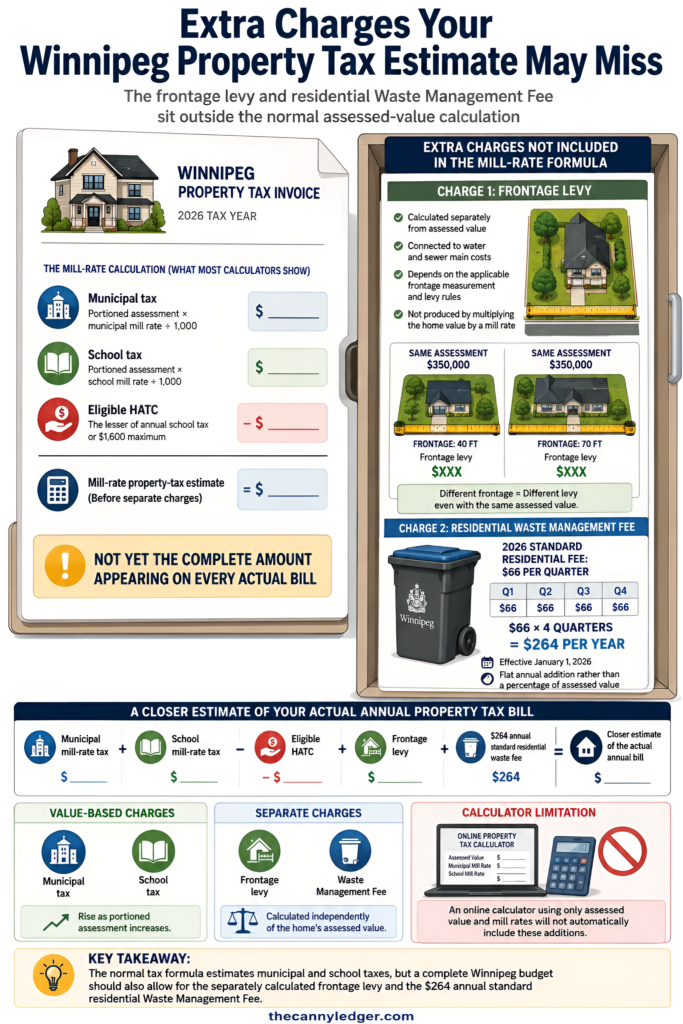
A calculator built from mill rates alone still misses two real charges that show up on an actual Winnipeg tax bill. A frontage levy, based on the length of your property and tied to water and sewer main costs, gets billed separately from the mill-rate calculation entirely, so it won’t show up in any estimate built purely from assessed value and mill rate. The City’s residential Waste Management Fee is a second flat add-on, billed quarterly and set at $66 per quarter for a standard residential property as of January 1, 2026, working out to $264 a year on top of the municipal and school tax total. Neither of these scales with your home’s assessed value the way the mill rate calculations do, so they’re worth budgeting for as fixed additions rather than folding into the percentage-based math above.
Turning the Annual Number Into a Monthly One
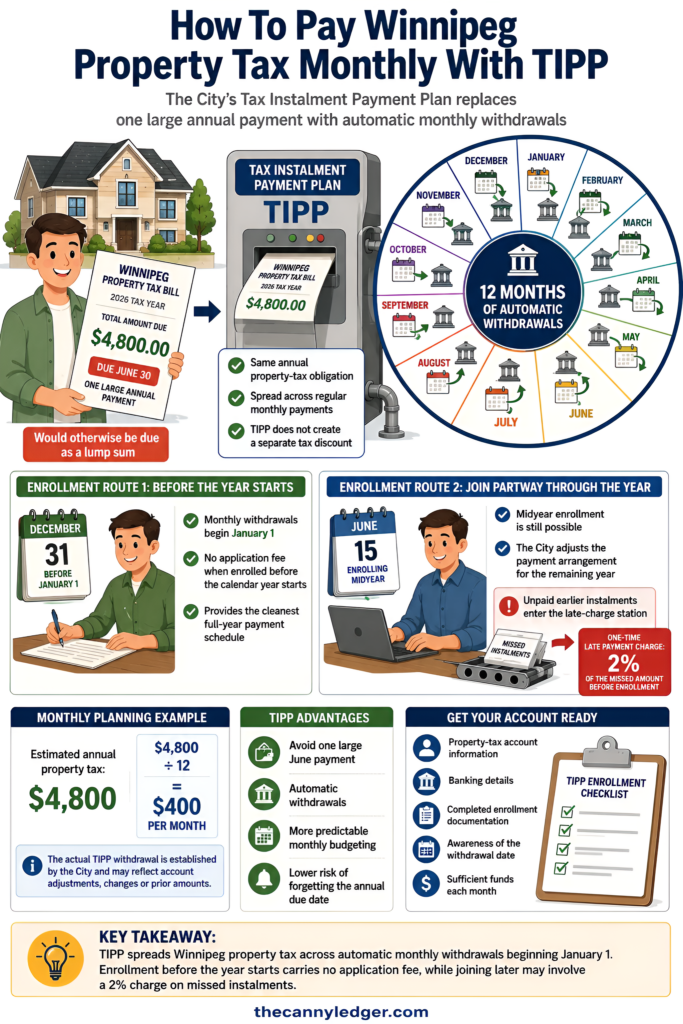
Once you’ve got a real annual total, the obvious next question is how to actually pay it without one large lump sum landing all at once in June. The City’s Tax Instalment Payment Plan, TIPP, spreads that same annual total across monthly automatic withdrawals starting January 1 rather than requiring a single payment, and enrolling before the calendar year starts carries no application fee at all. Joining partway through the year still works, though missed instalments carry a one-time 2 percent late payment charge on whatever was missed before enrolling. The full mechanics of TIPP, along with every other way to actually pay a Winnipeg tax bill and the deadlines that come with each, are covered in payment methods and deadlines, worth reading once the formula above has given you a real number to work with.
Using the City’s Own Change Calculator
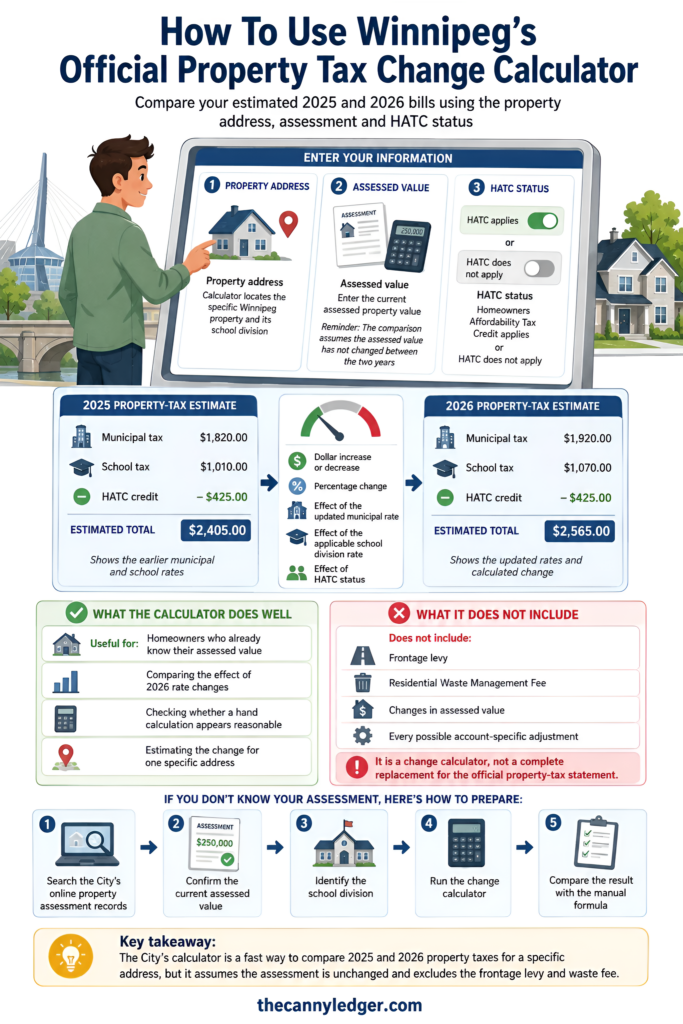
For homeowners who already have a 2025 tax bill in hand and just want to see how 2026’s rate changes affect their specific number, the City runs its own Property Tax Change Calculator that compares 2025 to 2026 directly using your property address, assessed value, and HATC status. It’s a narrower tool than working from the formula above, since it assumes your assessed value hasn’t changed and doesn’t include the frontage levy or waste fee either, but it’s a fast way to sanity-check a specific property once you already have last year’s numbers on hand. For anyone who wants to understand what the assessed value itself actually represents before running any of this math, that groundwork is covered in understanding your Winnipeg property tax assessment, and looking up your own current assessed value if you don’t already have it is covered in how to search your assessment online.
Common Calculator Questions, Answered
Why did my neighbor’s tax increase look different from mine this year, even though our homes are similar? Different school divisions raised their mill rates by different amounts for 2026, ranging from a 2.4 percent increase in Seven Oaks to a 10.9 percent increase in Seine River, so two similar homes in different divisions can see meaningfully different percentage increases even off similar starting points.
Does the calculator formula work for condos the same way it works for houses? Yes, for the mill rate math itself, since condos are still classified as residential property taxed on the same 45 percent portioning rate. Individually assessed condo owners also qualify for the HATC advance the same way house owners do, unlike owners of multi-unit properties like duplexes.
If my assessed value didn’t change this year, will my tax bill stay the same? No, and this catches people off guard. Even with an unchanged assessment, both the municipal and school mill rates increased for 2026, so the tax owed on that same portioned value still went up, just from the rate side of the formula rather than the value side.
Does everyone get the same $1,600 HATC regardless of home value? No. The full $1,600 only applies below $1 million in assessed value. Above that, the credit shrinks by $3.40 for every $1,000 over the threshold, and it disappears completely at $1.5 million, so a higher-value home’s real net tax bill needs that adjustment factored in rather than assuming the flat maximum applies.
Grab your assessed value, confirm your school division, and run the two-part formula above rather than guessing from last year’s bill or a citywide average. The eight-division spread means “the average Winnipeg homeowner” isn’t a number that applies cleanly to any specific address, your own division’s mill rate is the one that actually determines what you owe.