
A quarter of Manitobans experienced food insecurity in 2024. Seven percent lived in extreme food insecurity, and 62 percent of Manitoban families reported going hungry at least once a month because they couldn’t afford enough food. Those aren’t numbers from a national report parachuted into a local article, they come directly from the organization built specifically to respond to them, an organization most Manitobans still call by its old name even though it hasn’t gone by that name in years.
- More Than Four Decades of Growth
- The Scale Behind “Manitoba’s Food Bank”
- What’s Actually in a Harvest Hamper
- Beyond Hampers: The Full Range of Programs
- Reaching Northern and Indigenous Communities
- The Real Numbers Behind Rising Need
- How to Actually Get Help
- How to Help Instead
- Common Questions About Winnipeg Harvest and Harvest Manitoba
Winnipeg Harvest, now officially named Harvest Manitoba, is the province’s central food bank and distribution network, founded in 1984 and now supplying more than 380 member food banks and community agencies across 46 Manitoba communities, feeding over 108,000 people every month through hamper programs, school food programs, and a growing set of related initiatives well beyond simple food distribution.
More Than Four Decades of Growth
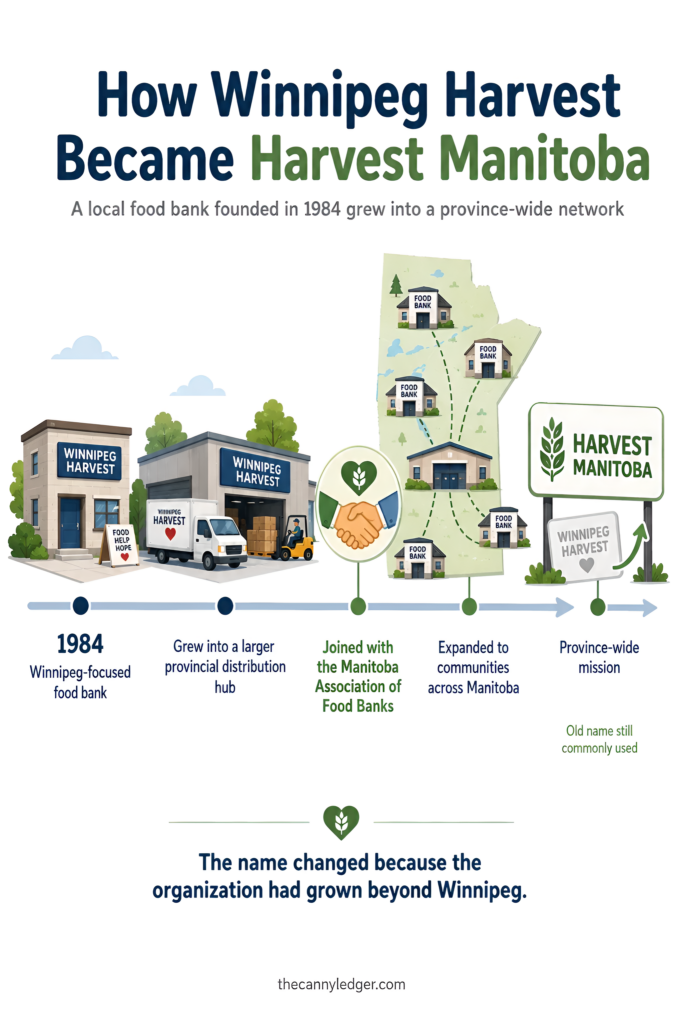
Harvest’s roots go back to 1984, a single Winnipeg-focused food bank responding to a specific moment of local need. Over the following decades, the organization grew far beyond that original scope, and its most significant structural change came when it formally amalgamated with the Manitoba Association of Food Banks, absorbing that provincial coordinating body into its own operations rather than the two continuing as separate entities. That merger is directly why the organization dropped “Winnipeg” from its name and became Harvest Manitoba, a rebrand meant to reflect an organization that had already grown into a genuinely provincial network long before the name caught up to the reality. The old name persists everywhere in casual use, and it’s the name most community directories, church bulletins, and long-time Winnipeggers still default to, but it hasn’t been the organization’s official name for years.
The Scale Behind “Manitoba’s Food Bank”
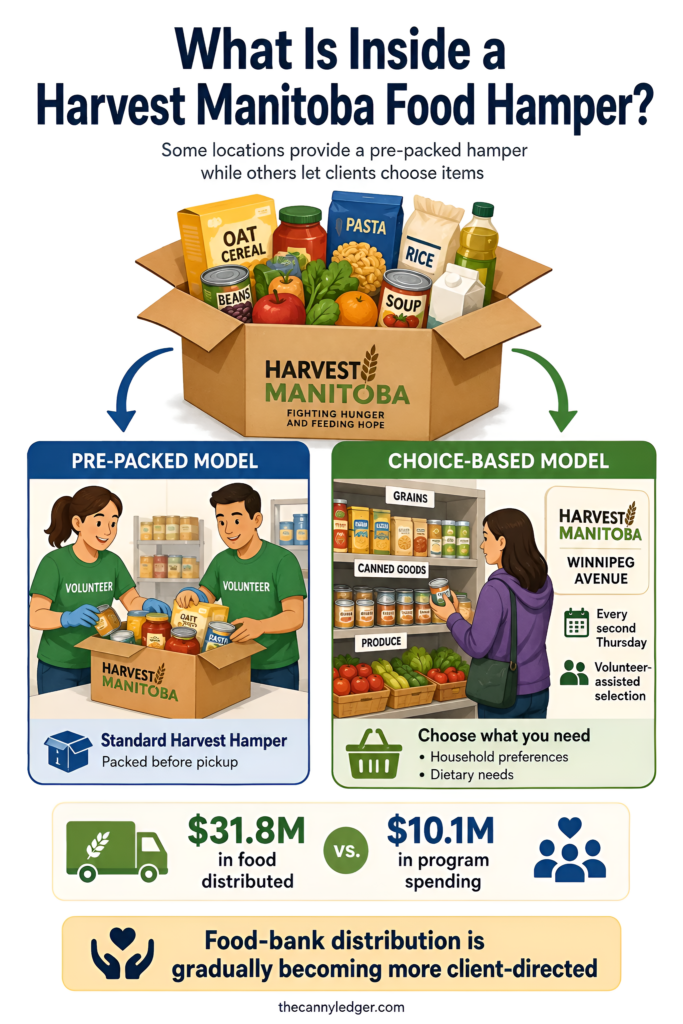
The numbers behind Harvest Manitoba’s operation are large enough to be genuinely hard to picture from the outside. The organization collects roughly 12 million pounds of food every year, sorted and packed by volunteers into Harvest Hampers before being distributed through its network of more than 380 food banks and partner agencies spanning Winnipeg, rural Manitoba, northern communities, and First Nations communities across the province. On the financial side, the most recently reported fiscal year saw Harvest distribute $31.8 million worth of food while spending $10.1 million in cash directly on its programs, a gap that reflects how much of the organization’s actual impact comes through donated food and volunteer labour rather than purchased inventory. All of this routes through a single Food Distribution Centre and warehouse operation based at the organization’s Winnipeg Avenue headquarters, which also houses the Emergency Food Support Assistance Line that coordinates registration and referrals across the entire network.

What’s Actually in a Harvest Hamper
The standard model for decades has been a pre-packed hamper, groceries and pantry staples assembled by volunteers and distributed as a set package to registered clients through their assigned food bank location. More recently, some Harvest-run locations have shifted toward a choice-based model instead, letting clients select what they actually need from what’s available on the shelf rather than receiving a fixed, identical package regardless of household composition or dietary needs. Harvest’s own Winnipeg Avenue headquarters location, opened as a dedicated neighbourhood food bank in April 2022, runs on this choice-based approach specifically, operating every second Thursday and giving clients the ability to pick items themselves with the help of friendly volunteer staff, a deliberate move away from the more clinical, take-what-you’re-given feel of a strictly pre-packed hamper system.
Beyond Hampers: The Full Range of Programs
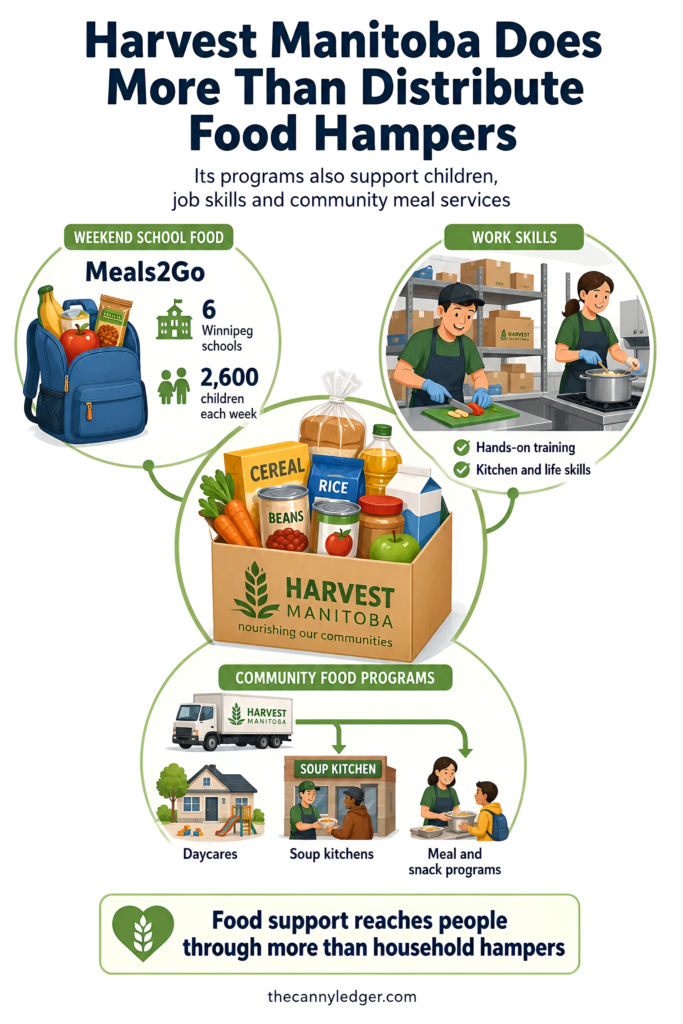
Hampers are only one piece of what Harvest Manitoba actually runs. The Meals2Go program specifically targets a gap most people don’t think about: kids who rely on school meal programs during the week but have no equivalent support over the weekend. Started in 2018 and now operating in six Winnipeg schools, Meals2Go sends roughly 2,600 children home each week with a weekend’s worth of nutritious food, addressing exactly the two days a week that school-based nutrition programs can’t reach. Separately, Harvest runs a warehouse training program giving participants hands-on kitchen and life skills training within a supportive, real working environment, a genuine job-skills pathway layered on top of the organization’s core food distribution work rather than a purely charitable add-on. The organization’s broader reporting also references support flowing to daycare partners, meal and snack programs, and soup kitchens across its network, reflecting just how many different points of contact Harvest actually touches beyond the household hamper model most people picture first.
Reaching Northern and Indigenous Communities
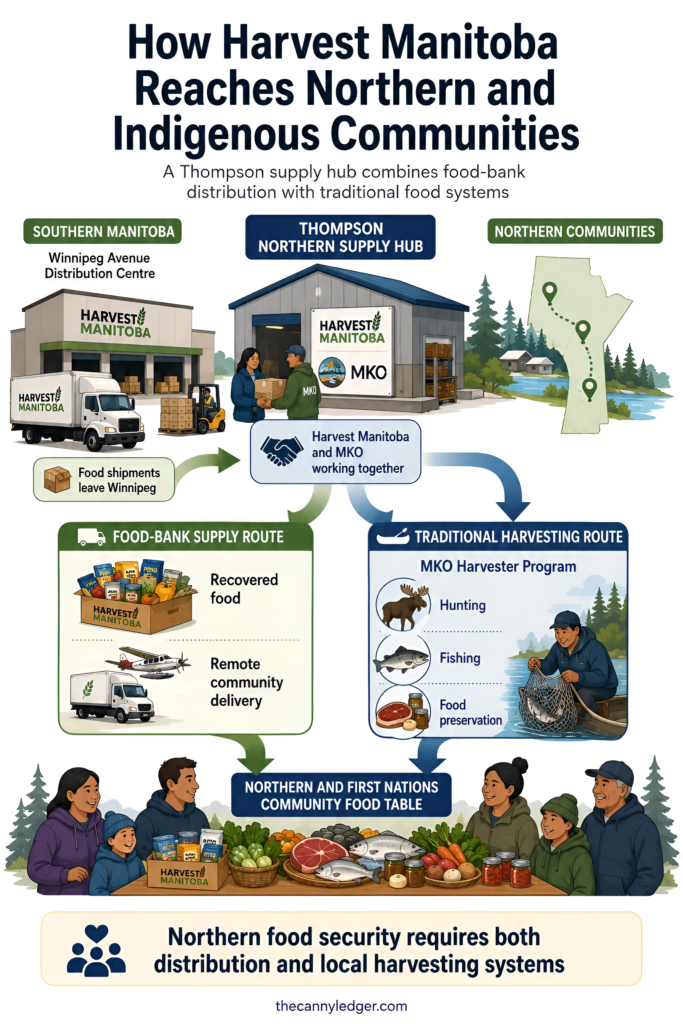
One of Harvest’s more significant recent expansions has been building direct infrastructure into northern Manitoba rather than relying entirely on distribution routes running out from Winnipeg. The organization has been developing a northern supply hub in Thompson in partnership with Manitoba Keewatinowi Okimakanak (MKO), the political advocacy organization representing northern Manitoba First Nations. This partnership connects with MKO’s own Harvester Program, which supports traditional food-gathering practices, hunting, fishing, harvesting, and food preservation, alongside more conventional food bank access, recognizing that food security in northern and Indigenous communities isn’t solved by the same single model that works in Winnipeg. Shipping food from southern food banks to remote northern communities has been part of this collaboration, built on lessons about recovered and rescued food that both organizations have shared with each other as the partnership has developed.
The Real Numbers Behind Rising Need
Demand hasn’t moved in a straight, gradual line. Harvest Manitoba saw a 40 percent increase in demand in 2022 alone, described at the time as the sharpest single-year jump in the organization’s then-38-year history, driven by inflation, rising housing and heating costs, and pressures that pushed people who’d never needed a food bank before through the door for the first time. Communications staff have been explicit about pushing back on outdated assumptions here: “the face of food bank users is changing,” and someone with decades of steady full-time employment and a stable retirement can end up at a food bank counter for the first time in their sixties, not because anything about their character changed, but because the cost of living outpaced what a fixed retirement income can cover. That reality runs directly counter to the stigma a lot of people still associate with food bank use, and Harvest’s own staff have pointed to that stigma as a real, ongoing barrier keeping eligible people from registering even when they clearly qualify for help.

How to Actually Get Help
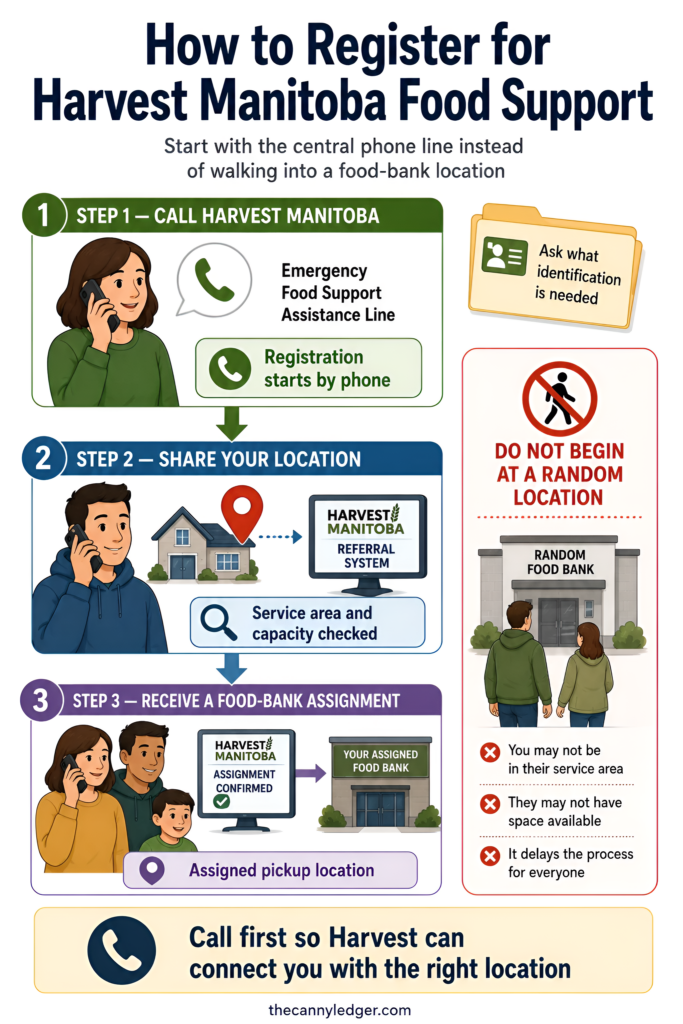
Registration works the same way across Harvest’s network regardless of which specific program a household ends up connecting with. The full step-by-step process, including what identification is accepted and how the biweekly access limit works, is covered in detail separately, but the short version is that access starts with a phone call to Harvest’s central line rather than a walk-in visit to any specific location, since the organization determines which food bank in its network a household gets assigned to based on where they live and current capacity.
How to Help Instead
For anyone in a position to support the organization rather than access it, Harvest accepts food donations, financial contributions, and volunteer time across a wide range of roles, from warehouse sorting to helping run a specific neighbourhood food bank day. The complete rundown of how volunteering with a Winnipeg food bank actually works covers exactly what that looks like in practice, and donations can be made by phone, in person at the Winnipeg Avenue headquarters, or by electronic transfer directly to the organization.

Common Questions About Winnipeg Harvest and Harvest Manitoba
Is Winnipeg Harvest still a separate organization from Harvest Manitoba? No. They’re the same organization under a single current name, Harvest Manitoba. “Winnipeg Harvest” is simply the older name that’s stuck around in everyday use even though the organization rebranded when it absorbed the Manitoba Association of Food Banks and expanded well beyond a Winnipeg-only scope.
Does Harvest Manitoba only serve people already facing homelessness or unemployment? No, and this is exactly the misconception the organization’s own staff have pushed back on directly. Employed households, retirees, students, and newcomers all show up regularly among the people Harvest serves, particularly as inflation and housing costs have pushed food insecurity into households that never needed this kind of support before.
How is Harvest Manitoba different from a smaller, independent food pantry? Scale and structure. Harvest operates as the central supply and coordination point for hundreds of smaller food banks and agencies across the province, most of which couldn’t source and manage food inventory at this volume on their own, while an independent pantry or meal program typically runs its own operation without drawing from Harvest’s central warehouse.
Whatever name you know it by, the organization behind most of Winnipeg’s food bank network has grown considerably beyond its original 1984 scope, and understanding the full range of what it actually does, hampers, school programs, job training, and a genuine push into northern and Indigenous partnership work, gives a much fuller picture than the single word “food bank” usually suggests.

