
A standard Winnipeg home insurance policy covers four core areas, the physical structure (dwelling), your belongings (contents), personal liability, and additional living expenses if you’re displaced, but sewer backup, overland flooding, and groundwater seepage are separate, optional endorsements that have to be added on purpose. Manitoba’s home insurance market is fully private and competitive, unlike MPI’s public auto insurance monopoly, so shopping between insurers and brokers genuinely changes both price and available coverage.
- What a Standard Home Insurance Policy Actually Covers
- Why Sewer Backup and Overland Flood Aren’t Automatic
- Replacement Cost vs Actual Cash Value: The Difference That Matters Most in a Big Claim
- Homeowners, Tenant, and Condo Insurance Are Three Different Products
- Winnipeg’s Own Insurance Company
- How to Actually Shop for Home Insurance in Winnipeg
- Questions to Ask Before You Buy
- Common Questions About Home Insurance in Winnipeg
What a Standard Home Insurance Policy Actually Covers
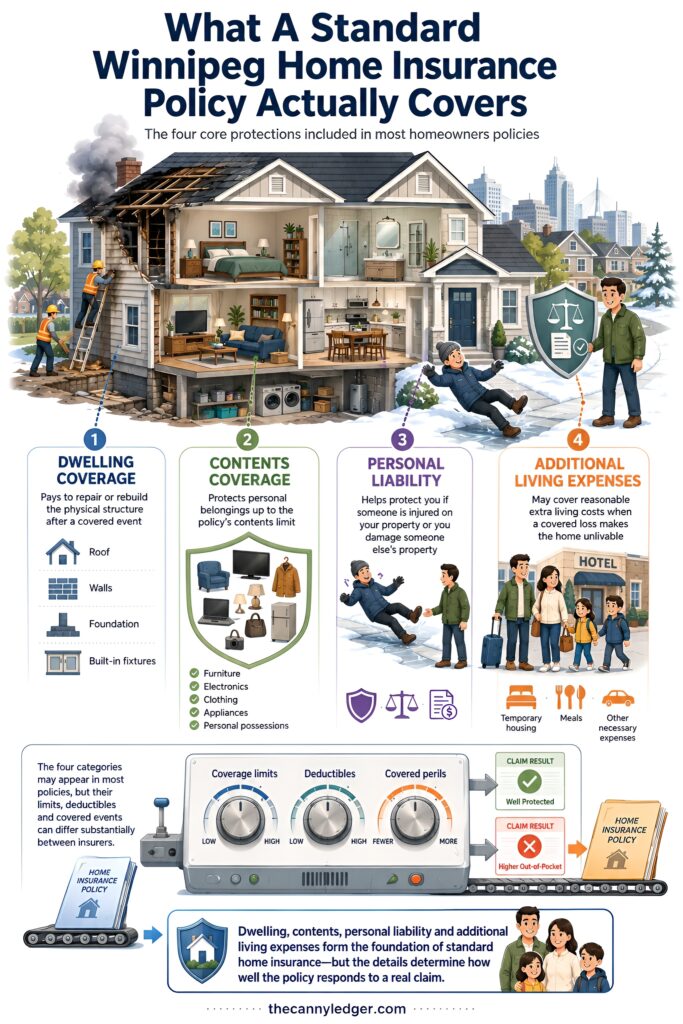
Every home insurance policy in Winnipeg is built around four core components, regardless of which insurer you choose. Dwelling coverage pays to repair or rebuild the physical structure itself if it’s damaged by a covered event, fire being the classic example. Contents coverage protects your personal belongings inside the home, furniture, electronics, clothing, up to whatever limit your specific policy sets. Personal liability coverage protects you financially if someone is injured on your property and sues, or if you’re found responsible for damage to someone else’s property. Additional living expenses, sometimes called ALE, covers the real cost of temporary housing, meals, and related expenses if a covered loss makes your home genuinely unlivable while repairs happen. These four components form the baseline nearly every policy includes, but the specific dollar limits, deductibles, and exactly which perils trigger coverage vary considerably between insurers, which is exactly why two policies that sound similar on paper can respond very differently to the same claim.
Why Sewer Backup and Overland Flood Aren’t Automatic
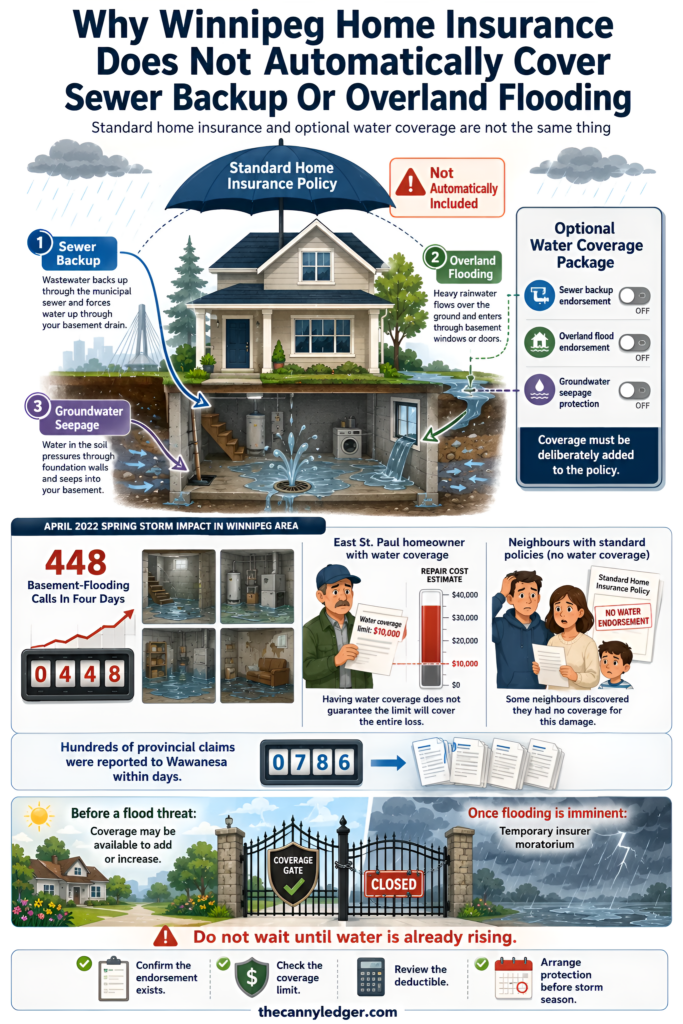
This is the single most important thing to understand before buying home insurance anywhere in Manitoba, and it’s worth repeating plainly: a standard home insurance policy does not automatically include overland flood coverage or sewer backup, according to Manitoba’s own Emergency Management Organization. These are optional endorsements that need to be actively added to a policy, and insurers typically bundle them together with groundwater seepage coverage as one combined water package rather than three separate add-ons. The real-world stakes here aren’t abstract. During the April 2022 spring storm, one East St. Paul homeowner had sewer backup and overland flood coverage up to $10,000, and even she expected her actual repair costs to exceed that limit, while plenty of her neighbours discovered they had no coverage for this kind of damage at all. Wawanesa alone logged hundreds of claims across the province within days of that single storm.
There’s a timing trap worth knowing about too: insurers can and do place a temporary moratorium on adding or increasing water-related coverage once a flood threat is already imminent, meaning the worst possible time to discover you lack this coverage is exactly when you’d want to add it. The only reliable approach is confirming this coverage exists on your policy well before storm season arrives, not scrambling to add it once water is already rising.
Replacement Cost vs Actual Cash Value: The Difference That Matters Most in a Big Claim
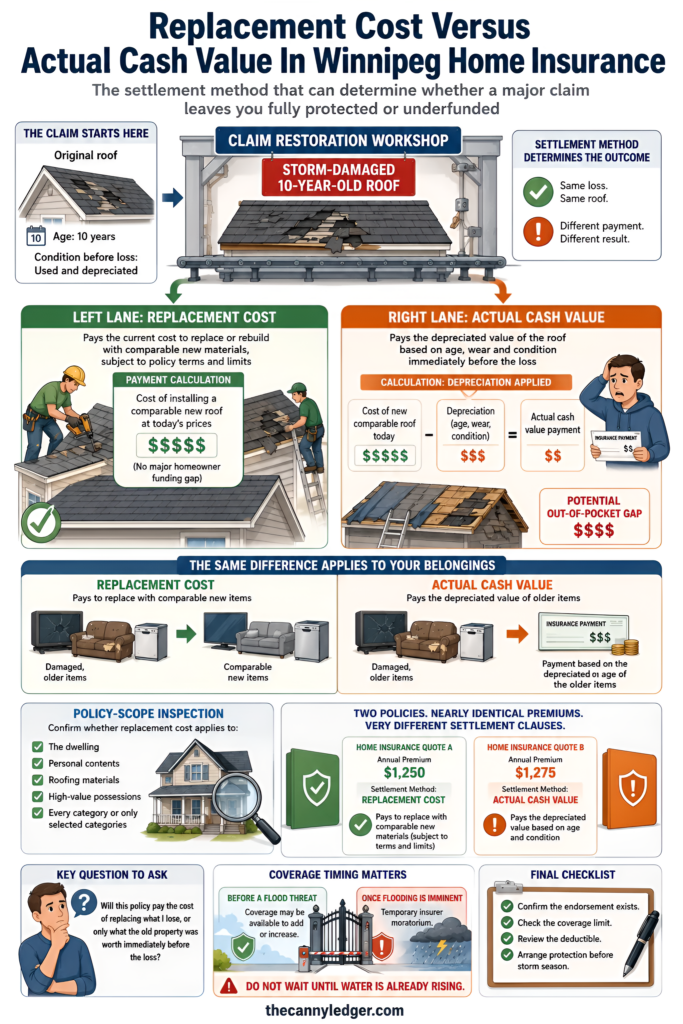
Buried in every policy’s fine print is a distinction that only becomes obvious, and painful, at claim time. Replacement cost coverage pays what it actually costs to replace a damaged item or rebuild a structure with new materials at today’s prices, regardless of how old or depreciated the original was. Actual cash value coverage pays the depreciated value of what was lost, the original cost minus wear and age, which can leave a genuine gap between what you receive and what it actually costs to replace something comparable. A ten-year-old roof destroyed in a storm might be worth a fraction of its replacement cost under an actual cash value policy, while a replacement cost policy pays what a new roof genuinely costs today. Confirming which basis a specific policy uses, and whether it applies uniformly across the whole policy or differently between the structure and its contents, matters more than almost any other single detail when comparing two insurance quotes that otherwise look similar in price.
Homeowners, Tenant, and Condo Insurance Are Three Different Products
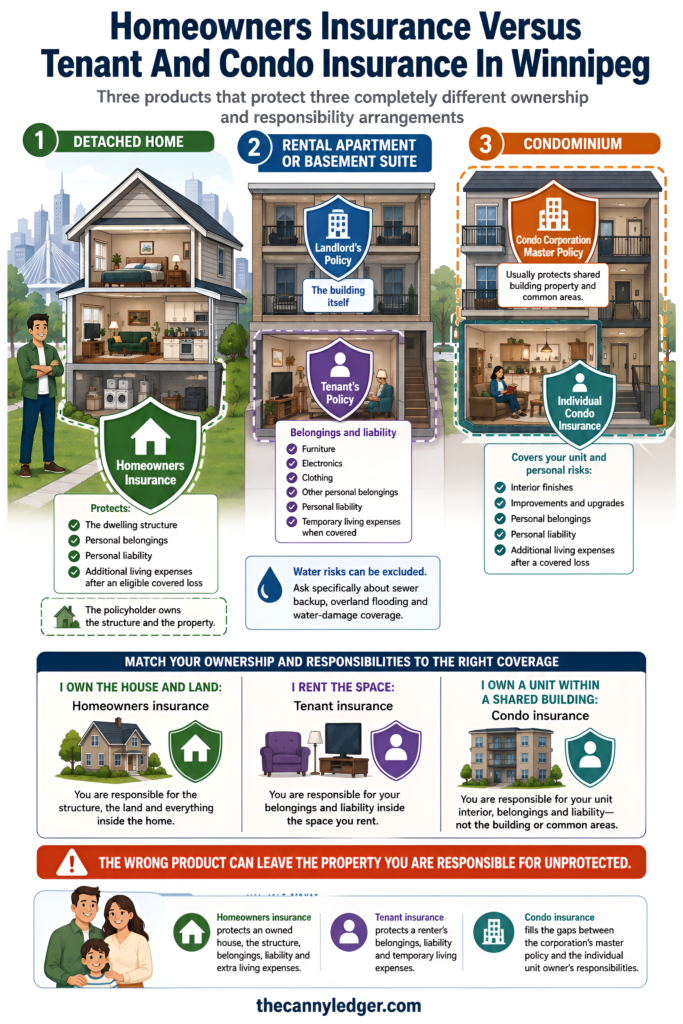
These three product types get talked about loosely as though they’re variations on the same thing, but they protect fundamentally different interests. Homeowners insurance covers someone who owns both the structure and the land it sits on, the full package of dwelling, contents, and liability coverage described above. Tenant insurance, also called renters insurance, covers a renter’s own belongings and personal liability, but never the building itself, since that’s the landlord’s responsibility and coverage, a detail worth understanding clearly if you’re renting anywhere in Winnipeg, including a basement suite, where water-related risk specifically is worth asking about directly given how often basement units see exactly this kind of damage. Condo insurance sits in between: a condo corporation’s own master policy typically covers the building’s shared structure, while an individual owner needs separate coverage for their unit’s interior finishes, personal belongings, and liability, since the master policy usually stops well short of covering everything inside an individual unit.
Winnipeg’s Own Insurance Company
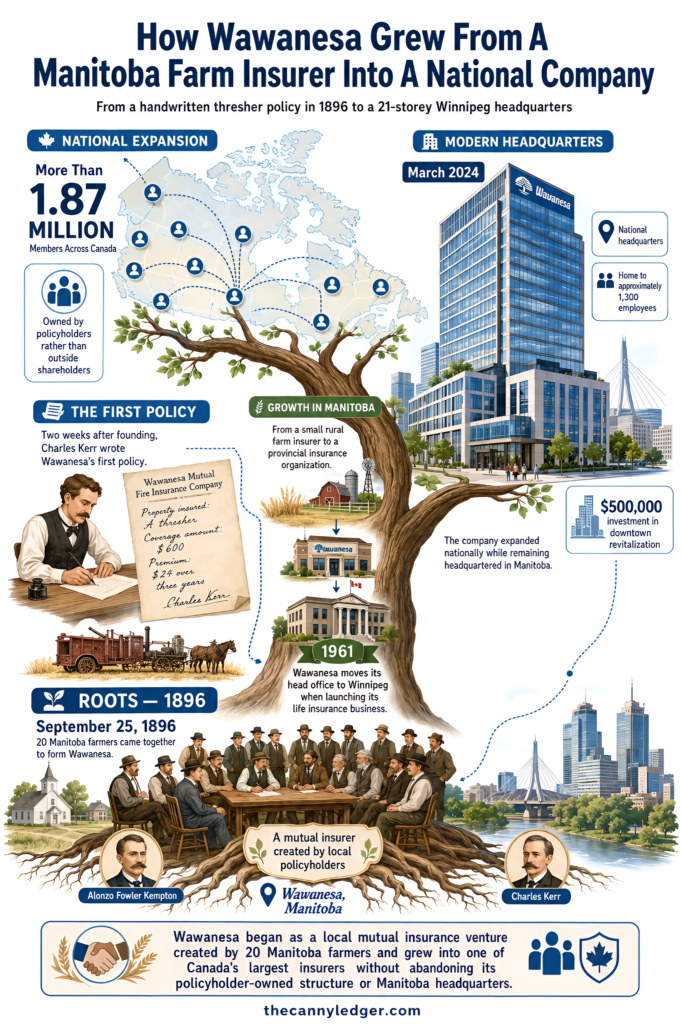
Worth knowing as genuine local context: one of Canada’s largest insurers didn’t start in a boardroom in Toronto or Montreal, it started with 20 farmers in a small Manitoba town. The Wawanesa Mutual Insurance Company was founded September 25, 1896, in the village of Wawanesa, Manitoba, by Alonzo Fowler Kempton and Charles Kerr. The company’s very first policy, handwritten by Kerr two weeks after founding, insured a thresher for $600 at a premium of $24 over three years. Wawanesa moved its head office to Winnipeg in 1961 when it launched its life insurance business, and in March 2024 opened a brand new 21-storey national headquarters at True North Square in downtown Winnipeg, home to 1,300 employees, alongside a $500,000 investment in downtown revitalization. As a mutual company, Wawanesa is technically owned by its own policyholders rather than outside shareholders, now serving more than 1.87 million members across Canada while still headquartered in the same city where it began.
How to Actually Shop for Home Insurance in Winnipeg
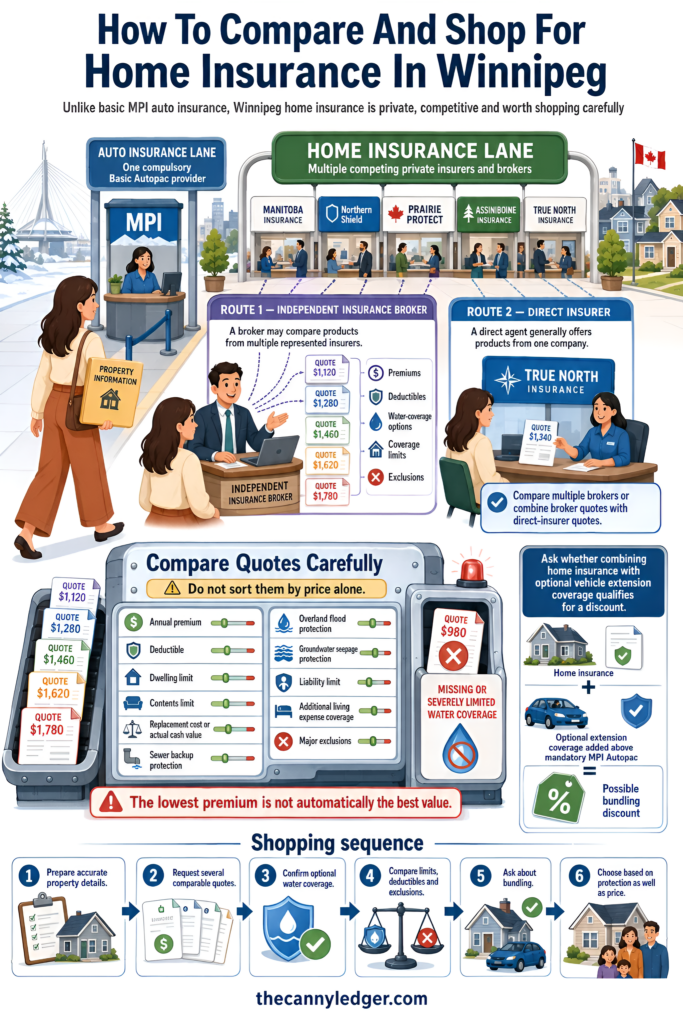
Manitoba’s home insurance market runs entirely differently from its auto insurance system. Where MPI holds an outright monopoly on basic auto coverage, home insurance is fully private and genuinely competitive, sold through independent brokers representing multiple insurers, or directly through a single company’s own agents. This matters practically: getting quotes from more than one source, whether that’s comparing several brokers or a mix of broker and direct insurer quotes, can turn up real differences in both price and what water-damage coverage is actually available or excluded. Many insurers, Wawanesa included, also offer a bundling discount for combining home insurance with the optional extension coverage available on top of your mandatory MPI Autopac policy, worth asking about directly since it’s an easy discount to miss if you’re only thinking about your home policy in isolation from your vehicle coverage.
Questions to Ask Before You Buy
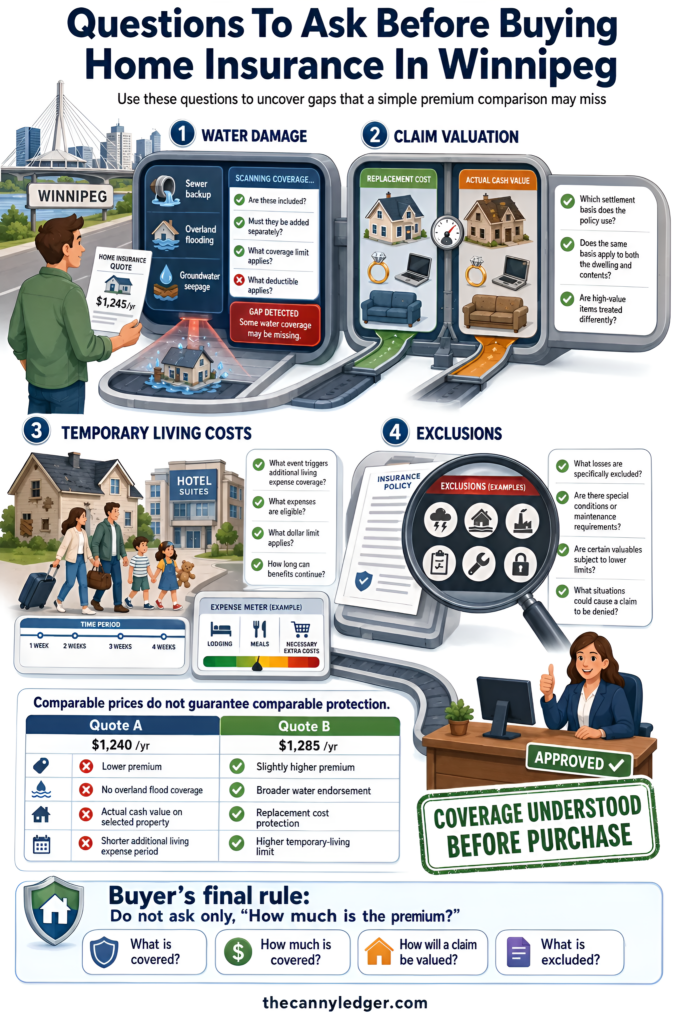
Before signing anything, a short list of direct questions separates a genuinely comparable quote from one that only looks similar on the surface. Ask explicitly whether sewer backup, overland flood, and groundwater seepage coverage are included or need to be added separately, and what dollar limit applies to each if they are. Ask whether the policy pays replacement cost or actual cash value, and whether that basis is consistent across the dwelling, contents, and any specific high-value items you own. Ask what triggers additional living expense coverage and for how long it applies if you’re genuinely displaced. And ask directly what’s specifically excluded, every policy has exclusions, and knowing them before a claim happens is worth far more than discovering them during one.
Common Questions About Home Insurance in Winnipeg
Is home insurance legally required in Manitoba the way basic auto insurance is? No, unlike MPI’s compulsory Autopac coverage, home insurance isn’t legally mandated in Manitoba. In practice, though, most mortgage lenders require proof of adequate home insurance as a condition of the mortgage itself, making it effectively mandatory for anyone financing a home purchase even without a direct legal requirement.
Does tenant insurance cover water damage to my belongings from a sewer backup in my rental unit? It depends entirely on whether that specific coverage was added to your tenant policy, the same optional-endorsement rule that applies to homeowners insurance applies here too, so confirming this directly rather than assuming it’s included is just as important for renters as for owners.
Can I switch home insurance providers mid-policy if I find a better rate or better water coverage elsewhere? Generally yes, though cancelling before your renewal date may involve a short-rate penalty or fee depending on your specific insurer’s terms, worth confirming directly before assuming a mid-term switch is entirely free of cost.
Confirm sewer backup and overland flood coverage exists on your policy well before storm season, not after water starts rising, and get more than one quote before assuming your current insurer’s renewal price reflects what’s actually competitive in Winnipeg’s market. Between the four core coverages, the water-damage endorsements too many homeowners skip, and the replacement-cost-versus-actual-cash-value distinction that decides what a real claim actually pays out, understanding these specifics before buying matters far more than the brand name on the policy itself.